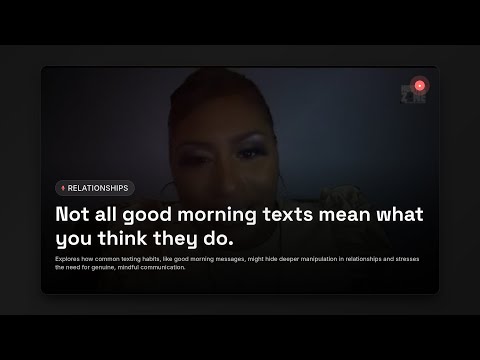
The Hidden Truth Behind Good Morning Texts: Are They Hurting Your Relationship?
Men make time for what is important to them — everything else is just an excuse dressed up as busy.
The Hidden Truth Behind Good Morning Texts: Are They Hurting Your Relationship?
Peasant Sex and Relationships
On this episode of Peasant Sex and Relationships, host Twila Ray takes aim at one of dating culture’s most romanticized rituals: the good morning text. Backed by her producer Ryan Perez running the title cards and a rotating cast of commenters weighing in live, Twila lays out why a habit so many women describe as “sweet” might actually be doing the opposite of what it seems.
Twila opens with a confession — she used to be one of those women who loved a good morning text. Not anymore. Her core argument is that the text itself means nothing without context. The questions she wants every woman asking are simple: Is this the only time you hear from him? Is it random, or does it feel copy-and-pasted? Is it genuine, or is it lazy and repetitive — “same bad channel, same bad time”?
From there she walks through three reasons the habit can be manipulative. First, she says it can function as a way to “meet the bare minimum” — just enough contact to keep a woman satisfied while a man keeps other women in rotation. Second, it can create a false sense of security, mimicking the consistency women say they want without any of the substance behind it. Third, and most pointedly, she argues it can be a tool to keep a woman “stuck” — because a text that checks the boxes of feeling special, thought-of, and prioritized can be enough to stop a woman from walking away, even when nothing else in the relationship is showing up.
The episode’s second act is a rundown of what Twila calls the five most common lies men tell: “I’m busy,” “I just wanna love you,” “she’s just a friend” (or roommate), “I’m working late or out of town,” and phone excuses like a dead battery or lost signal. She spends real time on “I’m busy,” doing the math live on air — four days of silence is ninety-six hours, or, as she puts it, 345,600 seconds — to make the point that genuine busyness rarely accounts for total silence. Her line, repeated more than once: men make time for what is important to them.
She’s careful to note the flip side, though — she says it’s not that these men aren’t actually busy; many of them are, building businesses, raising kids, running their lives. The test she offers isn’t whether someone is busy, but whether they still make you a priority within that busyness: checking in briefly, naming a specific time they can talk, and putting the schedule back in your hands rather than leaving you guessing.
The back half of the show shifts into advice, delivered as a set of “curve him” cards: don’t chase, stop being so available, don’t answer every call, get off the phone first sometimes, be busy yourself, and don’t always be the one to initiate. She’s blunt about adjusting standards to accommodate a man, arguing that doing so is itself a sign to walk away. She closes the advice segment with a note on intuition — if something feels off, it likely is — but adds a genuine disclaimer: before acting on that feeling, consider whether it’s coming from real red flags in front of you, or from unresolved suspicion carried over from a past partner or a friend’s bad experience.
Ryan joins for the last stretch of the show, and the conversation gets notably more candid. He talks about being a single father running multiple businesses, admits he’s caught himself defaulting to “I’m busy” when he could have made five minutes, and shares that in a past relationship he didn’t take the time when it mattered — a decision that, by his own account, helped end things and got him labeled an “f-boy” by her friends. He also offers his own read from the other side: that some of the flood of texts he gets isn’t about connection so much as the other person not having much else going on, which Twila agrees with, tying it back to her advice that women maintain full lives of their own rather than filling idle time by pressuring a partner for attention.
The episode closes with Twila plugging her upcoming master class, Sex Money Magic, and thanking the live audience for tuning in.
Lessons from this one
A repetitive, copy-paste 'good morning' text with no real action behind it can function as the bare minimum needed to keep someone satisfied.
This maps onto the psychological concept of 'breadcrumbing' — sending sporadic, low-effort messages to keep someone interested without real investment. A peer-reviewed study on ghosting and breadcrumbing found these are recognized relational behaviors associated with distinct psychological correlates, supporting the idea that minimal, repetitive contact can function as a low-cost way to maintain someone as a backup option rather than a genuine partner.
Sustained unavailability is rarely just about being busy — it reflects where someone's priorities actually lie.
The academic construct of 'perceived partner responsiveness' — whether a partner's behavior demonstrates understanding, validation, and caring through attention and action — is treated in relationship science as a core organizing signal of how much a partner is prioritized. This body of work supports the general claim that responsiveness (including making time to reach out) functions as evidence of relational priority, rather than time constraints alone explaining silence.
Reducing constant availability and always-initiating behavior can shift the dynamic of who is pursuing whom.
A peer-reviewed experimental study directly tested when 'playing hard to get' increases romantic attraction, finding that reduced availability increases desirability specifically when the person is also perceived as highly selective/desirable overall — i.e., scarcity interacts with perceived value to drive pursuit, rather than working as a simple universal rule.
Trusting intuition about a relationship is valuable, but it should be weighed against whether the feeling stems from the current situation or from past hurt.
A 2025 peer-reviewed study examined how prior relationship harm shapes betrayal sensitivity and trust in new relationships, finding that survivors of past intimate partner violence carried significantly elevated betrayal sensitivity into new relationships regardless of how the new partner actually behaved — though those who went on to have satisfying relationships showed lower distrust/threat-perception scores, suggesting positive current experience can help recalibrate suspicion rooted in the past.
Having a full, independent life outside the relationship reduces the pressure that leads to over-texting and perceived neediness.
No controlled study was found testing this exact claim about romantic-partner texting behavior specifically. The closest verifiable adjacent research is a longitudinal study finding that boredom proneness is a mediating pathway that predicts increased mobile phone use/addiction tendency over time — which lends indirect support to the boredom-drives-excess-contact half of the claim, but the link to 'having a full independent life reducing perceived neediness toward a partner' specifically has not been directly studied and reflects the guest's own reasoning more than an established research finding.
Sources
- Navarro, R., Larrañaga, E., Yubero, S., & Víllora, B. (2020). Psychological Correlates of Ghosting and Breadcrumbing Experiences: A Preliminary Study among Adults. International Journal of Environmental Research and Public Health, 17(3), 1116.
- Reis, H. T. (2011). Perceived partner responsiveness as an organizing theme for the study of relationships and well-being. In Interdisciplinary Research on Close Relationships: The Case for Integration. American Psychological Association.
- Dai, X., Dong, P., & Jia, J. S. (2014). When does playing hard to get increase romantic attraction? Journal of Experimental Psychology: General, 143(2), 521-526.
- Melin, A., & Salkovskis, P. M. (2025). Sensitivity to betrayal and new intimate relationship building in survivors of intimate partner violence. Psychology and Psychotherapy: Theory, Research and Practice, 98(4), 1050-1063.
- Yang, Y., Luo, Y., Chen, M., & Zhai, J. (2023). Life Events, Boredom Proneness and Mobile Phone Addiction Tendency: A Longitudinal Mediation Analysis Based on Latent Growth Modeling (LGM). Psychology Research and Behavior Management, 16, 2407-2416.
- Runtime
- 1h 00m
- Show
- Peasant Sex and Relationships
- Host
- Ryan Perez
Been through something like this?
Peasant Sex and Relationships is conversations with people who built something out of the thing that was supposed to stop them. If that is you, say so.