Can Friends With Benefits Stay Casual? The Surprising Truth About Emotional Attachments
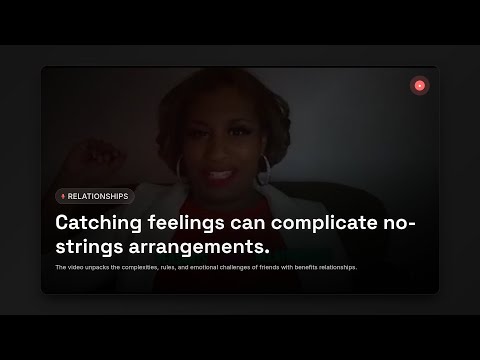
The stereotype that women catch feelings in a friends-with-benefits arrangement isn't about low self-esteem — it's oxytocin doing its job, while the real reason many women avoid FWBs in the first place is the fear of being shamed for it.
Can Friends With Benefits Stay Casual? The Surprising Truth About Emotional Attachments
Peasant Sex and Relationships
Can two people really keep a friends-with-benefits arrangement casual, or is catching feelings just a matter of time? That’s the question the host of Peasant Sex and Relationships opened this episode with, going live and inviting the audience to weigh in on a stereotype she’s heard often: that it’s women, specifically, who end up catching feelings in an FWB situation.
Her answer starts with biology, not blame. She points to oxytocin — the so-called “cuddle hormone” — explaining that women tend to release more of it during sexual encounters, while men release more dopamine. Oxytocin, she says, is essentially the “catching feelings hormone,” which is exactly what you want in a committed relationship and exactly what can complicate a no-strings arrangement. What she flatly rejects is the idea, which she says she’s heard from men, that women who get into FWB situations do so because of low self-esteem or low morals. In her telling, the real reason many women steer clear of these arrangements isn’t insecurity — it’s the fear of being shamed, judged, or having their “body count” held against them once the arrangement is known.
She’s also careful not to generalize in the other direction. Plenty of women, she says, are perfectly fine with a purely physical arrangement and don’t need more than that; others know themselves well enough to know they want emotional connection too, and an FWB setup simply isn’t for them. The whole episode circles back to that idea: know yourself first, and don’t force yourself into an arrangement that doesn’t fit who you are.
From there, the host runs through what she frames as the keys to actually making an FWB situation work: understanding why you’re getting into it in the first place (an itch that needs scratching versus, say, sleeping with someone as the only way to get their attention — which she warns against outright), setting clear boundaries, and putting real rules in place. Her own list includes texting only to arrange time and place, never staying for breakfast, not discussing anything outside of sexual needs, deciding upfront whether the arrangement is exclusive or open, and — importantly — agreeing in advance on how it will end, so nobody is left confused when it fizzles out.
About twenty minutes in, her co-host and producer Ryan Perez joins after some technical hiccups (a frozen camera, a dropped connection) and is put on the spot for his own rules. He describes booking time in advance and not tolerating rescheduling, keeping identifying details — even his real phone number — out of the arrangement, avoiding social media connections entirely, and enforcing a hard line against staying over more than a few hours. The two also spend time debating the difference between a “friend with benefits” and a “jump off,” with a viewer comment arguing that a real FWB implies an actual friendship, while a jump off is more of a one-time, no-repeat encounter — a distinction Ryan generally agrees with, joking that a jump off for him is a one-time “itch that needed to be scratched.”
The conversation closes with the host’s four reasons FWB arrangements typically fail: lack of communication, being “too nice” (which blurs the emotional lines both people are supposed to hold), a change in the dynamic (someone catching feelings, meeting someone else, or wanting more), and misinterpretation — specifically, the moment one partner has to remind the other “this is just casual,” which she says almost always leaves the other person feeling disrespected and often ends the arrangement.
The episode also drifts into a broader riff on the show’s recurring “peasant” concept — men who, unlike a “fuckboy,” are fully capable of committing but simply never evolve within the relationship — and a discussion of how men and women tend to grieve breakups on different timelines, with the host noting that women often process during the relationship while men process after. Along the way, the show also celebrated a milestone: the Hustle Zone account crossing 22,000 followers live on air.
As always, the host’s bottom line is less about rules and more about self-knowledge: if you know you’re a relationship person, don’t force yourself into a friends-with-benefits situation, and if you know you don’t catch feelings, there’s no reason to let the fear of judgment keep you from enjoying something that works for you.
Lessons from this one
The "catching feelings" stereotype has a biological basis, not a moral one.
Real oxytocin/sexual-response research exists, but it complicates the clean "women get oxytocin, men get dopamine" framing rather than confirming it outright. Carmichael et al. (1987), a foundational human-subjects study (9 men, 13 women) published in The Journal of Clinical Endocrinology & Metabolism, found plasma oxytocin rises significantly during arousal and orgasm in BOTH sexes, not predominantly in women. Separately, Young & Wang's (2004) influential Nature Neuroscience review on the neurobiology of pair-bonding lays out the animal-model basis (mainly prairie voles) for oxytocin being more tied to female attachment/bonding circuitry and vasopressin to male bonding circuitry -- the underlying science the host's claim is a popularized, human extrapolation of. So there is a real biological literature behind the general idea that bonding-hormone chemistry differs by sex, but no controlled human study cleanly shows women simply release more oxytocin and men more dopamine during sex.
Clear, upfront rules reduce the chance of a casual arrangement ending badly.
This maps closely onto a well-known, peer-reviewed study of real FWB relationships that found participants routinely negotiated explicit rules (e.g., no romantic contact outside sex, keeping the arrangement secret, avoiding deep emotional disclosure) precisely to keep the relationship from destabilizing into unwanted attachment or conflict -- the same mechanism the host and Ryan describe.
Not agreeing on how the arrangement will end is itself a source of emotional harm.
No study tests the exact FWB-specific claim (pre-negotiating an ending vs. ghosting), but the closest verifiable, on-point research is on ghosting -- ending things without a defined process or conversation -- and how people's beliefs about relationships shape how much distress that ambiguity causes. This supports the underlying mechanism (an undefined, ambiguous ending breeds confusion/hurt) even though it isn't a direct experimental test of the host's specific advice.
Self-knowledge about attachment tendencies predicts whether casual sex will work for a given person.
Two real, verifiable studies directly support this idea: Vrangalova & Ong (2014) found sociosexual orientation (essentially, one's own disposition toward casual vs. committed sex) moderated whether casual sex increased or decreased psychological well-being -- i.e., it worked well for people whose orientation matched it and poorly for those whose didn't, which is exactly the host's "know yourself" framing. Gentzler & Kerns (2004) separately found attachment insecurity (anxious/avoidant styles) was associated with different patterns and reactions to casual/uncommitted sexual experiences, supporting the attachment-specific angle.
Verbally reasserting a casual boundary can be the very thing that breaks the arrangement.
No controlled study found for this specific claim -- despite genuine searches (including for "define the relationship" conversations, relational boundary-reinforcement talk, and communication effects in non-committed relationships), nothing in the peer-reviewed literature tests the precise mechanism the host describes (a verbal reminder of the casual label itself causing offense/rupture after a relationship had drifted toward more intimate behavior). This reflects the guest's own lived/observed experience via a friend's anecdote, presented as such rather than as research-backed fact.
No controlled study found for this specific claim -- reflects the guest's own lived experience (a friend's anecdote), presented as such rather than as research-backed fact.
Sources
- Carmichael, M.S., Humbert, R., Dixen, J., Palmisano, G., Greenleaf, W., & Davidson, J.M. (1987). "Plasma Oxytocin Increases in the Human Sexual Response." The Journal of Clinical Endocrinology & Metabolism, 64(1), 27-31.
- Young, L.J. & Wang, Z. (2004). "The Neurobiology of Pair Bonding." Nature Neuroscience, 7(10), 1048-1054.
- Bisson, M.A. & Levine, T.R. (2009). "Negotiating a Friends with Benefits Relationship." Archives of Sexual Behavior, 38(1), 66-73.
- Freedman, G., Powell, D.N., Le, B., & Williams, K.D. (2019). "Ghosting and Destiny: Implicit Theories of Relationships Predict Beliefs About Ghosting." Journal of Social and Personal Relationships, 36(3), 905-924.
- Vrangalova, Z. & Ong, A.D. (2014). "Who Benefits From Casual Sex? The Moderating Role of Sociosexuality." Social Psychological and Personality Science, 5(8), 883-891.
- Gentzler, A.L. & Kerns, K.A. (2004). "Associations Between Insecure Attachment and Sexual Experiences." Personal Relationships, 11(2), 249-265.
- Runtime
- 1h 26m
- Show
- Peasant Sex and Relationships
- Host
- Ryan Perez
Been through something like this?
Peasant Sex and Relationships is conversations with people who built something out of the thing that was supposed to stop them. If that is you, say so.