How Liz Wilcox Found Freedom in Full-Time RV Living: Her Inspiring Journey
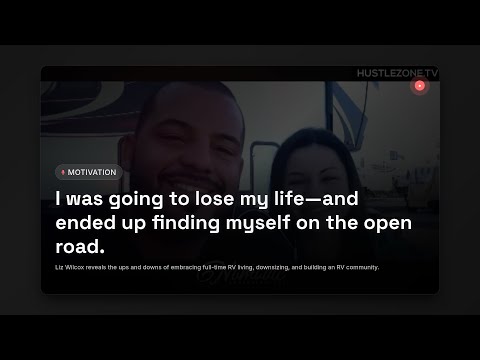
Stationary RVing, Liz Wilcox says, is "all the cons of RVing with none of the benefits" — you still fight the black tank and the propane, you just don't get a new view.
How Liz Wilcox Found Freedom in Full-Time RV Living: Her Inspiring Journey
When a house sale fell through and left Liz Wilcox and her husband short $8,000 in cash they didn’t have, the couple did something a lot of people wouldn’t: they let the house go. What came next turned into full-time RV life, a book about the messiest parts of it, and a small media brand called “the virtual campground.”
Liz joined hosts Sandra and Louis of First Class RV Adventures to walk through how she went from a stationary life in New York to full-time travel — a transition she’d only just made official five or six days before this conversation, though she and her family had been RVers for about a year and a half by then.
The story starts almost by accident. Liz’s husband was finishing up his time in the Army, and the family was relocating from New York to Alabama when their home sale collapsed. Her husband had joked before about everyone in Alabama living cheap in campers — and something about it stuck with her. She rented an RV just to try it out on the drive south and knew almost instantly: “this is home.” Days later, they found a fifth wheel parked outside a closed dealership on a holiday, walked through the open door, and bought it the next day — before they even owned a truck to pull it.
What followed was, in Liz’s words, “literally hell.” They moved into the RV just eight days after deciding to do it, having done almost no research beyond a warning to avoid water damage — which, of course, they had. Walls, floors, and cabinets all needed replacing within the first three months. She got through it the only way she knew how: by laughing. That instinct became the seed of her book, “Tales from the Black Tank,” a collection of the disaster stories she and other RVers don’t usually talk about — busted plumbing, flooded bathrooms, wheels falling off mid-drive. It’s available on her website, lizwilcox.com.
Family reactions were mixed. Her sister, already used to Liz’s spontaneous streak, shrugged it off as “on brand.” Her mom loved the idea so much she asked about buying a teardrop trailer just to tow behind them and stay close. Her brother laughed. Her husband’s side of the family was more reserved, mostly worried about where all their belongings would go and how a family could live in such tight quarters. Liz and her husband didn’t ease into downsizing — they got rid of almost everything within days, guided by one rule: if it doesn’t fit, it’s gone.
One story stands out as a snapshot of RV life’s reality: a flooded second bathroom, caused by one of the kids leaving a knob on, that Liz filmed in the moment specifically because she knew it would be funny later — dubbing in “listen to Daddy” audio for a YouTube clip. It’s the kind of moment she says defines the difference between staying stationary and hitting the road: stationary RVing, she says, is “all the cons of RVing with none of the benefits” — you’re still dealing with the black tank and the propane, just without a new view every day.
More recently, the family downsized again, moving from the fifth wheel into a motor home about half the size. Her husband, at six foot five, had to adjust to a tighter layout, though he’s found it actually means fewer things at head height to run into.
Asked for advice, Liz kept it simple: do your research, make friends with people already living the lifestyle (she credits connections made at the RV Entrepreneur Summit for making her own transition easier than her husband’s, whose former peers mostly called him crazy for stepping away from a retirement track), and — only half-joking — get your degree from “YouTube University.”
Asked how she wants to be remembered, Liz didn’t hesitate: not for sharing bad stories, but for making people laugh. She has a tattoo that reads “laugh always” as a daily reminder. Between the book, the website, and her social presence — all under the name the virtual campground — that’s the thread running through everything she’s building: humor as the thing that gets full-time RVers through the hard parts, together.
Lessons from this one
A financial setback can become the opening for a lifestyle you never planned on.
When their home sale fell through and they were asked for $8,000 cash they didn't have, Liz and her husband simply let the house go — a dead end that, combined with an offhand joke about cheap camper living in Alabama, led directly to buying their first RV.
Skipping the research phase on a big life change can turn a dream into a crash course in disaster recovery.
Liz admits they moved into their fifth wheel just eight days after deciding to try RV life, did no research beyond avoiding water damage, and ended up gutting walls, floors, and cabinets within three months. Her top advice to others is simply to do their homework first.
Finding a peer community that already understands your new lifestyle smooths a difficult transition.
Liz says making friends with full-time RVers, including at the RV Entrepreneur Summit, gave her people who checked in on her during the shift, while her husband's former military peers were more likely to call the choice 'crazy,' leaving him without the same support network.
Turning hardship into humor and shared stories can build genuine community around a difficult experience.
After living through renovation disasters and a flooded RV bathroom, Liz collected similar 'nobody talks about this' stories from other RVers into her book, 'Tales from the Black Tank,' and says she wants to be remembered specifically for making people laugh.
Family and friends often react to an unconventional life choice in very different, individual ways.
Liz describes her sister and mother embracing the RV move almost immediately, her brother laughing it off, and her husband's family reacting with more reserve, focused on logistics like storage and living in close quarters.
No controlled study found for this specific claim (variation in how individual family members react to a relative's unconventional lifestyle choice) — reflects the guest's own lived experience, presented as such rather than as research-backed fact.
Sources
- Seibert, S. E., Kraimer, M. L., Holtom, B. C., & Pierotti, A. J. (2013). "Even the Best Laid Plans Sometimes Go Askew: Career Self-Management Processes, Career Shocks, and the Decision to Pursue Graduate Education." Journal of Applied Psychology, 98(1), 169-182.
- Buehler, R., Griffin, D., & Ross, M. (1994). "Exploring the 'Planning Fallacy': Why People Underestimate Their Task Completion Times." Journal of Personality and Social Psychology, 67(3), 366-381.
- Cohen, S., & Wills, T. A. (1985). "Stress, Social Support, and the Buffering Hypothesis." Psychological Bulletin, 98(2), 310-357.
- Martin, R. A., & Lefcourt, H. M. (1983). "Sense of Humor as a Moderator of the Relation Between Stressors and Moods." Journal of Personality and Social Psychology, 45(6), 1313-1324.
- Runtime
- 26m
- Show
- First Class RV Adventures
- Host
- Ryan Perez
Been through something like this?
First Class RV Adventures is conversations with people who built something out of the thing that was supposed to stop them. If that is you, say so.