How a Family of 8 Thrives in a Debt-Free Nomadic Lifestyle
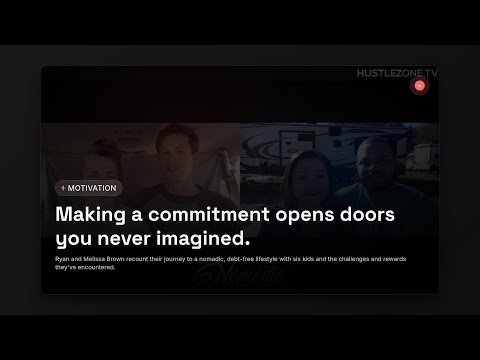
As Melissa Brown put it, weighing the freedom of the road against everything they left behind: "I'd rather be free than fancy."
How a Family of 8 Thrives in a Debt-Free Nomadic Lifestyle
Two months. Six kids. Eight thousand miles. That’s the shorthand for where Ryan and Melissa Brown were sitting when they joined hosts Sandra and Louis of First Class RV Adventures to talk about trading a house for a camper — and a family of eight for a life on the road.
The decision didn’t happen overnight, even though it felt that way in the end. Melissa explained that she and Ryan had been remodeling a house and talking about the nomadic lifestyle for a long time without ever picking a date. Mentors they’d met through the hosts kept telling them the same thing: stop talking about it, set a date, and push hard. So Melissa finally told Ryan they needed to “put their feet in the river and just pray God would make it happen.” Ryan didn’t say much in response — just nodded. Four or five days later, he came home and told her he’d given his notice at work. Three weeks after that, the Browns were laser-focused and gone.
For Ryan, the turning point was believing they could actually make a living on the road — something he hadn’t been able to picture until he saw Melissa researching and pursuing it herself. For Melissa, it came down to faith and track record: she and Ryan had done unconventional things before, including him going to school full-time while she stayed home with the kids, and she said they’d always seen God provide, even when they had to “hustle a little.” Central to that confidence was one fact both of them returned to repeatedly: they carried no debt at all. Being debt-free, Melissa said, took so much pressure off and let them live frugally with far less fear about the leap.
Reactions from family and friends were mixed but mostly encouraging. Melissa said they were surprised by how little pushback they got — friends already knew them as “dreamers” who “do crazy stuff,” and several told her they were envious and wanted to know how to do the same thing. Grandparents carried more fear about safety with six kids on the road, which Melissa said she understood but wouldn’t let control her: accidents can happen anywhere, and she wasn’t going to live in fear. Sandra shared a parallel story from her own nomadic journey — her mother-in-law was on board immediately, while her own mother took real convincing and has only recently, seventeen months in, become what Sandra called a full advocate.
The Browns didn’t pretend the first two months were smooth. When they pulled out to head toward North Carolina, the camper’s electrical, water, and gas systems weren’t fully working — Ryan said he was essentially “camping out of a camper,” fixing things as they went because the family had committed to a timeline and wasn’t turning back. Beyond the mechanical hiccups, there was the adjustment of eight people suddenly sharing a small space full-time, including the logistics of eight people trying to brush their teeth at once. Ryan framed those frictions as part of the point: he wanted the journey to grow the whole family, even when that growth was uncomfortable. Melissa added a quieter upside — cooking dinner with the kids doing schoolwork right behind her, instead of at the other end of a house where she couldn’t hear their questions.
Asked what advice they’d give someone considering the same move, the Browns’ first answer was consistent: get debt-free first, even if it means selling things. Melissa put it plainly: “I’d rather be free than fancy.” Their second piece of advice was one they admitted they hadn’t followed themselves — go slower. In two months they’d already covered 8,000 miles trying to see everyone they wanted to see, and by the time of the interview they were ready, and had been saying they were ready for weeks, to finally slow down.
The Browns homeschool all six kids, and Melissa is active in Facebook groups built around encouraging other homeschooling parents, alongside sharing about natural health and travel on her personal social media. A YouTube channel is something they’ve talked about but haven’t committed to yet, torn between the different directions their story could go.
Asked how they wanted to be remembered, Ryan said he hoped to be known as a man who loved God, his wife, and his family passionately, and who helped and inspired others to be their best. Melissa echoed the sentiment in her own words: that she loved the Lord, served him with her whole heart, loved her family, and was an encourager to others. Sandra and Louis closed the conversation by promising to check back in with the Browns at their one-year “Nomadversary” to see where the road has taken them.
Lessons from this one
Setting a concrete date turns a long-deferred dream into action faster than more planning does.
Melissa said she and Ryan talked about the nomadic lifestyle for a long time without a set date, and it was only after mentors pushed them to pick one that Ryan gave notice at work within days and the family departed three weeks later.
Eliminating debt before a major lifestyle change removes stress and expands what feels possible.
Both Ryan and Melissa repeatedly cited being debt-free as the foundation that let them take the leap with less fear, and their top piece of advice to others was to become debt-free first, even if it means selling possessions.
Drawing on past experiences of resourcefulness builds the confidence to attempt a bigger leap.
Melissa said their confidence came partly from reflecting on previous hard seasons, like Ryan attending school full-time while she was a stay-at-home mom, where they always found a way to get by, which reassured her they could do the same on the road.
Enthusiasm in the early stage of a major transition can lead to overextension that later requires deliberate slowing down.
The Browns covered 8,000 miles in their first two months trying to visit everyone they wanted to see, and by the time of the interview said they had been ready to slow down for weeks, calling it advice they wished they'd followed from the start.
Shared physical proximity in a small space can deepen family bonds even as it creates friction.
Ryan and Melissa both described the adjustment of eight people living in a small camper as challenging, from shared space to timing morning routines, but framed it as intentional growth, with Melissa noting she now hears her kids' questions instantly instead of being separated across a house.
Sources
- Gollwitzer, P. M. (1999). "Implementation intentions: Strong effects of simple plans." American Psychologist, 54(7), 493-503.
- Sweet, E., Nandi, A., Adam, E. K., & McDade, T. W. (2013). "The high price of debt: Household financial debt and its impact on mental and physical health." Social Science & Medicine, 91, 94-100.
- Bandura, A. (1977). "Self-efficacy: Toward a unifying theory of behavioral change." Psychological Review, 84(2), 191-215.
- Atchley, R. C. (1982). "Retirement as a Social Institution." Annual Review of Sociology, 8, 263-287.
- Schweer-Collins, M., Mintz, B., & Skowron, E. A. (2019). "Differentiation of Self in Bowen Family Systems Theory." In Encyclopedia of Couple and Family Therapy, Springer.
- Runtime
- 25m
- Show
- First Class RV Adventures
- Host
- Ryan Perez
Been through something like this?
First Class RV Adventures is conversations with people who built something out of the thing that was supposed to stop them. If that is you, say so.