Mastering Jealousy & Communication in Polyamorous Relationships: Real Stories & Tips
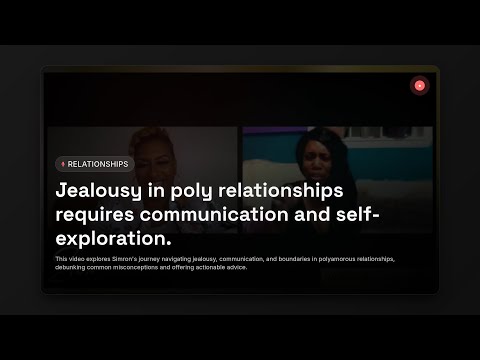
As Simran put it, jealousy in a poly relationship isn't a sign to shut things down — it's a signal to get curious about where it's really coming from, because "the onus is also on you to explore where that's coming from."
Mastering Jealousy & Communication in Polyamorous Relationships: Real Stories & Tips
Episode 10 of Peasant Sex and Relationships found host Twila Ray digging into a topic she said comes loaded with more misconceptions than almost any other: polyamory. Her guest was Simran, a former client turned close friend, who Twila introduced as someone whose journey into ethical non-monogamy she wanted listeners to hear straight from the source. Simran, who also works as a professional matchmaker (known online as “the cosmic matchmaker”) and runs a sound healing practice, spent the hour walking through how she found the lifestyle, what it actually looks like day to day, and where it can go wrong.
Simran traced her first exposure to polyamory back to an episode of MTV’s True Life she saw in high school — enough to plant the idea that ethical non-monogamy existed, even if she didn’t think it was for her at the time. Years later, in her early twenties and freshly out of what she described as a controlling, abusive relationship, she matched with a guy on OkCupid whose profile mentioned he was already in a polyamorous relationship. That connection eventually led her to meet his partner; the two lost touch, reconnected after the couple had married and had a child, and Simran ended up forming a lasting friendship with the wife that has outlasted the couple’s own relationship. A second poly relationship followed the same pattern — she became close friends with her partner’s other partner, too. That experience is what hooked her: even when a specific relationship didn’t survive, the connections it produced still felt meaningful.
One piece of poly vocabulary came up early: “the meta,” meaning a partner’s other partner. Simran explained that for years she kept finding herself in the position of being someone else’s meta without ever having her own primary partner — a gap that eventually pushed her out of the lifestyle for a while.
Much of the conversation focused on knocking down assumptions. Simran was clear that not every polyamorous relationship is sexual; she described her own attraction as running on a spectrum, where a romantic connection with someone might mean only hand-holding or cuddling rather than anything sexual. She and Twila also called out the double standard where men in poly relationships face far less judgment than women do. Other misconceptions they addressed head-on: that poly relationships automatically collapse the moment jealousy shows up, that people pursue non-monogamy purely to have more sex, and — perhaps most surprising to listeners — that cheating isn’t possible in a poly dynamic. Simran was direct that it absolutely is possible, describing how a broken agreement around protection with a non-primary partner became one of the reasons a past relationship ended.
Jealousy got the deepest treatment. Simran and Twila agreed that communication is the antidote — speaking up the moment a feeling surfaces rather than letting it sit. Simran also put responsibility on the partner receiving that disclosure: to listen and be sensitive without treating the feeling as license to control anyone’s behavior. For the person experiencing jealousy, she said the real work is self-reflection — tracing the feeling back to its root, which for her once turned out to be a perceived difference in how much she was valued compared to another partner. She was candid that jealousy isn’t confined to a primary relationship either; she described getting jealous over her meta’s other dates, admitting she holds an inconsistent, “weird” expectation that her metas be monogamous to her even though she knows that doesn’t track logically.
The two also discussed practical structures poly people use — “kitchen table” polyamory, where partners and metas socialize together, versus closed triads, which Simran flagged as a setup that can attract predatory “unicorn hunter” couples. Asked what advice she’d give a 21-year-old considering poly for the first time, she urged caution around established couples seeking a third, and recommended starting out solo or seeking people who date separately, along with finding educational poly community groups first.
Producer Ryan Perez closed out the episode with his own takeaway: strip relationships down to first principles and it comes down to consent and agreement — you can have an understanding with as many people as you want, as long as everyone keeps the agreement they signed up for. Simran left listeners with a simpler message: don’t let other people’s opinions stop you from exploring what you’re curious about, whether or not you choose to be public about it the way she has been.
Lessons from this one
Jealousy in a relationship is information to investigate, not a verdict on the relationship structure.
Simran described tracing her own jealousy back to a perceived difference in how valued she felt compared to another partner, saying the person experiencing jealousy has an obligation to explore its root rather than treat it as proof that polyamory itself is the problem.
Explicit, ongoing agreements matter more than the relationship label itself.
Simran and Ryan both landed on consent and keeping agreements as the real foundation, noting that cheating is entirely possible in a poly relationship if someone breaks a boundary the partners agreed to, such as protection use with other partners.
Attraction and intimacy needs vary on a spectrum, so poly relationships are not inherently sexual.
Simran explained her romantic attraction to a person doesn't always include a sexual component, sometimes amounting only to hand-holding or cuddling, which she said tends to confuse people expecting non-monogamy to be primarily about sex.
Structures that isolate a third partner within a pre-existing couple carry higher risk than dating separately.
Simran warned that closed triads and 'unicorn hunter' couples have a reputation for being predatory, especially toward younger women, and advised newcomers to be cautious of established couples seeking a third rather than partners who date independently.
No controlled study found for this specific claim (that couple-seeking-a-third/'unicorn hunting' structures carry measurably higher risk than independently-formed poly relationships, or specifically target younger women). A genuine search turned up real peer-reviewed ethnographic work on power dynamics within polyamorous relationships generally (e.g., Sheff, E. (2005). Polyamorous Women, Sexual Subjectivity and Power, Journal of Contemporary Ethnography, 34(3), 251-283), but nothing that isolates or tests the couple-seeking-a-third configuration and its risk profile specifically. This point reflects the guest's own lived experience and community-circulated caution, presented as such rather than as research-backed fact.
Delaying difficult conversations lets small discomforts calcify into relationship-ending issues.
Simran said the number one tip for a successful poly relationship is communicating the moment a feeling comes up rather than letting it stew, describing a direct conversation she had with a partner as soon as she noticed something bothering her.
Sources
- Sharpsteen, D. J., & Kirkpatrick, L. A. (1997). Romantic jealousy and adult romantic attachment. Journal of Personality and Social Psychology, 72(3), 627-640.
- Rubel, A. N., & Bogaert, A. F. (2015). Consensual Nonmonogamy: Psychological Well-Being and Relationship Quality Correlates. The Journal of Sex Research, 52(9), 961-982.
- Bogaert, A. F. (2004). Asexuality: Prevalence and associated factors in a national probability sample. The Journal of Sex Research, 41(3), 279-287.
- Sheff, E. (2005). Polyamorous Women, Sexual Subjectivity and Power. Journal of Contemporary Ethnography, 34(3), 251-283.
- Christensen, A., & Heavey, C. L. (1990). Gender and social structure in the demand/withdraw pattern of marital conflict. Journal of Personality and Social Psychology, 59(1), 73-81.
- Runtime
- 1h 00m
- Show
- Peasant Sex and Relationships
- Host
- Ryan Perez
Been through something like this?
Peasant Sex and Relationships is conversations with people who built something out of the thing that was supposed to stop them. If that is you, say so.