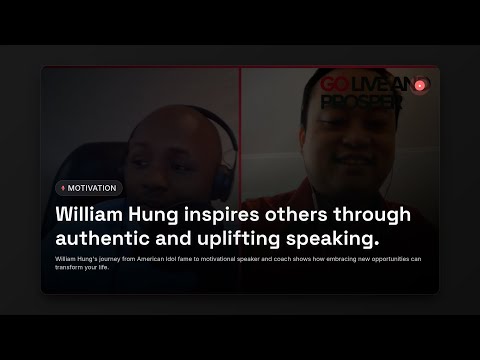
Where Is William Hung Now? American Idol Star’s Inspiring Career Transformation
Every talk should be a gift to your audience — not a highlight reel of yourself.
“# Where Is William Hung Now? American Idol Star’s Inspiring Career Transformation\n\nShow: Go Live and Prosper | Hustle Zone Network\n\nMost people remember William Hung for one moment: a wobbly, joyful rendition of Ricky Martin’s "She Bangs" in front of Simon Cowell, Paula Abdul, and Randy Jackson on American Idol. On this episode of Go Live and Prosper, host Ryan Perez sat down with Hung to find out what happened after the cameras stopped rolling on that clip — and it turns out the real story is a lot more interesting than the viral one.\n\nHung told Perez the audition almost didn’t happen. At the time he was studying civil engineering at UC Berkeley, struggling and unhappy with the path he was on. He spotted a poster for a school talent show, figured he had nothing to lose, studied Ricky Martin videos to prepare, and sang "She Bangs." He won the grand prize — a DVD player — and that small win gave him the confidence to try out for American Idol.\n\nWhat came next was a now-famous piece of television: Cowell’s blunt "you can’t sing, you can’t dance, so what do you want me to say?" Hung said he didn’t feel embarrassed by how it played out, noting that most contestants who don’t advance past Hollywood week have their less-than-flattering auditions aired — his simply happened to catch fire with the public. His parents, he said, were initially shocked that he’d auditioned at all, but their perspective shifted within about a year once they saw how much his life — and by extension theirs — had changed.\n\nA record deal with Koch Records followed, which Hung described as the moment he knew he could take entertainment further. He toured, appeared on Jimmy Kimmel Live and The Ellen DeGeneres Show, and performed alongside Ricky Martin in Las Vegas. But after about four years of what he called his "dream life," the momentum slowed. Faced with a choice between continuing to chase show business or settling into something stable, he chose stability — going back to school at Cal State Northridge to finish a bachelor’s degree in math, trying his hand at teaching, and eventually spending eight years working for the government, including time with the sheriff’s department.\n\nEventually, sitting behind a desk stopped being enough. "I feel like there’s more to me than hiding behind my cubicle," Hung told Perez, describing the pull that led him toward public speaking. He credited a TEDx speaking coach with a piece of advice that reframed how he approaches every talk: every talk should be a gift to your audience, not a chance to talk about yourself. That idea now anchors the online coaching program he’s building to help other people find and shape their own stories.\n\nMuch of the conversation focused on the practical side of turning a personal story into a speaking business. Hung said he looks to work with clients who have a vision bigger than themselves — he pointed to a recent client pursuing a TEDx talk about visa delays, after her mother died of cancer while her aunt’s visa to visit from Vietnam was still being processed; her aunt ultimately arrived two months too late, and the story had already drawn national media attention.\n\nOn the question of how newer speakers build credibility and land bookings, Hung didn’t point to a shortcut. He recommended Toastmasters as one of the best investments a speaker can make — inexpensive, roughly $45 every six months, and a place to get instant audience feedback. Beyond that, his advice was simple: reach out to local organizations directly, don’t wait for permission, and ask what problems they’re trying to solve at their next event so you can match your expertise to their need.\n\nHung also discussed his book, Champion by Choice, which took about a year and a half to finish. He was candid that the writing process was difficult since English is his second language, and that he leaned on mentors, coaches, and friends to get it across the finish line. His closing message to listeners was direct: no matter how ordinary your life feels, there’s an inspiring story inside it — in your relationships, your career, your health — and the job is to find the moments of fear or frustration and frame them positively for whoever’s listening.\n\nThe episode closed out with a lightning round covering everything from his childhood nickname to his retirement plans (he’s aiming for 47), before Perez pointed listeners to willhung.com to connect with him directly.”
Lessons from this one
A public failure can become the foundation of a career instead of the end of one.
Hung's American Idol audition was widely mocked, and Simon Cowell's on-air critique was blunt, but Hung said he didn't view it as embarrassing and used the attention as a springboard into music, television appearances, and eventually speaking. This maps onto the psychological concept of posttraumatic growth — positive psychological change reported by some people following adversity, including public humiliation or reputational setbacks — rather than simple resilience (a return to baseline).
Effective public speaking is framed around the audience's benefit, not the speaker's résumé.
Hung directly credited a TEDx coach's advice that 'every talk should be a gift to your audience' as the idea that reshaped how he approaches every talk, moving away from the natural tendency to talk about oneself. This is corroborated by TED's own speaker-coaching framework (Briar Goldberg, TED's Director of Speaker Coaching, explicitly tells speakers to identify 'the gift they're giving the audience'), and it aligns with established persuasion research showing that how a message is received by an audience — not just what a speaker wants to say — determines persuasive impact.
Careers can have multiple distinct acts, and stepping away from a spotlight is not a failure.
After four years of touring and entertainment success, Hung chose a stable path — finishing a math degree and working in government for eight years — before pivoting again into speaking and coaching.
Low-stakes, repeated practice with real feedback builds the confidence needed for bigger stages.
Hung recommended Toastmasters specifically because it is inexpensive and provides instant audience feedback, calling it one of the best investments a new speaker can make before pursuing bigger opportunities.
Selecting clients or causes with a vision bigger than the individual creates more compelling stories.
Hung said he seeks out coaching clients with a clear vision beyond themselves, citing a client whose personal loss due to visa delays became the basis for a TEDx talk aimed at broader policy awareness.
Sources
- Tedeschi, R.G. & Calhoun, L.G. (2004). "Posttraumatic Growth: Conceptual Foundations and Empirical Evidence." Psychological Inquiry, 15(1), 1-18.
- Petty, R.E. & Cacioppo, J.T. (1986). "The Elaboration Likelihood Model of Persuasion." Advances in Experimental Social Psychology, Vol. 19, pp. 123-205, Academic Press.
- Ibarra, H. (2003). Working Identity: Unconventional Strategies for Reinventing Your Career. Harvard Business School Press.
- Ericsson, K.A. (2008). "Deliberate Practice and Acquisition of Expert Performance: A General Overview." Academic Emergency Medicine, 15(11), 988-994.
- Krause, R.J. & Rucker, D.D. (2020). "Strategic Storytelling: When Narratives Help Versus Hurt the Persuasive Power of Facts." Personality and Social Psychology Bulletin, 46(2), 216-227.
- Runtime
- 29m
- Show
- HustleZone
- Host
- Ryan Perez
Been through something like this?
HustleZone is conversations with people who built something out of the thing that was supposed to stop them. If that is you, say so.