Are You Just an Option? Hidden Truths About Dating Apps & Relationships
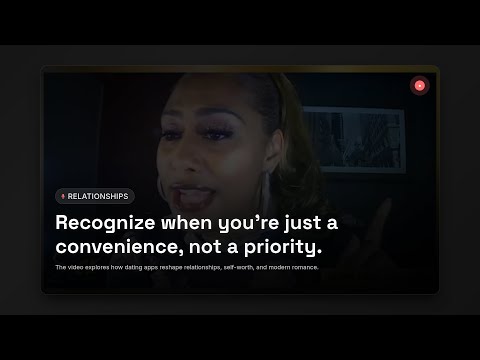
Being picked up occasionally and put down the rest of the time isn't a relationship — according to Twila Ray, it's being kept "on retainer."
Are You Just an Option? Twila Ray Breaks Down the “Retainer” Trap on Peasant Sex and Relationships
On this episode of Peasant Sex and Relationships, host Twila Ray dug deeper into a concept she introduced the week before: the idea of being “on retainer” in a relationship. If last episode planted the seed with five diagnostic questions, this one was the harvest — a full breakdown of exactly how people, mostly the men in these dynamics as Twila frames it, keep women around without ever fully committing to them.
Twila opened by borrowing the term straight from the business world. A retainer, she explained, is what a company pays a lawyer or freelancer ahead of time — not because they necessarily need the work done right now, but so the person is available and on call whenever they do. Applied to dating, the metaphor lands hard: someone kept “on retainer” isn’t necessarily a side piece, she clarified, but they’re also not truly a priority. They’re available. On call. Convenient.
From there, Twila laid out four categories she says explain how this plays out in real relationships.
The first is convenience — being kept around simply because the other person hasn’t found anything better yet. According to Twila, a man in this dynamic gives just enough attention to keep hope alive, showing flashes of who you fell for, before reverting to old habits within what she pegged as three to five days. The second is the hobby — something people pick up when bored and put down when they lose interest, with no real plans being made around you. Third is basic, which Twila described as a relationship with little connection, little communication, and a lot of “keeping up appearances” — two people coexisting without either walking away. The fourth is fill-a-need, where a partner leans on someone for financial, sexual, or emotional support and that person mistakes being relied upon for being valued, when in reality, Twila argued, they’re simply easy to manipulate.
Producer Ryan Perez joined partway through, and the conversation took a candid turn when he admitted, half-laughing, that he’d been on both sides of these dynamics himself — describing relationships that “don’t check all the boxes” but fill a need for excitement. He also shared an anecdote about a cousin who told him he had “some girls on retainer,” not realizing, per a leaked group chat Ryan described, that the women involved were saying the exact same thing about him and his friends.
That thread led into a broader riff on dating apps. Twila revealed she has never used Tinder or Bumble, and recounted turning off Facebook Dating in a hurry after a screenshot she posted led to a friend recognizing her nephew’s profile in the results. Ryan, meanwhile, joked that swiping culture lets people carry on multiple conversations at once — “multitasking like an octopus,” as he put it — while a friend of Twila’s described Tinder as full of people looking for something short-term, not the serious relationship she wanted. The two landed on a shared nickname for this world: “peasantville.”
To close, Twila offered a checklist for escaping retainer status: know your value, decide in advance what your actual deal breakers are (not someone else’s), figure out the specific qualities you want a partner to have, and be willing to walk away the moment those lines get crossed — no second chances once a deal breaker is confirmed. A viewer named Robert chimed in during the live chat with a comment about finding fulfillment through helping others, which Twila acknowledged but distinguished from the episode’s focus on romantic patterns specifically.
The episode closed with lighter, more spontaneous energy — a viewer question caught Twila off guard when someone asked if she was free the next evening, prompting some on-air laughter about being “picked up” on her own show. Twila wrapped by pointing viewers to her website and social handles, and gave a shoutout to Ryan Perez and the Hustle Zone team for the show’s recent rebrand.
Underneath the humor, the episode’s core message was straightforward: know the difference between being chosen and being kept around, and don’t confuse occasional attention for genuine commitment.
Lessons from this one
Occasional flashes of the person you fell for can keep you hooked longer than consistent good treatment would.
This matches 'traumatic bonding theory' in relationship psychology: Dutton & Painter's foundational test found that intermittent, unpredictable good/bad treatment (versus consistent treatment) produces stronger, harder-to-break emotional attachment to a partner — the same variable-reward mechanism Twila describes with the occasional 'glimmer of hope.' The original study is about intermittent abuse specifically, so it supports the underlying reinforcement mechanism rather than being a direct study of 'glimmers of hope' in otherwise-neglectful dating relationships.
Borrowing a business framework (the 'retainer') can make an ambiguous relationship dynamic suddenly legible to both partners.
There is a real academic literature on relational uncertainty and ambiguity in romantic relationships (e.g., Knobloch & Solomon's work on episodic relational uncertainty), which speaks to why undefined relationships are psychologically confusing. But no controlled study exists testing Twila's specific 'retainer' business-metaphor framing or measuring whether it helps people recognize their situation more than other framings would.
No controlled study found for this specific claim — the 'retainer' framing is the guest's own original metaphor/lived-experience framework, presented here as such rather than as research-backed fact.
Dating apps can function more as spaces for casual, parallel conversations than as tools for finding committed partners.
Survey research on emerging adults directly found that among the motivations for using Tinder, casual sex, entertainment, and ease of communication were more prominent than seeking a committed relationship; complementary qualitative work on Tinder relationship initiation similarly found a wide range of intents and low follow-through toward commitment, consistent with Ryan and Twila's description of parallel, low-stakes app conversations.
Deciding your relationship deal breakers in advance, rather than in the moment, makes them easier to actually enforce.
Gollwitzer's extensively replicated research on implementation intentions ('if-then' plans decided in advance) shows that pre-committing to a specific response to a future situation substantially increases the odds the intended behavior actually happens, versus deciding in the moment — the general mechanism behind Twila's advice to set deal breakers ahead of time. Separately, Jonason et al. catalogued the actual traits people treat as dealbreakers in mate selection, giving empirical grounding to the concept of a personal, non-negotiable standards list, though it doesn't test the 'decide in advance' timing claim itself.
Being repeatedly relied on to meet someone's needs can be mistaken for being valued, when it may actually reflect being easy to use.
Equity theory research on intimate relationships found that people in inequitable relationships — including those who give more than they get — often misjudge or rationalize the imbalance as care or importance rather than recognizing it as one-sided dependence, and that under-benefited partners report more distress even when they initially frame the arrangement positively. This directly supports the mechanism Twila describes: mistaking being depended-upon for being valued.
Sources
- Dutton, D. G., & Painter, S. (1993). Emotional Attachments in Abusive Relationships: A Test of Traumatic Bonding Theory. Violence and Victims, 8(2), 105-120.
- Sumter, S. R., Vandenbosch, L., & Ligtenberg, L. (2017). Love me Tinder: Untangling emerging adults' motivations for using the dating application Tinder. Telematics and Informatics, 34(1), 67-78.
- LeFebvre, L. E. (2018). Swiping me off my feet: Explicating relationship initiation on Tinder. Journal of Social and Personal Relationships, 35(9), 1205-1229.
- Gollwitzer, P. M. (1999). Implementation intentions: Strong effects of simple plans. American Psychologist, 54(7), 493-503.
- Jonason, P. K., Garcia, J. R., Webster, G. D., Li, N. P., & Fisher, H. E. (2015). Relationship Dealbreakers: Traits People Avoid in Potential Mates. Personality and Social Psychology Bulletin, 41(12), 1697-1711.
- Hatfield, E., Traupmann, J., Sprecher, S., Utne, M., & Hay, J. (1985). Equity and Intimate Relations: Recent Research. In W. Ickes (Ed.), Compatible and Incompatible Relationships (pp. 91-117). Springer.
- Runtime
- 55m
- Show
- Peasant Sex and Relationships
- Host
- Ryan Perez
Been through something like this?
Peasant Sex and Relationships is conversations with people who built something out of the thing that was supposed to stop them. If that is you, say so.