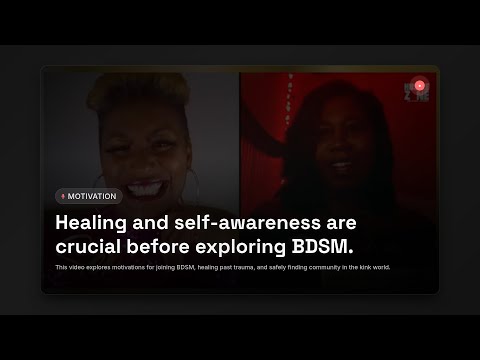
How to Start Your BDSM Journey Safely: Healing, Community & Finding Your Role
"My pleasure is a form of rebellion" — Maya Gobara's answer to anyone questioning whether her dominatrix lifestyle fits someone else's idea of empowerment.
How to Start Your BDSM Journey Safely: Healing, Community & Finding Your Role
Peasant Sex and Relationships | Host: Twila Ray | Guest: Maya Gobara
When Twila Ray opened the show by admitting she’d “barely been able to stand my seat,” it set the tone for an episode packed with candor, laughter, and a genuine education in a world most viewers only know through porn and punchlines. Her guest was Maya Gobara — spiritual educator, ordained Reverend Priestess, content creator, and a lifestyle and professional dominatrix who works especially with neurodiverse and chronically ill fems. Over the course of the conversation, Maya walked the audience through gender identity, the mechanics of BDSM roles, the business of professional domination, and — repeatedly — the importance of doing this work from a place of health rather than unhealed trauma.
Maya opened by unpacking the word “fem,” a term she said she’s expanded to include her nonbinary community. It has nothing to do with anatomy, she explained — it’s about whether someone identifies with feminine energy, however they move through the world. Twila connected that immediately to her own femininity work, noting how long it took her to stop rejecting feminine identity because it didn’t fit a narrow, overly “washed out” spiritual-community mold.
From there, the conversation turned to Maya’s own origin story. She started sex work in her early twenties, tried escorting, and quickly realized she hated being told what to do. A colleague suggested she try dominating instead — she shadowed an experienced dominant woman and was, in her words, “sold.” She soon left the adult entertainment company model altogether rather than split her earnings, choosing to build her own client base and eventually find the broader kink community. Interestingly, she said her greatest mentors in the lifestyle side of the work were men, while the women who mentored her taught her how to handle money, set rates, and assert her authority so she wouldn’t be taken advantage of.
Maya then broke down the vocabulary for newcomers: Masters and Mistresses who keep slaves in full 24/7 dynamics with no autonomy; Dom/sub relationships governed by detailed, multi-page contracts spelling out boundaries; tops and bottoms, which describe a role within a specific scene rather than an identity; pet players who take on kitten, puppy, or rabbit personas, collars and all; and brats — submissives who push back and enjoy the tug-of-war — a dynamic Maya was candid about disliking personally, even while acknowledging it works beautifully for other pairings.
She was equally direct about her own relationship life. With her male partner, she mostly operates on “equal footing,” though she enjoys certain kink acts like being spanked or choked without taking on a submissive role emotionally. She described the slow build of trust behind her partner occasionally stepping into a more assertive “let me be the man” role for her — including a small, telling moment over hotel-room coffee that made her laugh recalling it.
Perhaps the most pointed part of the episode came when Maya addressed misconceptions: that professional dominatrixes have sex with clients (she said that’s simply not the norm, and conflating the two erases the sex workers who do offer that different service), and that domination is just wild, reckless abuse. In reality, she said, safe impact play demands real study — knowing anatomy, avoiding organs, understanding pressure points, and building technique on pillows and couches before ever practicing on a person.
Asked what she’d tell someone newly curious about BDSM, Maya’s first move was always to ask about motivation — because using kink as a stand-in for unresolved trauma, she warned, “gets real sticky really fast” and can retraumatize rather than heal. Her advice for people ready to explore: read, research, and find local community through spaces like Fetlife and “munches” — casual, clothed meetups in restaurants or coffee shops where newcomers can meet real people in the scene without the intensity of an actual event.
Ryan Perez, the show’s producer, closed out the conversation reflecting on how much he’d learned and how the discussion reframed BDSM not as a weekend hobby but, as Maya insisted throughout, a genuine lifestyle. When the conversation turned to feminism and politics, Maya was unequivocal: her choices are her own form of “womanism,” her pleasure is “a form of rebellion,” and she has no interest in defending her life to anyone else’s framework of empowerment.
Lessons from this one
BDSM should never be used as a substitute for trauma therapy.
Maya said her first question to anyone curious about BDSM is about their motivation, warning that people who try to use kink dynamics to heal or process trauma instead of going to therapy find things 'get real sticky really fast' and can end up further traumatizing themselves, including women she works with who are still triggered and having nightmares in submissive spaces.
Firm, explicit boundaries are the actual foundation of safe dominance, not an afterthought.
Maya said the first practice for anyone wanting to be a dominatrix is having 'firm ass boundaries,' explaining that people will test a dom's limits, and that she and her therapist built an explicit 'if this, then this' decision framework for her, in part because she is autistic and can find real-time social cues difficult to read.
Low-stakes, clothed community events lower the barrier for newcomers exploring kink.
Maya recommended newcomers start with 'munches' — casual meetups in regular clothes at restaurants, libraries, or coffee shops — as a gentler way to meet the local kink community, contrasting it with her own account of being overwhelmed the first time she witnessed an actual kink event in person.
No controlled study or peer-reviewed research was found on 'munches' specifically, or on gradual-exposure/harm-reduction models applied to community-based kink or sexuality education generally. This appears to be a community practice documented mainly in community and journalistic sources rather than academic literature. Presented here as the guest's own practical advice/lived experience rather than as a research-backed claim.
Safe impact play is a technical skill built on anatomy knowledge, not improvisation.
Maya described needing to learn where organs like the liver and kidneys sit, understand pressure points, and practice striking technique repeatedly on pillows or couches before ever practicing on another person, specifically to avoid causing real physical harm.
Dominant and submissive roles don't map cleanly onto conventional gender expectations.
Maya said male dominants actually outnumber public perception in the lifestyle scene, even though media and porn skew toward female dominatrixes because, as she put it, 'that's where the money is,' and she described noticeably different emotional dynamics with her feminine-identifying versus masculine-identifying submissives.
Sources
- Wismeijer, A.A.J., & van Assen, M.A.L.M. (2013). Psychological Characteristics of BDSM Practitioners. The Journal of Sexual Medicine, 10(8), 1943-1952.
- Hull, L., Petrides, K.V., Allison, C., Smith, P., Baron-Cohen, S., Lai, M.C., & Mandy, W. (2017). "Putting on My Best Normal": Social Camouflaging in Adults with Autism Spectrum Conditions. Journal of Autism and Developmental Disorders, 47(8), 2519-2534.
- Drouin, M., Hernandez, E., Machette, A., Garcia, J.R., & Boyd, R.L. (2023). An exploration of marks/injuries related to BDSM sexual experiences. Sexual Medicine, 11(3), qfad020.
- Schori, A., Jackowski, C., & Schön, C.A. (2022). How safe is BDSM? A literature review on fatal outcome in BDSM play. International Journal of Legal Medicine, 136(1), 287-295.
- De Neef, N., Coppens, V., Huys, W., & Morrens, M. (2019). Bondage-Discipline, Dominance-Submission and Sadomasochism (BDSM) From an Integrative Biopsychosocial Perspective: A Systematic Review. Sexual Medicine, 7(2), 129-144.
- Runtime
- 1h 11m
- Show
- Peasant Sex and Relationships
- Host
- Ryan Perez
Been through something like this?
Peasant Sex and Relationships is conversations with people who built something out of the thing that was supposed to stop them. If that is you, say so.