Audrey Absin's Inspiring Dance & Burlesque Journey – Creativity & Community
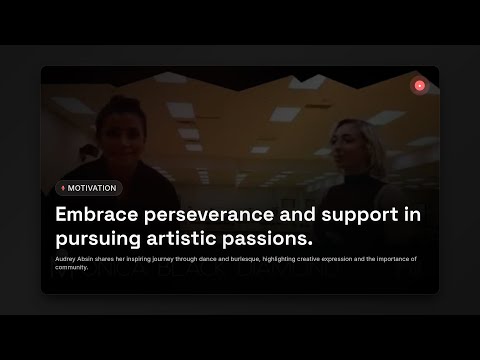
Audrey Absin wasn't good at dance until she was eighteen or nineteen — proof, in her telling, that persistence and enjoyment beat raw talent every time.
Audrey Absin’s Inspiring Dance & Burlesque Journey – Creativity & Community
On this episode of the Monica Black Diamond show, part of the Hustle Zone TV network, host Monica sits down with Audrey Absin, a Calgary-based dancer, aerialist, and burlesque performer, for an exclusive interview she’d been wanting to do since the two first connected. The conversation was filmed at Mount Royal University, where Audrey holds most of her rehearsals and also runs a burlesque club on campus.
Audrey runs Sanguine Sirens, a burlesque troupe, and the interview opens light — Monica asks Audrey what color and stone she’d be if she were a diamond. Audrey lands on garnet or ruby, tracing it back to a lifelong love of dark red, visible in several of her piercings.
From there the conversation turns to her path into dance. Audrey started in ballet as a young child, then moved into Irish dance for about seven years — “curly wigs, socks, spray tan,” as she puts it — before switching into jazz. Since then she’s kept adding disciplines: jazz, tap, ballet, lyrical, acrobatics, aerial hoop, and pole, with silks next on her list to learn this summer. She trains or teaches nearly every day of the week, with only one day off.
Monica asks her to explain aerial hoop for viewers who might picture a hula hoop. Audrey laughs that off — the apparatus is a metal hoop suspended from the ceiling, nearly as heavy as she is, used for acrobatic work in the air. She describes the feeling as being on a playground, though Monica, having seen her perform live, describes it as something closer to magical.
A large part of the discussion centers on costuming and production. Audrey produces shows through Sanguine Sirens, and unlike the studio work she does professionally — where costumes are provided — burlesque means building everything herself, from garments to sets. Her troupe gets together to glue sequins onto pieces by hand, work she calls both a team-building exercise and a creative outlet with a hot glue gun and fabric. For one of their last big productions, Swan Lake, the troupe built all of their own props, including a full castle. For the upcoming Pantheon show, Audrey is currently constructing a Trojan horse costume.
Asked about pushback or misunderstanding along the way, Audrey says the reception to her work has generally been more positive than she expected, given how risqué burlesque can be perceived. At Mount Royal University specifically, a friend suggested she start a burlesque club, and rather than resistance, the school has embraced it — even inviting her to perform at campus awards ceremonies. She does note some people are judgmental, but says most reactions land on “that’s cool” rather than criticism. She also recalls her first time performing being terrifying, something she says has eased considerably with experience.
When Monica asks what encouragement she’d offer other artists — dancers or otherwise — starting out, Audrey points to persistence over natural talent. She says she wasn’t good at dance until she was around eighteen or nineteen, and that her biggest improvements have come in just the past few years. Her advice: keep trying, allow yourself an off day without spiraling over it, then go back and train harder. She also stresses surrounding yourself with a supportive network — she credits her longtime sound engineer, Josh, and her lighting collaborator, as people she trusts and who believe in her work the way she believes in theirs.
The episode closes with details on two upcoming shows: an exclusive event on May 19th, and Pantheon on May 25th, a smaller-stage, more traditional burlesque show themed around gods and goddesses, staged at Koi (formerly Cafe Koi) — a venue whose late-night menu Audrey herself designed. Josh will DJ at Pantheon. Tickets for both shows are available through Eventbrite, with more information linked through the Sanguine Sirens website, Facebook page, and Instagram, alongside Audrey’s own personal page. Monica wraps the episode by thanking the Hustle Zone TV network for backing local Calgary artists like Audrey before cutting to a clip of her performing.
Lessons from this one
Sustained skill growth can come from years of accumulated practice rather than early natural ability.
Audrey says she wasn't good at dance until she was around eighteen or nineteen, and that her biggest gains have come only in the past few years, despite starting in ballet as a young child and adding new disciplines continuously since.
Fear of public judgment around risqué or non-mainstream art forms often outpaces the actual reception.
Audrey describes expecting more resistance to burlesque given how risqué it can seem, but found general reception more positive than anticipated, including her university embracing a student burlesque club and inviting her to perform at awards ceremonies.
A trusted network of fellow collaborators sustains an artist's willingness to keep performing and producing.
Audrey credits her longtime sound engineer Josh and a regular lighting collaborator as people who believe in her work as much as she believes in theirs, describing mutual support between local artists as key to keeping her shows going.
Permitting occasional off days without self-punishment supports long-term persistence in a demanding practice schedule.
Audrey, who trains or teaches nearly every day of the week, says her approach to bad days is to let herself have one off day, calm down, and then return to train harder rather than dwelling on feeling behind others.
Hands-on creative ownership of costumes and sets can deepen an artist's investment in a production.
Audrey explains that unlike her studio work where costumes are provided, her burlesque troupe builds its own costumes and props from scratch — including a full castle for Swan Lake and a Trojan horse for the upcoming Pantheon show — describing it as both team-building and a way to fully realize a creative vision.
Sources
- Ericsson, K.A., Krampe, R.T., & Tesch-Römer, C. (1993). "The Role of Deliberate Practice in the Acquisition of Expert Performance." Psychological Review, 100(3), 363-406.
- Regehr, K. (2012). "The Rise of Recreational Burlesque: Bumping and Grinding Towards Empowerment." Sexuality & Culture, 16(2), 134-157.
- Baquero-Sierra, A., Annicchiarico, I., & Galeano, C.M. (2024). "The Role of Resilience, Social Support, and Artistic Activities in Mental Health During Pandemics." Psychological Reports.
- Mosewich, A.D., Kowalski, K.C., Sabiston, C.M., Sedgwick, W.A., & Tracy, J.L. (2011). "Self-Compassion: A Potential Resource for Young Women Athletes." Journal of Sport & Exercise Psychology, 33(1), 103-123.
- Norton, M.I., Mochon, D., & Ariely, D. (2012). "The IKEA Effect: When Labor Leads to Love." Journal of Consumer Psychology, 22(3), 453-460.
- Runtime
- 19m
- Show
- Monica Black Diamond
- Host
- Ryan Perez
Been through something like this?
Monica Black Diamond is conversations with people who built something out of the thing that was supposed to stop them. If that is you, say so.