How Tangible 2 Breaks the Mold: Authentic Rap, Wild Shows & Grassroots Success
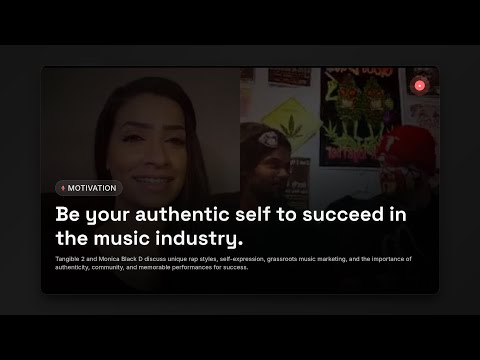
As Wheatstock put it, chasing being "the best" is the wrong goal — the real work is being the best you on every song and every performance.
How Tangible 2 Breaks the Mold: Authentic Rap, Wild Shows & Grassroots Success
Monica Black Diamond’s latest sit-down brought on Tangible 2 — Wheatstock and Bagshaw, a rap duo out of Vancouver Island — for a conversation that moved from origin stories to stage-blood war wounds to a live, unreleased performance.
A friendship built on free Slurpees
Wheatstock’s rap journey started young — around 12 to 14 years old, inspired by Eminem, ICP, Tech N9ne, and Boondocks, recording rhymes on a tiny desktop microphone with a single-track program. Years later, working at a 7-Eleven, he kept running into a regular customer named Bagshaw, and the two struck up a friendship over — by Wheatstock’s own account — free Slurpees. Around the same time, Wheatstock started landing bigger solo shows. Bagshaw, going through a breakup, had started rapping too and showed Wheatstock a phone recording of his very first attempt. Wheatstock liked what he heard, and what followed was, in his words, Bagshaw sleeping on his studio floor for a couple of years while they recorded together for a year straight. Four years later, Tangible 2 was a real thing — the name itself pulled from a lyric Bagshaw kept repeating in a song.
Painted faces and a philosophy of self-expression
Wheatstock’s painted face — a different design nearly every show — started under the name “Spiral” before he settled into “Wheat,” a nod to his last name and his rural upbringing. He described the face paint as pure self-expression that doubles as branding: people who see it once, he said, remember it years later. Asked why he always seems to land on similar color combinations, his answer was refreshingly unglamorous — he just buys the same five-color paint pack.
Earning stage time the hard way
Both artists were candid about how they built an audience: by asking, and asking again, until someone gave them an opening slot, then making that show impossible to forget. Their advice to newer artists was blunt — don’t just stand there and rap, make it a big deal. That same hustle led to a pointed critique of how opening slots get filled in the local scene. Tangible 2 argued that artists deserve to be paid even as openers, that they’ve personally lost real money “investing” in shows early on, and that promoters should be evaluating openers on merit rather than just their ability to move tickets.
Scars from the stage
Some of the episode’s most memorable moments were physical. Bagshaw described trying to jump onto a speaker mid-show, missing, and gashing his shin open — then finishing the set as if nothing happened, blood and all. In a separate story, Wheatstock recalled Bagshaw accidentally poking him hard enough in the eye to feel a finger go into the socket — and he kept rapping anyway. Their shared philosophy for when something goes wrong on stage: make eye contact, feed off each other, and if all else fails, talk to the crowd until the moment passes.
Advice, influences, and what’s next
Asked what they’d tell other artists, Wheatstock offered a line that anchored the whole conversation: trying to be “the best” — better than every other rapper — is the wrong goal. The real work is being the best version of yourself on every song and every performance. Their influences ranged wide — Red Man, Ol’ Dirty Bastard, Ludacris, Tupac, James Brown, and Stevie Wonder, alongside Boondocks, ICP, Eminem, Tech N9ne (who they’ve already opened for), and Slipknot, whose live intensity shaped their own stage show.
The two also touched on balancing life and music — Bagshaw has a daughter, Zoe, who he said is part of why he raps in the first place — and on the state of unity in the local rap scene, which they described as mostly humble, with the “shady” characters naturally falling away over time.
Before wrapping up, Tangible 2 performed a live, stripped-down, previously unreleased track for the stream, touching on themes of loneliness, role models, and struggle. They closed by teasing an upcoming album called “POS” and pointing listeners to their YouTube channel, Facebook page, and SoundCloud to find more of their music — with a promise that a much bigger, harder catalog is coming soon.
Lessons from this one
Grassroots exposure comes from relentlessly asking for stage time, not waiting to be discovered.
Tangible 2 described their early marketing as a matter of constantly asking promoters until someone let them open a show, then using that one shot to become memorable enough that people started calling them back.
A distinctive visual signature can function as branding as much as artistic expression.
Wheatstock explained that painting his face differently for nearly every show is primarily self-expression, but he also acknowledged it works as marketing because people remember him years after seeing it once.
Underpaid opening slots reflect a broader power imbalance between promoters and emerging artists.
Tangible 2 said they lost significant money paying to open early shows and argued promoters should evaluate openers on musical merit rather than ticket-selling ability, calling for artists to feel confident negotiating fair pay.
Performers can sustain focus and finish a task even through real physical pain or injury.
Bagshaw kept performing after gashing his shin jumping toward a speaker, and Wheatstock kept rapping after being accidentally poked hard in the eye mid-show, both treating the show as something that had to continue regardless.
Measuring yourself against yourself, not against competitors, is framed as the healthier path to artistic growth.
Wheatstock told other artists that chasing being objectively "the best" rapper is the wrong goal, and that focusing on being the best version of yourself in every song and performance is what actually matters.
Sources
- Yong Liu (2006), "Word of Mouth for Movies: Its Dynamics and Impact on Box Office Revenue," Journal of Marketing, 70(3), 74–89.
- Nielsen, "Global Trust in Advertising" report — finding 83% of global respondents trust recommendations from friends and family above all other advertising formats.
- Fiocchi, G., & Seyed Esfahani, M. (2023), "Exploring the uniqueness of distinctive brand assets within the UK automotive industry," Journal of Brand Management.
- von Restorff, H. (1933) — originating study of the 'isolation effect' (von Restorff effect): distinctive stimuli among homogeneous items are disproportionately remembered.
- Hesmondhalgh, D., & Baker, S. (2010), "'A very complicated version of freedom': Conditions and experiences of creative labour in three cultural industries," Poetics, 38(1), 4–20.
- Tesarz, J., Schuster, A. K., Hartmann, M., Gerhardt, A., & Eich, W. (2012), "Pain perception in athletes compared to normally active controls: A systematic review with meta-analysis," Pain, 153(6), 1253–1262.
- Nicholls, J. G. (1984), "Achievement motivation: Conceptions of ability, subjective experience, task choice, and performance," Psychological Review, 91(3), 328–346.
- Festinger, L. (1954), "A Theory of Social Comparison Processes," Human Relations, 7(2), 117–140.
- Runtime
- 1h 12m
- Show
- Monica Black Diamond
- Host
- Ryan Perez
Been through something like this?
Monica Black Diamond is conversations with people who built something out of the thing that was supposed to stop them. If that is you, say so.