From Bullied to Boss
David Williams’ Inspiring Entrepreneurial Journey
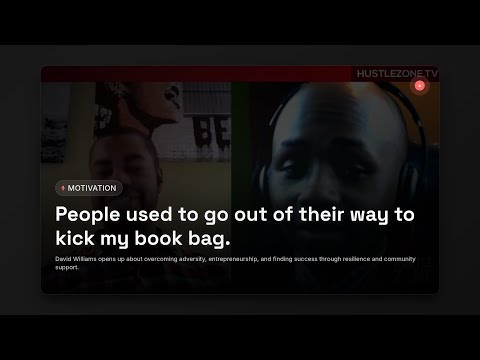
David Williams turned years of being doubted and bullied into a defining creed: "They told me I couldn't, so that's why I did."
From Bullied to Boss: David Williams’ Inspiring Entrepreneurial Journey
Hustle Zone
On this episode of Hustle Zone, host Ryan Perez sat down — after four scheduling attempts, technical hiccups, and a running joke about it — with David Williams, an entrepreneur juggling three ventures and a nonprofit, for a conversation that landed, fittingly, on David’s 30th birthday.
Williams didn’t come up as the confident, big-thinking entrepreneur he is today. He told Perez he was the quiet kid in school, sticking to two or three close friends and staying mostly to himself. He’s also dyslexic with a high IQ, a combination he said made school genuinely tough — teachers dumped his messy desk onto the floor in front of classmates, and other kids went out of their way to kick his book bag or take things from his locker. When Perez pressed on whether he’d ever been doubted, Williams didn’t dodge it: yes, repeatedly, and for years it left him with what he called “a chip on my shoulder.” One of his favorite lines, he said, sums up the response that chip produced: “They told me I couldn’t, so that’s why I did.”
The decision to become an entrepreneur crystallized around age 25, though Williams described the deeper roots going back further. He noticed a pattern in his own working life — jobs that rarely lasted more than five months no matter how hard he worked — and grew tired of being, in his words, “at the mercy of other people.” A conversation with his mother about what she wanted done in the event something happened to her became a turning point: it pushed him to think seriously about leaving something behind, and about entrepreneurship as a more dependable path than a job market that, as he put it, “isn’t loyal.”
His grandfather looms large in the story. A man who ran a real estate investment, a nonprofit, a TV repair shop, and a construction business, he passed away before Williams could be mentored by him directly — something Williams called his one real regret. But learning the scope of what his grandfather built after he was gone became, in his telling, a kind of permission slip: “I’m gonna keep the torch going until it’s my time to pass it.”
The path there wasn’t a straight line so much as a foundation with branches. Williams started writing posts about astrology and numerology on Facebook, noticed they got more engagement than anything else he posted, and — encouraged by a friend — turned that into blogging, then into writing books. He’s written two so far and is working on a third, with a fourth in mind. Books, he explained, remain his foundation precisely because they don’t require him to trade time for money the way a job does; the income and confidence from that base let him branch into a fragrance line (Kyle’s Fragrance LLC) and a wine brand (Blissful Memories by Ky’s) without abandoning the writing that started it all.
Underneath the ambition sits a specific mission: Williams is building a project called Billionaires Under Construction, aimed at inspiring young Black entrepreneurs. He told Perez the idea grew out of a personal observation — that when he started researching the billionaires he admired, he saw plenty of white and Chinese names on the list, but very few that looked like him. Rather than finding that discouraging, he said it clarified where he wanted to put his energy, echoing his grandfather’s own nonprofit work with at-risk teens.
Asked who he studies, Williams named Warren Buffett specifically, admiring that a man worth tens of billions still reportedly drives the same car and lives modestly. That kind of humility, Williams said, is something he’s aiming for himself. When Perez asked what his “superpower” was, Williams didn’t point to hustle or hours — he pointed to his ability to stay calm, paired with a determination he described as relentless: “I don’t take no for an answer… it may take a while for me to get what I want, but I do get what I want eventually.”
The conversation closed out with Hustle Zone’s traditional lightning round — tomatoes are a fruit, Ron Weasley is the favorite Harry Potter character, and if he could ask Tupac one question, it’d be about what motivated him to attend dance school. Williams can be found on Instagram and Twitter as Billionaire Under Construction, alongside his book, fragrance, and wine projects — all works in progress he hopes to bring back to Hustle Zone for a follow-up once they’re further along.
Lessons from this one
Early bullying and self-doubt can be converted into long-term entrepreneurial drive rather than remaining a wound.
Williams describes being teased, having his desk dumped by teachers, and being doubted throughout school, but says that history built the determination and 'chip on my shoulder' that fueled his push into entrepreneurship, even as he says he's since let go of needing to prove anything.
A family member's example of building multiple ventures can motivate entrepreneurship more powerfully after their passing than any advice ever could while they were alive.
Williams credits his grandfather's real estate, nonprofit, TV repair, and construction businesses as a key motivator, saying he only fully grasped the scope of it after his grandfather died, and regrets not being mentored directly.
Anchoring new ventures to one sustainable foundation lets an entrepreneur diversify without losing momentum or credibility.
Williams explains that books are his 'foundation' — the thing he keeps returning to and building a third and fourth title around — while using time and income from that base to launch a fragrance line and a wine brand rather than abandoning writing for the next idea.
Studying specific, humble models of extreme success can make an intimidating goal feel achievable rather than reckless.
Williams says he wasn't intimidated by the idea of becoming a billionaire because he researched people who had already done it, singling out Warren Buffett's modest lifestyle despite immense wealth as something he personally aspires to emulate.
Noticing a representation gap in a field can be reframed from discouragement into a personal mission.
Williams says his 'Billionaires Under Construction' project came directly from researching billionaires and observing a lack of Black billionaires compared to other groups, turning that observation into a nonprofit aimed at inspiring young Black entrepreneurs.
Sources
- Ratcliff, J. J., Miller, A. K., Monheim, C., & Rice, C. (2025). Posttraumatic Growth and Meaning in Life Mediate the Relationship between Severity of Adolescent Bullying Victimization and Adulthood Health Outcomes. Journal of Interpersonal Violence, 41(13-14), 3968-3992.
- Chlosta, S., Patzelt, H., Klein, S. B., & Dormann, C. (2010). Parental role models and the decision to become self-employed: The moderating effect of personality. Small Business Economics, 38(1), 121-138.
- Kutzewski, T., Bahlmann, M., & Stam, W. (2020). Portfolio Entrepreneurship: A Multilevel Review of the Literature. Academy of Management Proceedings, 2020(1), 17677.
- Fellnhofer, K. (2017). Entrepreneurship education revisited: perceived entrepreneurial role models increase perceived behavioural control. International Journal of Learning and Change, 9(3), 260-283.
- Singh, R. P., & Nurse, S. (2024). Addressing the Racial Wealth Gap and Structural Racism Through Increased Black Entrepreneurship: An Entrepreneurial Ecosystem Perspective. The Review of Black Political Economy, 52(1), 57-86.
- Runtime
- 1h 16m
- Show
- HustleZone
- Host
- Ryan Perez
Been through something like this?
HustleZone is conversations with people who built something out of the thing that was supposed to stop them. If that is you, say so.