
From Foreclosure to Recovery
Matt Merriam's Proven Tips for Homeowners
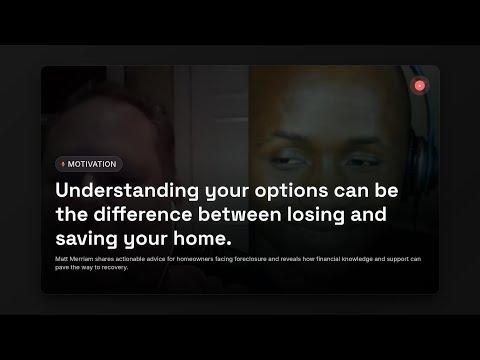
As Matt Merriam puts it bluntly about banks and defaulted homeowners: "They're not your friend when you're in default" — which is exactly why he built a business around making sure people know their options before the sheriff shows up.
From Foreclosure to Recovery: Matt Merriam’s Proven Tips for Homeowners
Hustle Zone TV
Some guests come on a livestream to promote a product. Matt Merriam, founder of Real Estate Recovery Group, came on Hustle Zone to talk about sheriff’s sales, dumpsters in front yards, and why he thinks the housing crisis never really ended — it just stopped making headlines.
Host Ryan Perez opened the episode noting he’d been trying to book Merriam for about a year, and once the mics were live, Merriam didn’t hold back. His path into the mortgage and foreclosure world wasn’t a straight line. He worked as a train operator for New Jersey Transit’s light rail for about five years, then, after health issues related to colitis, joined the mortgage business through his brother and sister-in-law’s company. He spent time in a post-closing department — a job he says he hated — before landing on a national website that helped homeowners sell properties themselves (FSBO) or connect with preferred agents when that didn’t work.
Then 2007 hit. Merriam described watching what he calls “tickler loans” and “garbage loans” unravel the mortgage industry, and homeowners signing documents they’d never fully read. That’s when short sales entered his world — and he’s quick to correct the common assumption behind the term. “There’s nothing short about a short sale,” he said, arguing it should be called a “short long sale” given how long the process actually takes.
Twelve years later, Merriam runs Real Estate Recovery Group’s “partners program,” where agents, investors, and even attorneys bring him cases they don’t have the specialized knowledge to handle themselves — foreclosures, short sales, loan modifications. He described one case where his team helped an agent who thought a deal was dead recover a $24,000 commission on a property headed for sheriff’s sale. In another case he mentioned on the show, a homeowner had already lost his house to what Merriam says was an improper foreclosure; after reviewing documentation, the team is now working to reopen the file and pursue a possible lawsuit against the bank.
A personal stake in the work
Merriam’s motivation traces back to his own family. His mother-in-law and father-in-law lost their house to foreclosure years earlier, and he said they told him that if they’d known someone like him back then, they might have kept the property. Years later, after a divorce, his mother-in-law faced foreclosure a second time — Merriam stepped in and helped her secure a streamlined modification. According to him, her mortgage payment rose by roughly $68 a month instead of the $500–$600 increase she’d been facing.
He also described a harder turning point: his father-in-law passed away, and around that same period he decided to walk away from his other business partnerships to focus solely on helping homeowners directly. He also shared that his wife, at 17 and away at college, learned her family’s Connecticut home was being sold out from under her with almost no notice — she said she lost what Merriam estimated as “about 99%” of her childhood belongings in the process. It’s a story he says still shapes how urgently he pushes his central message: know your options before the sheriff’s sale notice arrives, not after.
Numbers, systems, and a warning about banks
Merriam claimed that roughly 20% of the cases his team works on end in a settlement — where the homeowner keeps the house and the mortgage balance itself gets reduced, rather than the property being sold. He also alleged that loan modifications have been denied over discrepancies as small as 15 cents in reported income or expenses, without homeowners being told how to correct the error. His broader warning to listeners: banks and loan servicers, in his view, are not obligated to offer homeowners the best solution available to them, only the program they’re required to offer.
On the operations side, Merriam credited a four-person team and a CRM tool called Track with Ease for keeping hundreds of files organized, and said he’s in talks with a national real estate company about handling roughly 150 short sales in the coming year.
On success and failure
Asked what it takes to succeed, Merriam didn’t point to a tactic — he pointed to rejection. “Every failure is going to bring you closer to success,” he said, adding that he’s had to start over in the industry four times because he didn’t like the direction a partnership or business model was heading. He described himself as someone who has learned to sit with a “no” rather than avoid it.
The episode closed with a lightning round covering everything from Merriam’s love of rap over rock, his favorite childhood city of Hollywood, Florida, his refusal to ever retire, and his family nickname “Hoe” (short for his middle name, Howard) — a lighter note to end a conversation that spent most of its time in far more serious territory.
Listeners looking to reach Merriam were pointed to his website and to his recurring hashtag campaign — “know your options” — a phrase he returned to again and again as the one piece of advice he most wants struggling homeowners to hear before it’s too late.
Lessons from this one
Waiting until the last minute is the single biggest mistake homeowners make when facing foreclosure.
Merriam repeatedly returns to his mantra "know your options," describing how homeowners who wait for the sheriff's sale notice have far fewer paths available than those who reach out as soon as trouble starts.
Personal loss can be redirected into a more mission-driven version of an existing business.
Merriam ties his shift toward directly helping homeowners to his in-laws' own foreclosure and his father-in-law's death, saying that period is when he cut his other partnerships and refocused the company.
Minor clerical discrepancies in loan modification paperwork can have outsized, hard-to-reverse consequences for homeowners.
Merriam claims he has seen modification requests denied over reported income/expense discrepancies as small as 15 cents, with homeowners not told how to fix the line item.
Repeated rejection and business failure can function as training rather than a stop sign.
Merriam says he has had to "start over in this industry four times" and frames every closed door and every 'no' as bringing him closer to eventual success.
Specialized back-office expertise lets other professionals take on complex cases they would otherwise turn away.
Merriam describes agents, investors, and attorneys bringing him foreclosure and short-sale cases they lack the in-house knowledge to handle, citing a $24,000 commission recovered on a deal headed for sheriff's sale.
No controlled study or authoritative report was found specifically examining specialization/outsourcing of foreclosure or short-sale expertise within real estate brokerage or professional services. This lesson reflects the guest's own lived business experience and anecdote about a single deal, presented as such rather than as research-backed fact.
Sources
- Collins, J. Michael, and Maximilian D. Schmeiser (2013), "The Effects of Foreclosure Counseling for Distressed Homeowners," Journal of Policy Analysis and Management, 32(1).
- Shepherd, Dean A. (2003), "Learning from Business Failure: Propositions of Grief Recovery for the Self-Employed," Academy of Management Review, 28(2).
- Consumer Financial Protection Bureau, Consumer Complaint Database (ongoing, includes mortgage servicing and loan modification complaint categories).
- Duckworth, Angela L., Christopher Peterson, Michael D. Matthews, and Dennis R. Kelly (2007), "Grit: Perseverance and Passion for Long-Term Goals," Journal of Personality and Social Psychology, 92(6).
- Runtime
- 1h 04m
- Show
- HustleZone
- Host
- Ryan Perez
Been through something like this?
HustleZone is conversations with people who built something out of the thing that was supposed to stop them. If that is you, say so.