
From Cubicle to Creator
Jenn Nelson’s Inspiring Leap to Entrepreneurial Freedom
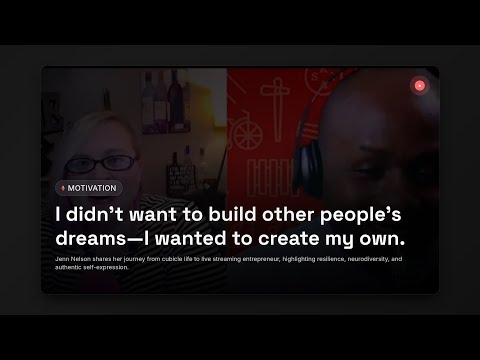
Jen Nelson didn't quit her federal job on a whim — she quit the day she went to HR, saw her real retirement numbers, and laughed at them.
From Cubicle to Creator: Jen Nelson’s Inspiring Leap to Entrepreneurial Freedom
On this episode of Hustle Zone, host Ryan sat down with Jen Nelson — the live streamer and entrepreneur behind Wine Antics, and a co-organizer of the upcoming Ladies Go Live virtual summit — for a conversation that traced an unusually winding road from a federal cubicle to building her own thing.
“I hated working in a cubicle. I mean, it’s just that simple.”
Asked how she became an entrepreneur, Jen didn’t dress it up. She’d held a federal job and hated the cubicle life, and getting away from it meant going out on her own. But the seed was planted long before any office job. As a kid, she bought sun-catcher craft kits and went door-to-door in her neighborhood trying to sell them, on top of running the classic childhood lemonade stand. She credits her mother, who repeatedly tried to start her own businesses and “romanticized” the idea of entrepreneurship for Jen — not because she was a wildly successful business owner, but because she kept trying, which made the notion of being your own boss feel attainable rather than out of reach.
College, the military, and a war that changed the plan
Jen joined the Army at 17 in 1999, before 9/11, in what she describes as a peacetime military — the classic “serve your time, come out ahead” arrangement that would pay for college she otherwise couldn’t afford. That calculus changed when she was in the initial invasion of Iraq and got stop-lossed, compressing what should have been a six-month transition out of the service into about a month. She says she couldn’t go back to being the person she was before the deployment, so she packed up her Mustang, moved to DC, and within two months was working as a federal contractor before moving into federal service with the Department of Defense. Looking back, she says she wouldn’t change the decision to enlist, and she argues some form of civil service — not necessarily military, but options like being a firefighter, EMT, or nurse — should be expected of young people coming out of high school, pointing to South Korea’s mandatory service model as an example.
The retirement projection that made her laugh out loud
By 2007, Jen says she’d grown to dislike the rigidity of federal work — feeling typecast, boxed in, unable to move between roles the way she wanted to. She started preparing for a change, and by 2013 or 2014 she hit a real crossroad: push for management, or find a way out. She went to HR to check her retirement projections at the ten-, twenty-, and thirty-year marks — and laughed at the numbers. That was the moment she decided to start a second career.
Getting bit by the wine bug
While working in Arlington and still stuck in what she calls a “cubicle maze” inside the Department of Defense’s defense-minded culture, Jen stumbled on a deal for wine certification classes through the Washington Wine Academy. She wanted to find a version of her work where people were happy to see her — and she found it pouring and talking about wine at festivals she volunteered for on her own time. She took a certification class and never looked back, eventually building Wine Antics — a name chosen deliberately so it could cover wine, beer, and spirits.
Getting there wasn’t smooth. Jen calls herself “a wine blogger who doesn’t like to blog” — she wrote a couple of posts and gave up on that format entirely, pivoting instead into live streaming on Periscope starting in November 2015. Her biggest ongoing challenge has been convincing the wine industry that live streaming is a legitimate form of content creation at all, fielding comparisons to vlogging and podcasting that she says don’t quite fit.
Partnerships, Ladies Go Live, and a bow tie
Jen met her production partner, Jonathan Tripp, on the live-streaming platform Blab. Her advice on picking collaborators: find someone doing something you admire or can’t do yourself, at a higher level than you, and adapt what works for them to fit you — rather than copying it outright.
More recently, Zeff San brought Jen into Ladies Go Live, a project that let her act on one of the four things she says she cares about most: live streaming and tech, being a veteran and veterans’ rights, and women’s issues. The Ladies Go Live summit — a fully virtual event run through two Facebook groups, with content available for 24 hours after airing — was set to launch that Friday, with registration through Eventbrite at ladiesgolive.com.
Jen was candid about the financial reality behind the leap: when she first started her business, her sister lent her a thousand dollars, because, as Jen put it, she wasn’t going to risk losing her house. Asked what she’d wish for with a magic wand, she said she’d want not unlimited money, but the mindset and skills to always be positioned to make it — security, on her own terms.
The interview closed on an unscripted note: Ryan surprised Jen on air with a wooden bow tie from Two Guys Bow Tie Co., a gift that visibly moved her and became one of the episode’s most memorable moments.
Lessons from this one
A parent's romanticized (not necessarily successful) example of entrepreneurship can be enough to make the idea feel attainable to a child.
Jen credits her mother, who repeatedly tried to start her own businesses and never quite succeeded, with 'romanticizing' entrepreneurship for her from a young age — making it feel like a desirable, reachable path rather than requiring an actual successful role model.
A concrete financial reality check can be the trigger that turns a vague 'someday I'll quit' into an immediate decision.
Jen describes going to HR to check her federal retirement projections at the ten-, twenty-, and thirty-year marks, laughing at what she saw, and deciding on the spot to start a second career.
No controlled study found for this specific claim — a genuine search (including for prospect-theory/loss-aversion research on job-quitting, and for entrepreneurship 'trigger event' literature such as Shapero & Sokol's displacement concept and Haynie & Shepherd's work on discontinuous career transitions) turned up related but not precisely matching research. This point reflects the guest's own lived experience, presented as such rather than as research-backed fact.
Choosing a business partner because they're better at something you admire — then adapting their approach rather than copying it — is a deliberate growth strategy, not luck.
Jen explains she partnered with Jonathan Tripp because he was doing something at a higher level than her, and her approach was to 'rip it to its fundamentals' and make it work for herself rather than imitate him outright.
New content formats often have to fight for legitimacy inside an established industry before they're accepted as real content creation.
Jen says the wine industry 'barely recognizes podcasting and vlogging' as legitimate content, and she repeatedly had to explain that her live streaming wasn't just vlogging or a podcast when people tried to categorize it.
A family financial safety net can be a decisive factor in surviving the unstable early phase of self-employment.
Jen recounts her sister lending her a thousand dollars when she first started her business, framing it as necessary support to avoid losing her house — alongside the savings she'd already set aside.
Sources
- Chlosta, S., Patzelt, H., Klein, S. B., & Dormann, C. (2010). "Parental role models and the decision to become self-employed: The moderating effect of personality." Small Business Economics, 38(1).
- Holcomb, T. R., Ireland, R. D., Holmes, R. M., & Hitt, M. A. (2009). "Architecture of Entrepreneurial Learning: Exploring the Link among Heuristics, Knowledge, and Action." Entrepreneurship Theory and Practice, 33(1).
- Suchman, M. C. (1995). "Managing Legitimacy: Strategic and Institutional Approaches." Academy of Management Review, 20(3), 571-610.
- Winborg, J., & Landström, H. (2001). "Financial bootstrapping in small businesses: Industry practices and knowledge base." Journal of Business Venturing, 16(3), 235-254.
- Runtime
- 47m
- Show
- HustleZone
- Host
- Ryan Perez
Been through something like this?
HustleZone is conversations with people who built something out of the thing that was supposed to stop them. If that is you, say so.