Embracing Vulnerability
How Diverse Leaders Build Trust & Community
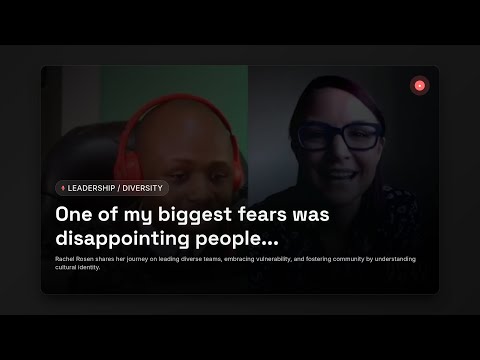
Rachel Rosen's students didn't start listening to her until she stopped pretending she had it all together and admitted, in tears, that she needed their help.
Embracing Vulnerability: How Diverse Leaders Build Trust & Community
On this episode of Hustle Zone, host Ryan Perez — founder of Bow Tie Kreative, the agency that donates free websites to entrepreneurs with disabilities — sat down with Rachel Rosen for a conversation that ran long, ran deep, and ended up being one of the show’s most personal yet.
Rachel introduced a phrase she said she’d coined only days before the interview: “holistic leadership.” Before that, she’d been calling her work executive coaching, or “executive coaching with a diversity lens,” but neither term fit. Holistic leadership, as she described it, is about seeing the whole person — recognizing that a leader’s story impacts their leadership, and their leadership impacts their story. She argued that leaders can collect credentials and resumes and still fail to build trust with their teams if they haven’t done the internal work of understanding their own identity and how it shows up in the room, especially for leaders navigating diverse teams during a moment she described as one of rising workplace tension.
Rachel’s own story started in Texas, where she was born after her family’s time in New York. Her parents divorced when she was ten — a moment she remembers as sudden and disorienting, arriving at what she thought was a family celebration for her sister leaving for college, only to learn her parents were splitting up. She described going numb, losing her voice for months, maybe years, and processing everything instead through journals and imagined worlds rather than out loud with anyone.
That early silence, she suggested, shaped the woman who later became a teacher. At 22, fresh out of a small liberal arts college where she studied Spanish and psychology, Rachel moved to the Bay Area and began teaching Spanish in East Oakland — a level of cultural difference she said she wasn’t prepared for. She’d been trained to “fake it till you make it,” to project control and hide vulnerability. It didn’t work. She described breaking down in front of a classroom of 32 students, admitting she didn’t know how to reach them and needed their help. That moment, she said, was the first time she took off a layer of what she called her “mask” — and it was the moment her students actually started listening.
The conversation’s most weighted moment came when Rachel talked about a former student named Javier, who called her “Auntie Tia” and was murdered in 2009. She described it as one of her deepest fears realized, and said it redirected the entire arc of her career — pushing her to become a middle school administrator at the feeder school near his old apartment, driven to understand why the education system was failing kids like him before it was too late to close the gaps.
From there, Rachel moved into work as a facilitator and coach for an educational nonprofit, focused on racial justice and helping leaders build genuine trust across difference. Alongside that work, she created Spark for Humanity, a card game she started sketching on index cards after a frustrating experience playing Cards Against Humanity and reading “Waking Up White” by Debbie Irving with her partner. The game, funded through a Kickstarter that hit its $4,000 goal, is built around the metaphor of fire — an invitation to slow down, sit together, and actually listen to each other’s stories.
Rachel was candid about the personal chapters that shaped this pivot too: her divorce, and later falling in love with a woman, which she said drew both support and hate mail, and led her to describe herself as pansexual rather than adopting a “coming out” narrative she felt didn’t fit her experience. She also spoke frankly about learning to value her own work financially, admitting it took real effort to move from just wanting to help people to confidently owning what her coaching and product are worth.
Ryan closed the episode, as always, with a few lighter questions — landing on kale salad, chocolate cake, Wonder Woman, and Michael Jackson over Prince — before thanking Rachel for a conversation he called one of the most fruitful the show has had, and reminding listeners that Hustle Zone exists to humanize entrepreneurs of every kind, whether they’re building products, building communities, or both.
Lessons from this one
Showing vulnerability as a leader can build trust faster than credentials or authority ever will.
Rachel described being taught to 'fake it till you make it' as a young teacher, only to find her classroom of 32 students disengaged and unreachable until she broke down in tears and admitted she didn't have it all together — a moment she says was the turning point in actually connecting with her students.
Leaders working across cultural difference need a raised, specific self-awareness of their own identity, not just general emotional intelligence.
Rachel opened the interview arguing that especially for white leaders leading diverse teams, understanding how your racial identity and personal story shape how others experience you is essential to building real trust and community.
Grief and personal loss can become the engine that redirects an entire career toward purpose.
The 2009 murder of her former student Javier, whom she describes as calling her 'Auntie Tia,' pushed Rachel to leave the classroom and become an administrator at his old feeder middle school, driven to understand why the education system fails students before it's too late.
Structured tools, like a card game with simple prompts, can lower the barrier to having hard conversations across difference.
Rachel built Spark for Humanity after a culturally insensitive experience with an existing party game, aiming to give people 'a little bit of structure and support' so they can talk about what matters instead of defaulting to small talk or online shouting matches.
Entrepreneurs, especially those from service backgrounds, often have to relearn how to charge what their work is worth.
Rachel described her steepest business learning curve as realizing she couldn't keep offering her coaching and product for free while going into debt to produce it, and that she had to do her own 'soul searching' about her money story before she could confidently claim her value.
Sources
- Brené Brown (2018), Dare to Lead: Brave Work. Tough Conversations. Whole Hearts., Random House
- Tervalon, M., & Murray-García, J. (1998), "Cultural Humility versus Cultural Competence: A Critical Distinction in Defining Physician Training Outcomes in Multicultural Education," Journal of Health Care for the Poor and Underserved, 9(2), 117-125
- Tedeschi, R. G., & Calhoun, L. G. (2004), "Posttraumatic Growth: Conceptual Foundations and Empirical Evidence," Psychological Inquiry, 15(1), 1-18
- Pettigrew, T. F., & Tropp, L. R. (2006), "A Meta-Analytic Test of Intergroup Contact Theory," Journal of Personality and Social Psychology, 90(5), 751-783
- Foong, E., & Gerber, E. M. (2021), "Understanding Gender Differences in Pricing Strategies in Online Labor Marketplaces," Proceedings of the 2021 CHI Conference on Human Factors in Computing Systems (CHI '21)
- Runtime
- 1h 25m
- Show
- HustleZone
- Host
- Ryan Perez
Been through something like this?
HustleZone is conversations with people who built something out of the thing that was supposed to stop them. If that is you, say so.