
From Losing Everything to Entrepreneurial Success
Dan the Waterman’s Story
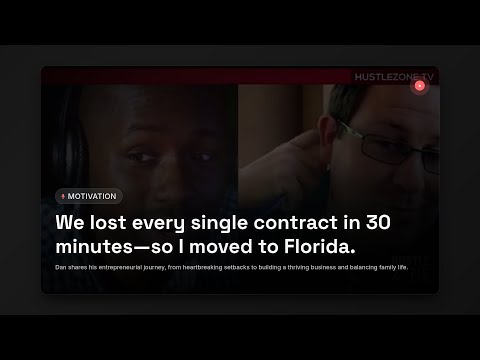
Dan's food-delivery empire didn't fail because the idea was bad — it collapsed in thirty minutes because he'd built it on employees who valued a Friday-night party over 98 deliveries, and no contract clause could protect against that.
From Losing Everything to Entrepreneurial Success: Dan the Waterman’s Story
Some entrepreneurs plan their path for years. Dan — known to his audience as “Dan the Waterman,” owner of Water Filter Warehouse — built his the way most real founders do: by getting knocked down, standing back up, and doing it again. He joined Ryan Perez on Hustle Zone TV to walk through a story that runs from selling candy bars in middle school to running a fast-growing water filtration company today.
Dan’s early hustle started small. Growing up as a military kid, his family moved around — Jersey, then Norfolk, Virginia for elementary and middle school, then the rural Eastern Shore of Virginia for high school. Along the way he sold Bubblicious bubble gum, candy bars, and Jolly Ranchers, whatever he could move. By high school, the hustle had scaled up: at 17, he and a friend (old enough to legally open the business) launched a restaurant food-delivery service and landed 18 contracts with 18 different restaurants — years before food delivery apps made that idea common.
That business was making real money — Dan says he was pulling in $2,500 to $3,000 a week at 17 — while he was also enrolled in college. Then came a moment that changed his trajectory: he asked one of his business professors how much he made. The answer was $80,000 a year. Dan quit school that same day, convinced he didn’t want to cap out there. He was, in his own words, happy for about a week — until the delivery business collapsed almost overnight. On a Friday with 98 deliveries booked, his entire fleet of driver-employees skipped work for a party instead, and the company defaulted on every restaurant contract in a matter of 30 minutes, triggering clauses that ended the relationships for good.
From there, Dan moved to Florida to join his father, who had spent 23 years in water treatment. What followed was a lesson in the difficulty of mixing family and business. Dan describes doing a large share of the work and bringing in significant revenue while being paid the least of anyone in the company — a dynamic he says is common when family members work together. His advice to anyone in that position: keep personal and business clearly separated.
Rather than launch out on his own immediately, Dan spent three years working for a major water filtration company first, deliberately filling in the gaps in his knowledge — installation, service, financing — skills he hadn’t needed as a salesperson. That groundwork let him eventually start his own company, Water Filter Warehouse, with modest means: a small loan from a friend, put entirely toward equipment he knew he could sell.
The results came fast. In its first three months, the company was already doing $80,000 a month in business. What started as Dan and one business partner has grown into a team of seven in the field, with three more finishing sales training and a projected $150,000 in December. Water Filter Warehouse now handles everything from shower and sink filters to whole-house filtration and reverse osmosis systems, serving residential customers, hospitals, and businesses — with thousands of customers nationwide, business reaching into Canada, and more than 100 five-star reviews. The company currently runs as a “virtual warehouse,” dropshipping online orders, though Dan says they plan to open a physical office by January for training and meetings.
Dan also talked candidly about family — he’s been married ten years and has four boys, ages seven, five, two, and eleven months, with his wife homeschooling two of the kids. He calls himself a workaholic and admits the juggling act is real, but says the arrangement works because he tries to protect weekends for family unless there’s a genuine emergency. He credits playing soccer and football growing up with shaping how he leads his team today — describing the business not as him being the boss, but everyone moving as “one unit,” with no room for anyone who needs constant babysitting.
He also opened up about starting his own interview show, Entrepreneur Boulevard, six months before this conversation — driven not by confidence but by a fear of being on camera that he wanted to push through. His first guest was Jeremy Rubin, “The Friendly Flipper.”
The conversation closed with a lightning round covering everything from pumpkin pie to Bitcoin to his son’s math skills — including a proud moment about his seven-year-old figuring out that a hundred $100 bills equals $10,000.
Dan’s story is less a straight line to success than a series of restarts — each one informed by what the last one taught him.
Lessons from this one
Deliberately working for someone else first can be the fastest way to prepare for going out on your own.
Before launching Water Filter Warehouse, Dan spent three years at a major water filtration company specifically to learn installation, service, and financing — skills he had as a salesperson but not as an operator. He frames this as knowing where your boundaries are before you start a business.
Mixing family and business without clear boundaries breeds resentment even when the business is doing well.
Dan describes doing a large share of the work and bringing in significant revenue while working for his father's water treatment company, yet being paid the least of anyone there — and explicitly advises separating personal and business relationships when working with family.
Scaling a business on unreliable, easily-replaceable labor creates hidden structural risk.
Dan's teenage food delivery company collapsed within about 30 minutes when his entire roster of delivery drivers chose a party over a Friday night with 98 orders booked, triggering contract-default clauses with all 18 restaurant partners at once.
No controlled study found for this specific claim — reflects the guest's own lived experience, presented as such rather than as research-backed fact. General academic literature on gig/contingent labor (e.g., turnover studies in the restaurant industry) addresses related workforce-instability effects but no source located matches this specific scenario of concentrated, simultaneous labor loss triggering cascading contract defaults for a small operator.
Deliberately doing the thing that scares you can be a legitimate strategy for professional growth.
Dan says he started his Entrepreneur Boulevard show specifically because he was terrified of being on camera and going live, treating the show itself as a way to force himself past that discomfort.
Team-sport experience can directly shape how founders structure accountability in their companies.
Dan credits playing soccer and football with instilling a team-first mentality he now applies at Water Filter Warehouse, describing the company as one unit where everyone has to hold their own weight rather than be managed like employees under a boss.
Sources
- Timothy Bates (1990), "Entrepreneur Human Capital Inputs and Small Business Longevity," The Review of Economics and Statistics, 72(4), 551-559.
- Franz W. Kellermanns and Kimberly A. Eddleston (2004), "Feuding Families: When Conflict Does a Family Firm Good," Entrepreneurship Theory and Practice, 28(3), 209-228.
- Thomas L. Rodebaugh, Robert M. Holaway, and Richard G. Heimberg (2004), "The Treatment of Social Anxiety Disorder," Clinical Psychology Review, 24(7), 883-908.
- Kevin M. Kniffin, Brian Wansink, and Mitsuru Shimizu (2015), "Sports at Work: Anticipated and Persistent Correlates of Participation in High School Athletics," Journal of Leadership & Organizational Studies, 22(2), 217-230.
- Runtime
- 47m
- Show
- HustleZone
- Host
- Ryan Perez
Been through something like this?
HustleZone is conversations with people who built something out of the thing that was supposed to stop them. If that is you, say so.