From Homeless to Hero
Dany Redwine's Unstoppable Journey of Healing & Success
"It's okay to not know where your future is going to be — what isn't okay is that you just give up on it."
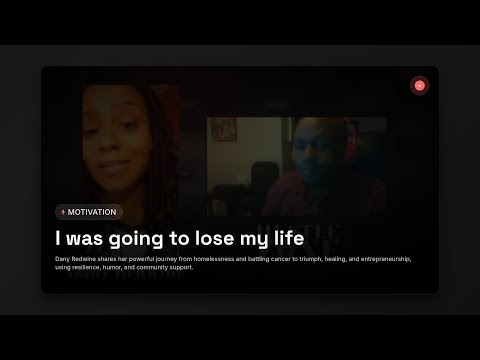
“# From Homeless to Hero: Dany Redwine’s Unstoppable Journey of Healing & Success\n\nHustle Zone\n\nSome guests arrive on the Hustle Zone with a pitch deck. Dany Redwine arrived with a story that took Ryan Perez’s breath away — literally. He opens the episode admitting he’d been scrolling Instagram and saw her crying after just finishing reconstructive surgery, and it hit him emotionally before she ever said a word on the show.\n\nDany is a breast cancer survivor who had just completed the final stage of a years-long reconstruction process — seven surgeries in total, the last one on November 1st. She walks through what most people never think about: a mastectomy isn’t one operation, it’s a series. Hers included a skin expander, an implant, fat grafting, and even liposuction on her lower back to harvest fat for symmetry. Four weeks out from the final surgery, still wearing a surgical garment and a little sore, she was, in her words, "claiming it" as the last one — and cancer-free.\n\nBut the cancer, she’s quick to say, wasn’t even the hardest part. At the time of her diagnosis, her marriage was failing, her firstborn son was tangled up with the wrong crowd and facing the judicial system, and she was the only brown woman in her corporate medical workplace, constantly ridiculed and questioned about who she was. Then her husband gave her an ultimatum — straighten up or get out — and she left. She became homeless, separated from her children, still carrying a skin expander in her chest, still in therapy, trying to hold everything together on almost nothing. She’s candid that there was a point she was depressed enough to think her kids would be better off without her, and a stretch of nearly six months where she simply stopped working and stayed in her apartment, unmotivated, because she’d given up.\n\nWhat turned it around wasn’t a single dramatic moment of triumph — it was a sunset. Driving down the highway after a bad day, she says something about the sky gave her "a sense of comfort" and a sense that she was going to be okay. That was when she started advocating publicly, giving interviews to newspapers and magazines, and sharing her story — and hearing back from people who told her it helped them too.\n\nComedy became part of that healing. Right after going cancer-free, she made a bucket list and finally tried standup — getting on stage with a skin expander still in her chest, padding her bra to look normal, and earning a standing ovation. She calls it "part of my therapy," a way to be honest about what she was going through without turning it into a sad story. Since then she’s crossed paths with names like Dave Chappelle, Cookie Hall, DC Young Fly, Trevor Houston, AJ Johnson and his brother Peanut, and DeNell Rollins, and is chasing 2017 opportunities with a comedy group headed to the Apollo, plus leads at the Comedy Store and the Laugh Factory.\n\nShe’s also an entrepreneur. Struggling with the seatbelt after her surgery, she rigged a homemade pillow to cushion it at home — a friend suggested she turn it into a real product, and with help from another friend who sews, she built a prototype and pitched it to a local investment group. She was selected in three days, which she notes is the fastest anyone had been pulled from the drawing, against a normal 30-day review window. The seed funding went fast covering material testing, legal fees, and a patent, and she’s since kept the product — called the Cushy — alive through sales at fundraisers and events while fielding interest from a company based in Florida.\n\nOn her relationship with her ex-husband, she’s blunt: there’s resentment from how things ended, and she has no interest in reconciling even though he’s made attempts, but they conduct themselves as adults, spend holidays and birthdays together with the kids, and keep old arguments away from their children.\n\nHer advice to women entrepreneurs afraid to start: you’re not going to know if you don’t try. Do the research, write the plan, network, and seek out local resources — she points to a Grand Rapids nonprofit that helps women start their own businesses as one example of support that exists for those willing to look for it.\n\nBy the end of the conversation, Redwine sums up her own arc simply: a story of hitting rock bottom and climbing her way back up — cancer, homelessness, depression, a failing marriage — while still building a comedy career and a product from scratch, and, for the first time in her life, feeling proud of herself for it.”
Lessons from this one
Comedy can double as therapy, not just performance.
Redwine says she started standup right after becoming cancer-free, getting on stage with a skin expander still in her chest, and describes it explicitly as 'part of my therapy' — a way to process what she was going through without framing it as a sad story.
Products born from a personal pain point can find a real market faster than expected.
The Cushy came from Redwine improvising a homemade seatbelt cushion during her own mastectomy recovery; a friend told her it was a sellable product, and she was selected by a local investment group in three days versus the normal 30-day review window.
Recovery from depression can hinge on a small, non-dramatic moment rather than one big turning point.
Redwine describes going nearly six months without working due to depression, and pinpoints her shift to a specific evening watching a sunset on the highway that gave her 'a sense of comfort,' rather than any therapy session or external event she names.
Co-parenting can function even when the romantic relationship ends in resentment.
Redwine says there's lingering resentment toward her ex-husband over the ultimatum that led to her homelessness, and no interest in reconciling, but they still spend holidays and birthdays together as a family and keep disagreements away from the kids.
Local, sector-specific nonprofits can be an underused resource for first-time entrepreneurs.
When asked what she tells women afraid to start a business, Redwine points specifically to a Grand Rapids nonprofit that helps women launch businesses, framing research and 'seeking out' these groups as a concrete first step rather than an abstract instruction.
Sources
- Tanay, M.A.L., Roberts, J., & Ream, E. (2013). Humour in adult cancer care: a concept analysis. Journal of Advanced Nursing, 69(9), 2131-2140.
- Zippel, C., & Bohnet-Joschko, S. (2017). Innovation for Safe and Effective Medical Devices: Contributions From Postmarket Surveillance. Therapeutic Innovation & Regulatory Science, 51(2), 237-245.
- Donaldson, S.R., Radley, A., & Dillon, J.F. (2023). Transformation of identity in substance use as a pathway to recovery and the potential of treatment for hepatitis C: a systematic review. Addiction, 118(3), 425-437.
- Lamela, D., Figueiredo, B., Bastos, A., & Feinberg, M. (2016). Typologies of Post-divorce Coparenting and Parental Well-Being, Parenting Quality and Children's Psychological Adjustment. Child Psychiatry & Human Development, 47(5), 716-728.
- Gabarret, I., & D'Andria, A. (2021). Improving gender equality through entrepreneurship: The role of women-dedicated business incubators. Journal of the International Council for Small Business, 2(2), 79-89.
- Runtime
- 45m
- Show
- HustleZone
- Host
- Ryan Perez
Been through something like this?
HustleZone is conversations with people who built something out of the thing that was supposed to stop them. If that is you, say so.