From Prison Roots to Plant Power
T Barb's Journey to Comedy Success
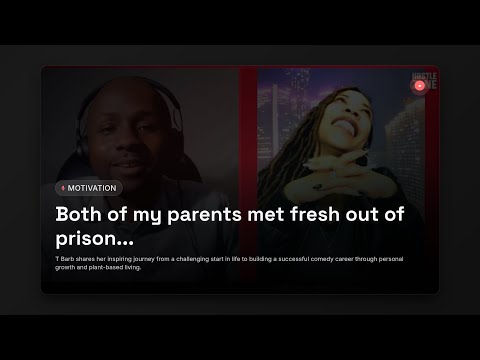
T Barb's core message is that you never have to stay where you start — coming from trauma doesn't disqualify you from building a different life, it just gives you a story worth telling.
From Prison Roots to Plant Power: T Barb’s Journey to Comedy Success
There’s a moment early in this Hustle Zone conversation where Ryan Perez introduces his guest as “a mother, comedian, entrepreneur, author, radio personality, a vegan chef” — and by the end of the episode, every one of those titles has earned its place.
T Barb — born Tiffany Barb — grew up on Joy Road in Detroit, a neighborhood she describes as rough, the kind other Detroiters know from rap references but few outsiders understand. Both of her parents met fresh out of prison, and her arrival marked the first real stretch of time either of them stayed out. She started smoking weed and cigarettes at age 11, not because anyone pushed her into it directly, but because it was simply the environment — adults in the neighborhood normalized it, and as she puts it, kids wanted to be adults because “it wasn’t popular to be a kid” anymore.
What makes her story land differently is the reflection she brings to it. She doesn’t paint her parents as villains — she describes them as products of their own unresolved trauma. Her mother aged out of the foster care system after entering it at two years old and was never shown what healthy parenting looked like. Her father carried his own generational wounds and later lost his kidneys when Tiffany was young, limiting how present he could be. “They were just doing the best that they could,” she says, while also noting that raising kids with zero structure and raising them with too much rigidity can both backfire.
That upbringing became the reason she went into social work. She became a first-generation college graduate, attending an HBCU in New Orleans after taking a Greyhound bus there alone from Memphis — a trip she still describes as one of her proudest accomplishments. She went on to earn an MBA and spent 14 years with the state of Michigan working in Children’s Protective Services, Adult Protective Services, and foster care. She talks candidly about the system’s chronic underfunding — foster families, she says, were still receiving the same daily reimbursement rate in 2019 that they received back in 2004 — and about the empathy gap she saw between caseworkers who came from the community and those who didn’t. Sometimes, she says, the difference between a family staying together and a child entering foster care was as small as buying groceries herself.
Comedy entered almost by accident. A coworker who did stand-up told her she was funny enough to try it, it was on her bucket list, and after one strong open mic she never stopped. Eventually she left her social work career behind entirely to pursue comedy, radio, and entertainment full time — and now has her first TV comedy special, “Getting Off,” releasing on Prime Video. She also wrote a short memoir, “Faith Over Fear: Tales of a Retired Hood Rat,” an 81-page book she says was inspired partly by a friend who told her nobody would want to hear her story — a comment she ultimately dedicated the book to disproving.
The conversation opens and closes on her plant-based lifestyle, which she frames less as strict veganism and more as an intentional, ingredient-conscious way of eating. It started as a spiritual Lent-style 40-day commitment, grew after watching the documentary “What the Health,” and solidified as she researched the environmental and health costs of commercial meat production. She’s now built “Hood Rat Kitchen,” a vegan cooking demo series aimed specifically at making healthier plant-based food approachable for people in her own community — without judgment toward those who still eat meat, including the meals she still cooks for her friends and family.
Through it all, she keeps returning to one idea: diversify everything you’re doing, because if one hustle slows down, another one carries you. Between the radio show, comedy bookings, the cooking series, general contracting, a hot dog cart, and raising her son, she jokes that she’s exhausted — but insists it’s necessary. And motherhood, she says, has been the thing that kept her out of real trouble, joking that her son deserves thanks for keeping her “free.”
By the end of the episode, Ryan Perez sums up what many listeners will likely feel: her path from Joy Road to a Prime Video comedy special isn’t just a hustle story — it’s proof, in her own words, that “you never have to stay where you start.”
Lessons from this one
Reframing a difficult identity label as a badge of growth rather than shame can be a powerful recovery tool.
T Barb deliberately calls herself a "retired hood rat" rather than avoiding the label, explaining it's about "embodying where I came from and acknowledging the growth" instead of hiding her past.
Parenting extremes on either end — total permissiveness or total rigidity — can push kids toward the same risky behaviors.
Both T Barb and Ryan independently observe that a total lack of structure led to early smoking and "hood rat" behavior, while T Barb also notes that overly strict parenting can backfire and cause kids to rebel toward the same outcomes.
Caseworkers and social workers who share lived experience with the communities they serve may make more empathetic, effective decisions than those who don't.
T Barb describes buying groceries herself rather than removing a child over lack of food, contrasting her approach with colleagues from more "privileged backgrounds" who she says apply rules "by the book" without understanding poverty.
No controlled study found for this specific claim (a genuine search of the peer-reviewed literature, including checks for research on caseworker-client lived-experience or racial/ethnic match effects on child welfare removal and substantiation decisions, did not turn up a study that isolates this effect) -- reflects the guest's own lived experience, presented as such rather than as research-backed fact.
Diversifying income streams and skills provides resilience when any single pursuit stalls.
T Barb lists radio hosting, comedy, a cooking demo series, general contracting, and a hot dog cart as simultaneous hustles, explicitly comparing it to "keeping five sources of income" as protection against losing any one of them.
Adopting a plant-based diet is often driven by a mix of health, spiritual, and environmental motivations rather than a single cause.
T Barb describes her shift starting as a spiritual 40-day sacrifice, reinforced by watching the documentary "What the Health," and later solidified by learning about water usage in meat production and antibiotic use in commercial farming.
Sources
- Ashforth, B. E., & Kreiner, G. E. (1999). "How Can You Do It?": Dirty Work and the Challenge of Constructing a Positive Identity. Academy of Management Review, 24(3), 413-434.
- Lamborn, S. D., Mounts, N. S., Steinberg, L., & Dornbusch, S. M. (1991). Patterns of Competence and Adjustment among Adolescents from Authoritative, Authoritarian, Indulgent, and Neglectful Families. Child Development, 62(5), 1049-1065.
- Throsby, D., & Zednik, A. (2011). Multiple job-holding and artistic careers: some empirical evidence. Cultural Trends, 20(1), 9-24.
- Fox, N., & Ward, K. (2008). Health, ethics and environment: A qualitative study of vegetarian motivations. Appetite, 50(2-3), 422-429.
- Runtime
- 46m
- Show
- HustleZone
- Host
- Ryan Perez
Been through something like this?
HustleZone is conversations with people who built something out of the thing that was supposed to stop them. If that is you, say so.