From Trauma to Triumph
Olympian Mom's Journey After a Harrowing Kidnapping
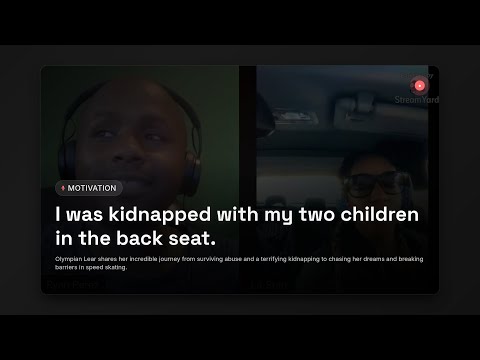
"Be your own superhero — don't wait for anybody else": the advice that took a survivor of a three-month kidnapping to an Olympic tryout.
From Trauma to Triumph: An Olympian Mom’s Journey After a Harrowing Kidnapping
Some episodes of Hustle Zone are fun. This one, hosted by Ryan Perez, is something else entirely — a conversation with a guest introduced simply as Lear: a single mother of three, a woman working three jobs, and one of only three Black women in the world competing in short-track speed skating at an elite level. She trains up to six days a week, sometimes two to four times a day, and is now pursuing a second Olympic sport, track cycling, alongside speed skating.
But the story underneath the athletic resume is what makes this episode land. Asked Hustle Zone’s standard opening question — “what is your story?” — Lear didn’t start with medals. She started with track and field, where she’d competed since ninth grade, running relay legs and posting a personal-best mile of 4:55. Then she explained why she walked away from the sport entirely: she was in an abusive relationship, one she describes as her first ever experience with abuse, involving physical, verbal, and psychological violence severe enough that she feared for her life — including an injury to her arm that changed color, which she thought might kill her.
The relationship ended in something far worse than a breakup. When she tried to leave, her partner held a knife to her throat and forced her to drive 18 hours, with her two children in the back seat, to a location she didn’t recognize. She was held for three months, beaten daily, and never allowed to hold her own phone or keys. Even bathroom stops were monitored — he stood outside the door so she couldn’t signal for help. She told Perez that thoughts of her children, not herself, were what kept her from trying to run, even in moments she believed she could physically outrun him.
She was eventually freed not by her own escape attempt but because the friend whose house they were staying at grew suspicious — noticing she wore the same outfit every day — and because his daughter had seen her being beaten through a bathroom door left ajar. That family called the police. In a strange coda, Lear later learned her abuser was arrested again after kidnapping another woman and her daughter using the identical method; the family that hadn’t believed Lear’s story the first time reached out to apologize.
Recovery, she said, involved therapy, a long stretch of depression, and what she describes as leaning heavily on prayer and faith — she noted she never turned to substances. From there, the conversation turns toward how she found speed skating: skating for fun at a regular rink, drawing attention from strangers who couldn’t understand why she was so fast, and eventually discovering short-track speed skating on television and deciding, almost on the spot, that she had to pursue it. She later learned she’d be one of only three Black women worldwide competing in the discipline.
The episode also touches on the attention that’s followed her rise, including a personal encounter with Dame Dash, who told her to “be your own superhero” — a line she returns to more than once. She’s candid about the volume of online negativity she receives, including people who’ve told her they hope she dies, and describes her method for handling it simply: “I do not receive it.”
Asked what she’d tell her younger self, she didn’t hesitate: don’t get married at 18. She did, had two children, and divorced six years later — advice she extends to young women broadly, encouraging them to build stability and self-worth before rushing into relationships. The interview closes with a rapid-fire lightning round (Sunday is her favorite day, Sacramento her favorite U.S. city, Michael Jackson over Prince) before she shares her competitive timeline: an April tryout, with track cycling aimed at the 2024 Olympics and speed skating targeting the 2022 Winter Games.
It’s a conversation that moves, without much transition, from one of the more disturbing survival stories Hustle Zone has aired to a genuinely uplifting profile of an athlete building something new out of what was left. Perez doesn’t try to smooth that over — he lets it sit exactly as heavy and as hopeful as it is.
Lessons from this one
Growth after trauma doesn't require the trauma to disappear — it can be channeled into intense, focused achievement.
Lear describes going from three months of near-daily abuse and a kidnapping to elite athletic training, explaining that she copes by 'zoning out' and focusing hard, treating athletics as the one area where she can control the outcome.
Disclosure of abuse is often met with disbelief, which can compound a survivor's trauma.
Lear says the people she first told about her kidnapping didn't believe her because the story 'sounded too fake,' and only believed her after her abuser kidnapped another woman the same way months later.
Leaving an abusive relationship is a dangerous, staged process rather than a single clean decision.
Lear explains that abuse victims often can't simply leave because of stakes like finances, children, and social networks that may side with the abuser — and in her case, the act of trying to leave is what triggered the kidnapping itself.
Representation in under-diversified sports carries meaning beyond the individual athlete's achievement.
Lear frames being one of only three Black women in the world competing in short-track speed skating as connected to broader visibility for Black athletes in sports, like cold-weather and swimming disciplines, where representation has historically been low.
Public visibility and success can invite disproportionate hostility, particularly for Black women in the spotlight.
Lear describes receiving frequent negative messages, including people telling her they hope she dies, and Perez draws a parallel to the scrutiny faced by other prominent Black public figures.
Sources
- Tedeschi, R. G., & Calhoun, L. G. (1996). The Posttraumatic Growth Inventory: Measuring the Positive Legacy of Trauma. Journal of Traumatic Stress, 9(3), 455-471.
- Ahrens, C. E. (2006). Being Silenced: The Impact of Negative Social Reactions on the Disclosure of Rape. American Journal of Community Psychology, 38(3-4), 263-274.
- Campbell, J. C., Webster, D., Koziol-McLain, J., et al. (2003). Risk Factors for Femicide in Abusive Relationships: Results From a Multisite Case Control Study. American Journal of Public Health, 93(7), 1089-1097.
- "Black-Free Zones: Black Athletes on the Clay and on the Court," in White Sports/Black Sports: Racial Disparities in Athletic Programs (2nd ed., 2024), Bloomsbury/ABC-CLIO.
- Bailey, M. (2021). Misogynoir Transformed: Black Women's Digital Resistance. New York University Press.
- Runtime
- 48m
- Show
- HustleZone
- Host
- Ryan Perez
Been through something like this?
HustleZone is conversations with people who built something out of the thing that was supposed to stop them. If that is you, say so.