From Setbacks to Stardom
Raven's Breakthrough Career Journey
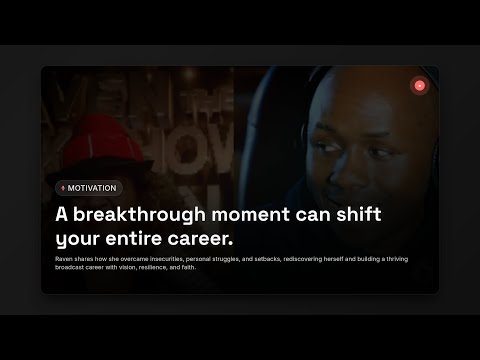
Raven's whole philosophy for getting through collapse — financial, marital, or emotional — comes down to one line she repeats: find whatever pushes you past your pain to your power.
From Setbacks to Stardom: Raven’s Breakthrough Career Journey
There’s a particular kind of energy that comes through when someone has genuinely lived every word of their own advice, and that’s exactly what showed up on this episode of Hustle Zone. Host Ryan welcomed Raven — known to her audience as “the talk show maven” — a Cleveland-born interviewer whose guest list includes Russell Simmons, Montel Williams, Jack Canfield, Les Brown, Lisa Nichols, Fran Drescher, and Brendon Burchard, among others. But the conversation spent far less time on the celebrity roster than on what Ryan calls “the story leading up to the glory.”
Raven’s story starts in East Cleveland, where she attended Shaw High School, got into her share of fights, and describes herself as a genuinely angry kid raised by strict parents. She later became, in her own words, a “huge introvert” — scared to speak up, shaped by relationships where she says she was expected to “sit there, look cute, don’t say nothing.” She tried modeling, wasn’t tall enough by industry standards, and instead built her own fashion and production troupe, Raven Blair and A Touch of Class Models — an early example of what would become a pattern: when a door closes, she builds one.
The real turning point, by her own account, didn’t arrive until she was 55. She traces it to a hospital hallway — Methodist Hospital in Houston, Texas, where her mother spent three weeks in the ICU. Sitting there, Raven was listening to a course by Alex Mandossian when she heard him say that the quickest way to become an expert is to interview other experts. That single line reoriented her. She started researching podcasting from the hospital’s front desk after visiting hours, built a vision board, and began reaching out to people she admired — including actress Jane Kennedy, whom she cold-emailed after finding a possible relative online. Four weeks later, Kennedy wrote back.
The path from there wasn’t smooth. Raven describes a marriage collapsing around her at the same time her show was gaining traction — sticky notes on her computer about divorce, a string of in-law deaths clustered eerily around the same date each month, and an eviction notice giving her family 21 days to act. Rather than fold, she called a friend who flew in to help her build a course virtually overnight. Nine people signed up at $297 each — and by her telling, the total matched, almost to the dollar, what she needed to stop the foreclosure.
She’s also candid about darker moments — describing a period during an emotionally abusive marriage where she sat in a closet contemplating suicide, and a separate low point in her sixties after a divorce and her mother’s death, when she says she “wanted to give up” before deciding she’d rather “soar.” Her language for getting through it is simple and repeated throughout the conversation: she looks for whatever pushes her “past my pain to my power” — prayer, motivational recordings, gospel playlists, and dancing.
Professionally, Raven’s central pitch to Ryan’s audience is a mindset shift she calls becoming a “talk show preneur” rather than a talk show host — treating interviewing as a business with real systems, not a hobby. She walked through pieces of her own methodology, including what she calls the “Icon Interview Formula” and a “Trinity” process for turning guest appearances into bookings and, eventually, paying clients. Her stated pet peeve: hosts who pour real time and money into their shows but never ask guests to pay for the exposure they’re providing.
Recognition has followed the work — Raven mentioned multiple “Rockstar” awards from her radio home, Amazing Women of Power (which she says reaches an audience of 4.7 million on iTunes radio), a Giant Community Award, and a Barack Obama Presidential Lifetime Achievement Award she says arrived after a nomination process she initially assumed was a scam.
By the end of the episode, Ryan sums up the throughline: it wasn’t luck or “pixie dust” that got Raven in front of the guests she’s interviewed — it was staying focused, treating the work seriously, and refusing to let the introvert in her stay quiet forever.
Key takeaway: Raven’s advice for surviving collapse — financial, marital, or emotional — boils down to one repeated phrase: find whatever pushes you past your pain to your power.
Lessons from this one
Financial crisis can be the forcing function that finally turns a hobby into a real business.
Raven describes facing eviction within 21 days while her marriage was collapsing, and responding by calling a friend to help her build a course almost overnight. Nine buyers at $297 each covered, by her account, the exact amount needed to stop the foreclosure.
A specific, clearly defined ask — to a person or to a partner — gets a very different response than a vague one.
Raven says she cold-emailed actress Jane Kennedy after finding a possible relative online and got a reply within weeks, and separately describes writing an explicit list of what she wanted (and didn't want) in a partner before meeting her current husband.
Career reinvention isn't confined to early adulthood — a long-dormant dream can resurface and take off later in life.
Raven says her radio dream began at 13 when she snuck into a Cleveland radio station, but 'life happenings' shrank it until it found her again at 55 in a hospital ICU waiting room, leading to a full second career as an interviewer.
Self-identifying as an introvert doesn't prevent someone from succeeding in a highly public-facing role.
Raven repeatedly calls herself an introvert who needs to recharge alone and gets uncomfortable with live streaming, while also being, by her own description, energetic and commanding on air — she calls herself 'a forced extrovert when I have to be.'
Naming and charging for the value you provide (shifting from 'hobby' framing to 'business' framing) changes how people treat the work.
Raven describes her shift from thinking of herself as a talk show host to a 'talk show preneur,' and says her biggest pet peeve is watching hosts do great work but never ask guests to pay for the platform and exposure they provide.
Sources
- Baker, T., & Nelson, R. E. (2005). Creating Something from Nothing: Resource Construction through Entrepreneurial Bricolage. Administrative Science Quarterly, 50(3), 329-366.
- Gollwitzer, P. M., & Sheeran, P. (2006). Implementation Intentions and Goal Achievement: A Meta-Analysis of Effects and Processes. Advances in Experimental Social Psychology, 38, 69-119.
- Azoulay, P., Jones, B. F., Kim, J. D., & Miranda, J. (2020). Age and High-Growth Entrepreneurship. American Economic Review: Insights, 2(1), 65-82.
- Zelenski, J. M., Whelan, D. C., Nealis, L. J., Besner, C. M., Santoro, M. S., & Wynn, J. E. (2013). Personality and Affective Forecasting: Trait Introverts Underpredict the Hedonic Benefits of Acting Extraverted. Journal of Personality and Social Psychology.
- Kadile, V., & Biraglia, A. (2020). From Hobby to Business: Exploring Environmental Antecedents of Entrepreneurial Alertness Using fsQCA. Journal of Small Business Management.
- Runtime
- 57m
- Show
- HustleZone
- Host
- Ryan Perez
Been through something like this?
HustleZone is conversations with people who built something out of the thing that was supposed to stop them. If that is you, say so.