From Trauma to Triumph
Jamie Lynn's Authentic Journey of Faith, Resilience & Love
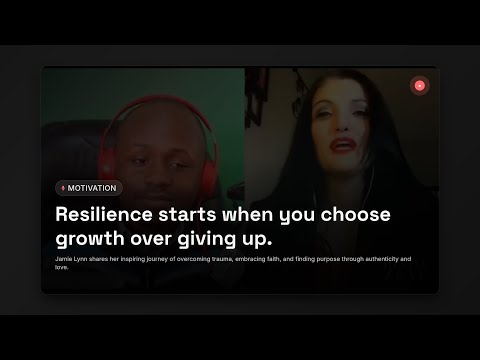
Jamie Lynn said she would go through everything she's ever endured — the rape, the sexual abuse, the physical abuse — all over again if it meant just one person found their way to faith because of her story.
From Trauma to Triumph: Jamie Lynn’s Authentic Journey of Faith, Resilience & Love
Ryan Perez opened this episode of Hustle Zone the way he opens most of them — talking directly to his community, checking in on a personal fitness challenge, and reminding viewers why he does the show at all: to “humanize the entrepreneur” by getting past the polished highlight reel and into the real habits and choices that shape a person’s path. Midway through the episode, a short video segment also featured Michael D. Haynes, a motivational speaker and client of Ryan’s company, Bow Tie Kreative, which donates websites to entrepreneurs with disabilities — an initiative Ryan says is personal to him because he himself has dyslexia.
But the heart of this episode belonged to his guest, Jamie Lynn, an author and self-described minister whom Ryan introduced as someone who “lights you up” without ever seeming like she’s been through very much. As Jamie put it herself early in the conversation: “I don’t look like what I’ve been through.”
What she’s been through is a lot. Jamie described being physically and sexually abused as a child, including being raped at age five. She and her siblings were removed from her mother’s care around age ten, returned home, then removed again after her mother became physically abusive — leading to a group home and a string of foster placements. By eighteen she was pregnant and had an abortion; at nineteen she became pregnant again and placed that daughter for adoption; at twenty she had her son. Not long after, she spent four years stripping, with the final year marked by drug and alcohol use and two suicide attempts. At twenty-five, deep in addiction, she became pregnant again and had another abortion.
The turning point, she said, came during a visit to Omaha, Nebraska, where she witnessed her cousin Brandy being beaten by a group of people — an experience she called one of the most horrific things she’d ever seen. It pushed her to a breaking point. She went home, looked up “pain” in the index of a Bible, landed on a passage in Jeremiah, and gave her life to her faith. She’s since written two books about the journey — “Diamond in the Rough,” which she said deals candidly with her post-conversion struggles, including a marriage she says she shouldn’t have entered and a return to drinking that led to a DUI and strain with her older daughter — and a shorter devotional titled “Encouragement Matters.” She also has a five-page contribution in a book called “Leading Ladies” covering her childhood story.
One of the most striking parts of the conversation was Jamie’s insistence that faith didn’t erase her struggles overnight. She pushed back on the idea that getting “saved” means sins are simply wiped away: real change, she said, is a “surrender” that happens gradually, not all at once, and backsliding into old comfort zones is often misunderstood — she framed it as part of progression rather than failure.
She also spoke emotionally about the daughter she placed for adoption as a teenager. Through an open adoption, she was able to see her a couple of times in early childhood before losing touch when the family moved, and the two have since reconnected — a relationship Jamie described as something she’s deeply grateful for today, joking that the two of them look more like sisters than mother and daughter.
On entrepreneurship, Jamie’s advice was simple: find what actually works for you rather than copying someone else’s routine, keep a small circle of positive people, and refuse to spend energy on negativity. She traced her public speaking back to recording short videos on her phone years before Facebook Live existed, saying her very first video pulled a thousand views in three days.
The episode closed on a lighter note, with a rapid-fire round covering favorite foods (Mexican), favorite era of music (old-school hip-hop and R&B), Michael Jackson over Prince, and a hypothetical trip to Paris and Africa. Jamie also shared, without much filter, what she wants played at her own funeral one day — “Don’t Worry, Be Happy,” not a somber hymn — a fitting note for someone whose whole conversation with Ryan circled back to one idea: that going through hardship doesn’t have to be the end of the story.
Lessons from this one
Outward composure can mask a history of severe trauma, so appearances shouldn't be mistaken for someone's actual story.
Ryan opens by noting Jamie 'doesn't appear' to have gone through much, and Jamie herself says 'I don't look like what I've been through' before describing childhood sexual abuse, foster care, addiction, and two suicide attempts.
A single witnessed traumatic event can serve as the catalyst that finally pushes someone toward lasting behavioral change.
Jamie identifies watching her cousin Brandy get beaten as the specific moment she decided to change her life and turn to faith, rather than any single point during her years of drug use or stripping.
Committing to change (religious or otherwise) is typically a gradual process with setbacks, not an instant transformation.
Jamie explicitly rejects the idea that getting 'saved' means sins are immediately gone, describing her continued drinking and a later DUI as part of a process of 'surrender' rather than proof the change wasn't real.
Open adoption arrangements can preserve the possibility of a meaningful relationship between birth parent and child later in life.
Jamie describes placing her daughter for adoption as a teenager through an open adoption, losing contact for years after the family moved, and later reconnecting into what she calls a close relationship today.
Sources
- Tedeschi, R. G., & Calhoun, L. G. (1996). The Posttraumatic Growth Inventory: Measuring the positive legacy of trauma. Journal of Traumatic Stress, 9(3), 455-471.
- Teruya, C., & Hser, Y.-I. (2010). Turning points in the life course: Current findings and future directions in drug use research. Current Drug Abuse Reviews, 3(3), 189-195.
- Miller, W. R. (2004). The phenomenon of quantum change. Journal of Clinical Psychology, 60(5), 453-460.
- Prochaska, J. O., & DiClemente, C. C. (1983). Stages and processes of self-change of smoking: Toward an integrative model of change. Journal of Consulting and Clinical Psychology, 51(3), 390-395.
- Grotevant, H. D., McRoy, R. G., Wrobel, G. M., & Ayers-Lopez, S. (2013). Contact between adoptive and birth families: Perspectives from the Minnesota/Texas Adoption Research Project. Child Development Perspectives, 7(3), 193-198.
- Runtime
- 57m
- Show
- HustleZone
- Host
- Ryan Perez
Been through something like this?
HustleZone is conversations with people who built something out of the thing that was supposed to stop them. If that is you, say so.