
Hans Lundgårde’s Inspiring Journey: Empowering Artists Through Music & Resilience
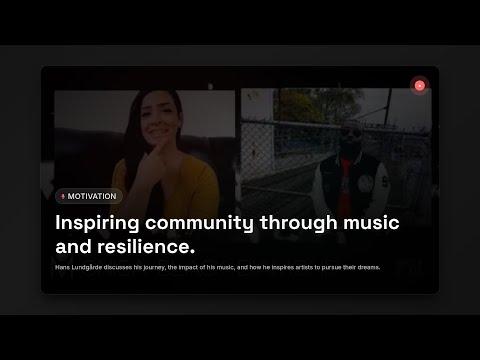
As Hans Le Bo put it, if you don't like your life, change it — starting with who and what you surround yourself with.
Hans Lundgårde’s Inspiring Journey: Empowering Artists Through Music & Resilience
The Monica Black Diamond show returned to a familiar face this week, welcoming back musician Hans Le Bo — known to fans as Kinghaz — for a catch-up episode built around one question: how’s the journey going since we last talked?
Monica opened by reminding viewers that this wasn’t Hans’s first time on the show. The two have an established rapport, and she framed the episode as a chance to “update” on where he’s landed since their last conversation left him, as she put it, “right at the tip” of a turning point. True to podcast form, the stream hit a rough patch of connection issues early on — enough that the show cut to a commercial break to sort out the audio — but once Hans was back, the conversation picked up right where it left off.
For anyone catching up for the first time, Hans reintroduced himself: a 23-year-old musician, artist, producer, singer-songwriter, and arranger currently living in East Orange, New Jersey. He gave credit up front — to God, to his team Trifecta, and to his manager Adler Nicholas — before diving into what’s been happening.
The headline news: Hans and his team recently sat down for a meeting at Def Jam Records, inside the UMG building in New York. A follow-up meeting is in the works, tied to his current single “Counting Blessings,” which is out now on YouTube, SoundCloud, and Spotify. He and his manager have been personally reaching out to DJs to build momentum, and he’s submitted the track to Hot 97, the New Jersey radio station, hoping it catches on there too.
Hans also opened up about a more personal record, a song called “Conqueror.” He explained that it came out of a real period of struggle — not with circumstances, but with believing in himself. “There was a point in my life where I was going through a battle,” he said, describing a stretch where his confidence and sense of his own potential were shaky. Writing the song became a way to work through that and, in his words, to remind listeners that “whatever you go through in life you got to keep going.” He referenced the opening line — that life has its ups and downs, and the point is to get back up when it knocks you down. He’s planning a live video for the song, bringing in a group of background vocalists for what he described as a small passion project still coming together.
Beyond the music, Hans talked about his role at his church, where he serves as band and music director. He described mentoring kids there, encouraging them to keep God first and chase their dreams regardless of what anyone else says is possible. He was candid about his own path to that mindset, saying he used to be surrounded by negative people and negative thinking, and that changing his surroundings changed how he saw things. “If you don’t like your life, change it,” he told listeners, tying it back to a broader point about self-improvement starting with the individual.
The conversation also turned personal when Monica brought up the music video for “Counting Blessings,” pointing out that Hans’s father appears briefly in it. Hans lit up talking about his parents — his mother, Evelyn Genty, and his father — thanking them for their support and guidance even through the moments where, as he put it, they “butt heads.” He and Monica spent a few minutes on the idea that artists don’t need validation from their parents or anyone else to keep moving forward, while still respecting family for who they are.
The episode closed on a lighter note: Hans confirmed he’s planning to visit Canada, likely in December, with talk of connecting with other artists and DJs while he’s there — Monica mentioned hopes of also getting to BC and Toronto. Hans left listeners with his social handles, built around the name Kinghaz across Instagram, Twitter, and Facebook, along with a personal Facebook page and a Kinghouse Music page, and an open offer to help anyone who reaches out with music or equipment advice.
It was a low-key, friend-to-friend check-in more than a formal interview, but the throughline was clear: a young artist balancing a major-label conversation with grassroots hustle, a personal song about self-belief, and a steady commitment to giving back through his church community.
Lessons from this one
Changing your surroundings can change your mindset.
Hans said he used to be around negative people and negative mindsets, and that changing his surroundings changed his circle and the way he thought, leading him to tell friends and coworkers to change their lives if they're unhappy rather than stay miserable.
Turning personal struggle into art can help both the creator and the listener process pain.
Hans described his song 'Conqueror' as coming from a real period of self-doubt and lack of confidence, written specifically to inspire listeners going through hardship to keep going and overcome their challenges.
Mentoring youth through a shared craft can reinforce a mentor's own sense of purpose.
Hans serves as band and music director at his church, where he tells kids to keep God first, chase their dreams, and follow their own heart rather than let others dictate what's possible for them.
Letting go of the need for outside validation, even from parents, supports an artist's growth.
Hans and Monica discussed that parents and others may not always understand an artist's chosen path, and agreed that seeking validation from other people can hold someone back from moving forward in life.
Grassroots promotion still matters even after a major-label meeting.
Despite a recent meeting at Def Jam/UMG, Hans and his manager were still personally emailing DJs and had submitted 'Counting Blessings' to Hot 97 to build the song's momentum.
Sources
- Fowler, J. H., & Christakis, N. A. (2008). Dynamic spread of happiness in a large social network: longitudinal analysis over 20 years in the Framingham Heart Study. BMJ, 337, a2338.
- Aalbers, S., Fusar-Poli, L., Freeman, R. E., Spreen, M., Ket, J. C., Vink, A. C., Maratos, A., Crawford, M., Chen, X. J., & Gold, C. (2017). Music therapy for depression. Cochrane Database of Systematic Reviews, 11, CD004517.
- Deane, K. L., Bullen, P., Williamson-Dean, R., & Wilder, K. (2023). The benefits of participating in a culturally translated youth mentoring program and service-learning experience for Aotearoa New Zealand mentors. Journal of Community Psychology, 51(8), 3366-3384.
- Ryan, R. M., & Deci, E. L. (2000). Self-determination theory and the facilitation of intrinsic motivation, social development, and well-being. American Psychologist, 55(1), 68-78.
- Hracs, B. J. (2012). A creative industry in transition: The rise of digitally driven independent music production. Growth and Change, 43(3), 442-461.
- Runtime
- 31m
- Show
- Monica Black Diamond
- Host
- Ryan Perez
Been through something like this?
Monica Black Diamond is conversations with people who built something out of the thing that was supposed to stop them. If that is you, say so.