
Inside Uruguay's Artistic Soul: Monica & Hugo on Passion, Culture & Colonia Suiza
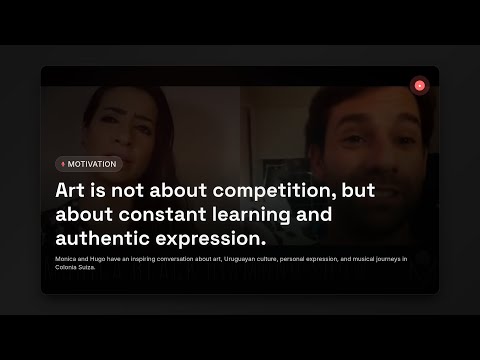
Hugo's guiding principle for artists: "You have to compete with yourself" — not with other musicians chasing the same trends.
Inside Uruguay’s Artistic Soul: Monica & Hugo on Passion, Culture & Colonia Suiza
There’s a moment early in this episode of Monica Black Diamond’s Hustle Zone TV show where the tech just won’t cooperate. Monica and her guest, the Uruguayan singer and actor Hugo, try to connect through a computer, give up, and end up doing the whole interview on their cell phones instead. It’s a fitting, unpolished start to a conversation that turns out to be less about production value and more about two artists genuinely enjoying each other’s company.
Monica opens by explaining what her show is really about: giving a platform to artists — established or “starving” — who want to share their story. “There’s nothing more beautiful than sharing each other’s stories,” she says, framing her circle of featured artists as family. Hugo, she tells her audience, is exactly that kind of find: a kind person with a great story.
Hugo takes it from there, describing himself first as a singer and actor from Uruguay — “this little tiny place in the world,” sandwiched between Argentina and Brazil, with a population he estimates at somewhere between three and four million. He walks Monica and her viewers through a quick tour of home: Montevideo, the capital, where most of the country’s people are concentrated; Colonia, which he calls beautiful and historic; and Colonia Suiza specifically, a spot near Colonia founded generations ago by Swiss settlers — hence the name — now known for producing the country’s most famous cheese. He also talks up Punta del Este’s beaches and what he describes as the distinctly European feel of the region, comparing Uruguayan cinema to French and Italian film.
Asked to describe himself, Hugo doesn’t pick a single word — he picks a stone full of colors. “Sometimes I’m a black diamond, sometimes I’m a white diamond, sometimes I’m a red diamond” (angry), and sometimes, he adds, a blue diamond. It’s Monica who lands on the phrase that seems to stick: a “color diamond.”
From there the conversation moves into his musical origin story. Hugo was born in Montevideo; his mother is from Minas and his father from Canelones. He’s 36, has three siblings, and spent time living in Argentina — as a child and again for about five years as an adult — where he recorded music with a friend who produces and plays guitar. He remembers being six or seven at a birthday party, lip-syncing along to a pop song on a makeshift stage, and thinking, this is what I want to be. In his 20s he had a band called Foxy Business, singing entirely in English even though the name wasn’t his choice. When he later went solo, he made a deliberate decision to write and sing in English rather than Spanish.
His first song as a solo artist, “Someone in the Sky,” came out of grief — he wrote it while walking to work, thinking about his father, who had passed away eight years earlier. Another song, “Good Liar,” came out of a breakup. Hugo describes songwriting as something that can’t be forced — sometimes months pass without a new song, and then an emotionally intense week produces several at once. Midway through the episode, he picks up his phone, repositions it, and performs “Someone in the Sky” live for Monica’s audience.
He also talks about the venues where he’s been performing, and about covering artists ranging from Argentine rock to Isaac Gracie, Gabrielle Aplin, Ben Howard, Oasis, The Beatles, The Clash, and Bowie. On the question of chasing more popular styles to gain a bigger audience, Hugo is firm: you have to stay true to yourself rather than perform music that isn’t really yours.
When Monica asks what advice he’d give to “starving artists,” Hugo’s answer centers on study, practice, and confidence — and on competing with yourself rather than with other people. On fame specifically, he argues you have to be ready for it and have something to say before it arrives, rather than wanting the title without the work behind it.
Hugo mentions he’s also an actor, with a recurring comedic character he performs on weekends, and that he can be found across Instagram, Facebook, Twitter, Spotify, Apple Music, and SoundCloud, with four songs out and more on the way. The episode closes with Monica thanking Hugo warmly, promising his links in the comments, and reminding viewers to subscribe to Hustle Zone TV to keep catching these conversations live.
Lessons from this one
Staying true to your own artistic style matters more than chasing whatever is popular.
Hugo says he won't perform music styles that aren't his own, using the example of a folklore singer being asked to do rock (or vice versa) — you have to be true to yourself even if a different style might reach more people.
Art can be a direct outlet for processing grief and emotional upheaval.
Hugo describes writing his first solo song, 'Someone in the Sky,' about his father's death eight years earlier while walking to work, and says intensely emotional weeks produce bursts of songwriting while calmer periods produce none.
Framing creative growth as self-competition rather than competition with peers supports sustained motivation.
When Monica asks about competition among Uruguayan artists, Hugo says the real work is competing with yourself, not others, and both agree confidence in one's own path is what shows through.
Aspiring to fame without first building the substance to justify it is backwards.
Hugo argues you have to 'work for' fame and be ready with something to share before it arrives — comparing it to being offered a Hollywood role without ever having learned to act.
Small, lesser-known places can carry an outsized cultural and artistic identity.
Hugo describes Uruguay as tiny in population yet rich in distinct regional character — from Colonia's Swiss-founded settlement Colonia Suiza and its cheese-making history to Punta del Este's European feel — and notes Uruguayan cinema's European stylistic influence.
No controlled study found for this specific claim — reflects the guest's own lived experience and observation of his home country, presented as such rather than as research-backed fact. (Searched Wikipedia's cultural nationalism, small state, island studies, and Cinema of Uruguay articles, and Godfrey Baldacchino's island-studies bibliography, without finding a peer-reviewed source specifically supporting 'small population, outsized distinct cultural identity' as a general finding.)
- Runtime
- 59m
- Show
- Monica Black Diamond
- Host
- Ryan Perez
Been through something like this?
Monica Black Diamond is conversations with people who built something out of the thing that was supposed to stop them. If that is you, say so.