
How Education Transformed My Life
From Immigrant to Entrepreneur in Canada
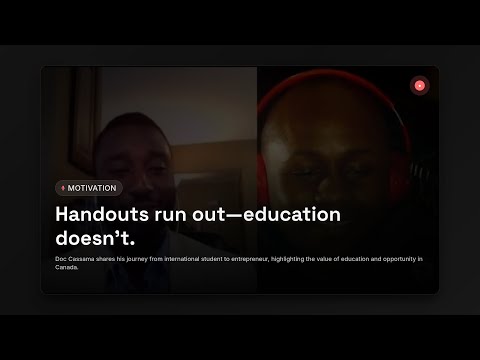
As Doc puts it on the show, give someone money or food and they'll always come back for more, but educate them and they gain the knowledge and hope to get things done on their own.
How Education Transformed My Life: From Immigrant to Entrepreneur in Canada
On this episode of the Hustle Zone, host Ryan Perez sits down with a 25-year-old entrepreneur known on the show simply as “Doc” — a nickname with a real story behind it. Doc explains that his parents named him after his uncle, a well-known doctor back home in Gambia, hoping he’d follow the same path. He hasn’t become a physician, but as he tells Perez with a laugh, “you should never say never.”
Doc’s own path took him across three continents before he ever built a company. Born in Gambia, he moved to Sweden as a child, where — in a country where soccer and hockey dominate — he discovered a passion for American football instead. That early talent turned into a scholarship at the University of Calgary, where he played for the Dinos, tried out with the Green Bay Packers, and ultimately chose business over a pro football career. Along the way he earned a communications degree, drawn to public speaking and what he calls “impacting people.”
It was at the University of Calgary, in his second or third year, that mentors took him under their wing and introduced him to entrepreneurship. They handed him books he says changed his life — Napoleon Hill’s Think and Grow Rich, The Richest Man in Babylon, and titles by leadership author John Maxwell among them. He credits that reading, combined with mentorship, with helping him figure out what he actually wanted out of life.
That personal journey now underpins Education Solutions Canada (ESC), the company Doc built in partnership with Ryan Perez, who designed and built the site itself. ESC lets students — Canadian or international — create a single profile and apply to multiple Canadian universities and colleges at once, without paying separate application fees to each school. “We want to save the student time… and secondly we want to save you money,” Doc says, describing the two priorities behind the platform.
He walks through the practical realities of studying in Canada: international students can expect tuition of roughly $12,000 to $30,000 a year depending on the program, plus about $10,000 in living expenses, while Canadian students pay closer to $5,000–$6,000 a year in tuition with similar living costs. He notes Canada’s prices compare favorably to traditional study-abroad destinations like the US, UK, and Australia, and that students are allowed to work while they study, which he did himself. ESC also gives out its own scholarship to a student starting studies in Canada and helps direct applicants toward government scholarships many don’t know exist.
Running ESC alongside Doc are two other directors: Barbara Cox, the company’s vice president, whom he describes as bringing deep business experience from a different background than his own, and Sandra Wig, who has spent years working with universities and understands the struggles both domestic and international students face when applying.
The conversation circles more than once around the value of education itself — a debate Perez raises directly, referencing voices like Robert Kiyosaki who argue formal education isn’t necessary for entrepreneurial success. Doc’s answer is more nuanced: the real question isn’t whether to pursue education, but whether you go in knowing what you want out of it. “Knowledge is only powerful if you use it,” he says. Having traveled through both wealthy and poor communities, he adds that he believes education is “the key to a lot of solutions” — because unlike money or food, once someone gains knowledge, it gives them the means and the hope to keep building on their own.
As the show moves into its rapid-fire round, Doc shares a few lighter details: key lime pie is his favorite dessert (best had, he says, at Calgary’s Cactus Club), sitting in traffic is his biggest pet peeve, and what motivates him most, simply, is helping as many people as he can. He points to his business partners, Barbara Cox and Sandra, as the people who give him the most encouragement.
Whether or not Doc ever goes back for that medical degree his parents once pictured for him, this episode makes the case that he’s found his own way to live out their hopes — building something meant to open doors for the next generation of students coming to Canada.
Lessons from this one
Mentorship in the critical early years of a career can redirect an entire life path.
Doc says it wasn't until his second or third year at the University of Calgary that mentors took him under their wing, introduced him to entrepreneurship, and gave him formative books, which he credits with shaping his mindset going forward.
Immigrants and international students often place a higher value on education than those who grow up with easy access to it.
Doc says people born in Canada often don't fully see the value of education, while his own family from overseas sees it as a real opportunity, and that education gave him options in a way money alone could not.
Reducing administrative friction (multiple applications, multiple fees) can meaningfully widen access to opportunity.
Doc built Education Solutions Canada specifically because applying to Canadian schools individually was time-consuming and costly, and his platform lets a student apply once, for free, and be seen by multiple institutions.
The debate over whether formal education is necessary for entrepreneurial success is not settled, and purpose matters more than the credential itself.
Perez raises the view, associated with figures like Robert Kiyosaki, that education doesn't guarantee success; Doc counters that the outcome depends on whether a student goes in knowing what they want out of it, not on the degree alone.
A diverse founding team, each member covering a different gap in experience, strengthens a new venture's chances.
Doc describes his three-person leadership team — himself, VP Barbara Cox with a different business background, and Sandra Wig with years of direct university experience — as core to why the company can serve both domestic and international students well.
Sources
- Eby, L. T., Allen, T. D., Evans, S. C., Ng, T., & DuBois, D. L. (2008). Does mentoring matter? A multidisciplinary meta-analysis comparing mentored and non-mentored individuals. Journal of Vocational Behavior, 72(2), 254–267.
- Kao, G., & Tienda, M. (1995). Optimism and achievement: The educational performance of immigrant youth. Social Science Quarterly, 76(1), 1–19.
- Knight, B. G., & Schiff, N. M. (2019/2022). Reducing Frictions in College Admissions: Evidence from the Common Application. NBER Working Paper No. 26151; American Economic Journal: Economic Policy (2022).
- van der Sluis, J., van Praag, M., & Vijverberg, W. (2005). Entrepreneurship Selection and Performance: A Meta-Analysis of the Impact of Education in Developing Economies. The World Bank Economic Review, 19(2), 225–261.
- Eisenhardt, K. M., & Schoonhoven, C. B. (1990). Organizational Growth: Linking Founding Team, Strategy, Environment, and Growth Among U.S. Semiconductor Ventures, 1978–1988. Administrative Science Quarterly, 35(3), 504–529.
- Runtime
- 44m
- Show
- HustleZone
- Host
- Ryan Perez
Been through something like this?
HustleZone is conversations with people who built something out of the thing that was supposed to stop them. If that is you, say so.