How Entrepreneur Paul Walhus Made Millions & Embraced the Tiny House Revolution
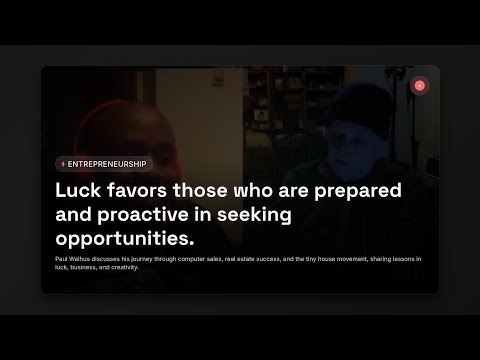
Paul Walhus turned a bet with a skeptical store owner into millions in computer sales — proof, as he and Ryan agree, that "we can't predict luck, but we can predict really good habits."
How Entrepreneur Paul Walhus Made Millions & Embraced the Tiny House Revolution
On this episode of The Hustle Zone, host Ryan Perez sits down with Paul Walhus, an Austin, Texas-based entrepreneur whose resume runs from early computer science pioneering to real estate development. Ryan opens by admitting he’s been trying to get Walhus on as a mentor “for like decades,” and once the conversation gets rolling, it’s easy to see why.
Walhus traces his path back to the University of Illinois in the late 1960s, where he studied urban planning but got pulled into an emerging world of mainframe computing, CAD, geographic information systems, and computer-aided architectural drawing — years before the IBM PC existed. That early exposure landed him a job in Austin at what he says was the first software company to go public, building accounting software for pre-PC computers. When IBM came calling about a new machine running something called “DOS,” Walhus’s company helped develop for it — long before hard drives were even standard.
The centerpiece of the episode is Walhus’s story about talking his way into computer sales. A store owner told him flatly he wasn’t cut out to be a salesman. Walhus made a bet: if he could sell a million dollars worth of computers in a year — against a store that normally did $100,000 to $150,000 annually — the owner would send him to the Caribbean for ten days, all expenses paid, with a $100 meal allowance. Walhus admits he himself turned out to be bad at cold-calling, so he hired someone for $10 an hour to dial for leads. Around the 30th call, they reached a representative from SEMATECH, the semiconductor consortium bringing together companies like IBM, Intel, AT&T, and Texas Instruments. That single connection turned into an order for 70 computers, then ballooned into ongoing tech-support contracts and orders running $100,000 to $400,000 a month. By year’s end, Walhus had done between three and five million dollars in computer sales — and found two tickets to the Cayman Islands sitting on the store owner’s desk, courtesy of NEC recognizing him for selling the most NEC printers of anyone that year.
Asked what made him so successful, Walhus is disarmingly humble: “Luck had a lot to do with it… I was at the right place at the right time.” Ryan pushes back gently, noting that showing up and staying ready is its own kind of skill — “we can’t predict luck, but we can predict really good habits.”
From there, the conversation moves into Walhus’s childhood in a small Illinois town between two bluffs on the Mississippi River, built around activities for kids — badminton, tennis, swimming, archery, fencing. He later played basketball and ran track in high school in St. Louis, and today he’s a self-described fan of “quantified fitness,” tracking his activity on a Nike watch.
The back half of the episode turns to Walhus’s current chapter: a 15-acre rural village outside Austin that he describes as part of the tiny house movement, featuring vintage Airstream trailers, shared large houses, duplexes, and a 5,000-square-foot home he built for himself. He says none of it came from a master plan — it “grew organically,” one structure at a time. The community includes architects, a movie set designer, musicians, and — for a period — 18 interns from the Philippines working at a nearby resort. Walhus also mentions renting space to Julie Angel and Vic Verdier, who ran a nature-and-movement program teaching people to climb trees and navigate the outdoors on the property’s creek and wooded grounds.
A rapid-fire round covers the personal side: his favorite dessert (cherries and yogurt), his biggest pet peeve (people who hold grudges), and marriage advice (“don’t rush into it, make sure it’s the right marriage”). Now 72 and semi-retired, Walhus reflects that his biggest regret is not pursuing an MBA — he says his technical, urban-planning-focused education left him short on business fundamentals like accounting, finance, and marketing.
Walhus closes by pointing listeners to his blog at austinspring.com and austinhangout.com, and teases a new co-working pass venture with a New York City partner that would let members access dozens of co-working spaces across cities including Austin, San Francisco, and Toronto.
Lessons from this one
Being consistently available and prepared matters more than trying to predict lucky breaks.
This maps to Israel Kirzner's concept of 'entrepreneurial alertness' in Austrian economics: opportunity discovery isn't pure chance but a disposition of attentiveness to overlooked possibilities, cultivated through habitual readiness rather than prediction. It's the academic root of the 'luck favors the prepared' framing Ryan uses against Walhus's 'right place, right time' account of the SEMATECH lead.
Delegating the parts of a venture you're bad at can unlock growth you couldn't reach alone.
The classical grounding for this mechanism is Adam Smith's division-of-labour argument (the pin-factory example): assigning distinct tasks to specialists multiplies output far beyond what one generalist could produce alone. This is the accepted theoretical foundation behind modern task-specialization/delegation practice, though it is 18th-century economic theory rather than a modern small-business-specific empirical study — a genuine search did not turn up a single well-known peer-reviewed study measuring 'founder delegates weak skill area → firm growth' directly, so this citation should be read as underlying theory, not a direct empirical match.
Deep technical skill without business fundamentals can leave a founder underprepared later in their career.
Noam Wasserman's research on founder decision-making (based on a large longitudinal dataset of startups) documents how technically skilled founders who lack complementary business, financial, and managerial expertise face predictable, often avoidable pitfalls as their companies scale — closely matching Walhus's stated regret about skipping formal accounting/finance/marketing/sales training in favor of a technical degree.
A venture can grow into something substantial without an upfront master plan.
Saras Sarasvathy's effectuation theory, developed from cognitive studies of expert entrepreneurs, formalizes exactly this pattern: successful ventures frequently emerge through means-driven, iterative action on available resources rather than upfront predictive planning toward a fixed goal — a close match to Walhus's account of his 15-acre rural village growing 'one building at a time' rather than from a deliberate master plan.
Prioritizing health and activity over wealth accumulation can be a durable personal driver later in a successful career.
WHO's global synthesis of the evidence confirms regular physical activity has substantial, lasting effects on wellbeing and mortality risk (WHO states insufficiently active people face a 20-30% higher risk of death than sufficiently active people), which supports the general wellbeing rationale behind Walhus prioritizing activity. However, the specific added value of self-tracking/wearable technology (the 'quantified self' element Walhus mentions) is less settled: the JAMA IDEA randomized trial found that adding a wearable activity tracker to a behavioral program produced no activity-level benefit and actually less weight loss than standard coaching alone. So the health-over-wealth value itself is well supported by research; the specific gadget-tracking habit is better read as Walhus's personal practice than a proven research-backed technique.
Sources
- Kirzner, I.M. (1973). Competition and Entrepreneurship. University of Chicago Press.
- Smith, A. (1776). An Inquiry into the Nature and Causes of the Wealth of Nations, Book I, Chapter 1 ('Of the Division of Labour').
- Wasserman, N. (2012). The Founder's Dilemmas: Anticipating and Avoiding the Pitfalls that Can Sink a Startup. Princeton University Press.
- Sarasvathy, S.D. (2001). "Causation and Effectuation: Toward a Theoretical Shift from Economic Inevitability to Entrepreneurial Contingency." Academy of Management Review, 26(2), 243–263.
- World Health Organization (2024). "Physical Activity" (Fact Sheet).
- Jakicic, J.M., Davis, K.K., Rogers, R.J., et al. (2016). "Effect of Wearable Technology Combined With a Lifestyle Intervention on Long-term Weight Loss: The IDEA Randomized Clinical Trial." JAMA, 316(11), 1161-1171.
- Runtime
- 42m
- Show
- HustleZone
- Host
- Ryan Perez
Been through something like this?
HustleZone is conversations with people who built something out of the thing that was supposed to stop them. If that is you, say so.