How Embracing Neurodiversity Sparked Creativity & Entrepreneurship | Chris Williams Story
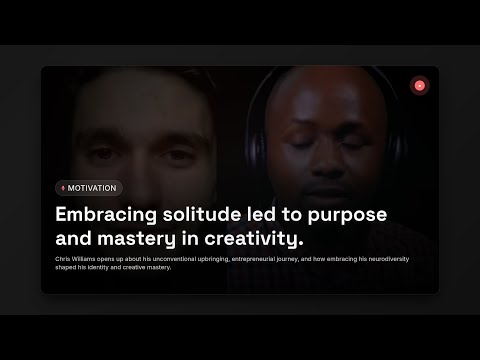
Christian Williams' definition of an entrepreneur: "a chronically unemployable delusional narcissist" — and he means it as a compliment.
How Embracing Neurodiversity Sparked Creativity & Entrepreneurship | Chris Williams Story
This episode of Hustle Zone, hosted by Ryan Perez, features Christian “Zabo” Williams — founder of The Visual Company (also referred to as VZ Co), a photo, cinema, and creative shop based in Hartford, Connecticut that Williams said was barely a week old at the time of the conversation. What starts as a lighthearted intro — Ryan admitting he mispronounced the guest’s last name and joking about his own dyslexia — turns into one of the more introspective conversations the show has featured, with both host and guest tracing how growing up different shaped how they build businesses today.
Williams was homeschooled for most of his childhood, raised by two entrepreneurial parents: his mother was the creative director of a New York City agency working with brands like AMX and PepsiCo, and his father was a marketing copywriter. Williams describes sitting in conference rooms with a coloring book as a kid, absorbing the language of business meetings without necessarily following every word. He calls it his real classroom — and jokes that his first “non-official internship” happened at age five.
That upbringing collided with a brief stint in public school, which Williams says he failed entirely — while simultaneously running an after-hours school store, marking up candy bars and pencils threefold and selling gum on the side. His entrepreneurial streak started even earlier: a lemonade stand at age seven, run as a cross-promotional “joint venture” with two neighbors lined up along the street, and by age twelve he had launched buildpaperairplanes.com, a subscription site and forum community teaching kids to build paper airplanes, built together with his father.
Much of the conversation centers on what Williams calls being “stuck in his own head.” He talks about studying psychology from a young age — comparing it to learning martial arts, but for the mind rather than the body — as a way to understand himself and the people around him. He and Ryan both describe feeling isolated as kids: Ryan ties it to being dyslexic and often unable to communicate what he was thinking, while Williams says he was almost always trying to find a place to belong but rarely felt welcomed. Both agree the isolation had an upside — it created space to build.
Williams is candid about the flip side of that intensity: years of what he calls self-sabotage, describing cycles of starting something and abandoning it — sometimes within hours, sometimes after a year — until he says he finally accepted “I’m a hot mess,” unable to stay fully present in a single conversation without his mind jumping several steps ahead. That admission leads to the episode’s most quotable line, when Williams describes the classic entrepreneur as “a chronically unemployable delusional narcissist” — a description he says came only after learning, fairly recently, to actually stop and listen to people around him rather than staying locked in his own head.
The episode also works through two audience questions. Anthony Davis asks how Williams got people to take him seriously as a young entrepreneur; Williams says it comes down to genuinely knowing what you bring to the table and how well you can connect your vision to a client’s, rather than “faking it till you make it.” A viewer named Crystal Day (also heard as Crystal Chief) asks what advice to give high-school-age natural leaders who feel pressured to be followers; Williams points to self-awareness as the core answer, while Ryan adds his own experience of learning the difference between being a controlling manager and being a genuine team player.
The show closes with a rapid-fire round — Williams names ice cream and New York cheesecake (with a specific craving for a particular style) as his favorite desserts despite being vegan, says his musical taste depends entirely on lyrical quality rather than genre, and when asked what he’d change about his past with a magic wand, says he wouldn’t change anything, because everything led him to exactly where he is now. Williams can be found on Instagram, Twitter, and Facebook at @cswalive, with The Visual Company at @VZCo and vz.co.
As always, Ryan closes out with Hustle Zone housekeeping — a new t-shirt line at hustlezone.clo, a magazine launching soon, and thanks to the regulars tuning in live for another blab-hosted episode.
Lessons from this one
An unconventional or immersive childhood environment can function as informal, high-context learning that outpaces formal schooling for a specific skill set.
Williams describes sitting in on his mother's agency meetings with Fortune 500 clients from age five, saying he learned to "think in the language" of business rather than just knowing the words, which he contrasts with peers sitting bored in classrooms for seven or eight hours a day.
Chronic overthinking and self-sabotage can stall a talented person's progress for years until they build genuine self-awareness.
Williams describes being repeatedly "yanked back" whenever he tried to move forward, cycling through abandoned starts, and says the breakthrough only came recently when he learned to stop and actually listen to people around him instead of staying locked in his own head.
Feeling socially isolated as a child for thinking differently can later become a source of drive and creative output rather than only a wound.
Both Ryan and Williams describe feeling alone as kids for being different — Ryan ties it to dyslexia, Williams to being an outsider who wanted community but rarely found it — and Williams says that isolation gave him "a lot of free time to create and to build."
Being taken seriously as a young or unproven entrepreneur comes down to substance and vision-alignment, not projected confidence alone.
Responding to an audience question about credibility, Williams says being taken seriously is "about whether or not you're actually worth being taken seriously," and explicitly rejects the idea of "faking it till you make it" in favor of genuinely connecting your vision to a client's.
Leadership and followership are not fixed traits but require self-awareness to apply appropriately to a given role or moment.
Asked how to advise natural-leader youth who feel pressured to be followers, Williams frames the answer around self-awareness and knowing what's right for you individually, while Ryan adds that his own early failures as a manager came from wanting control rather than knowing how to be a genuine team player.
Sources
- Lave, J., & Wenger, E. (1991). Situated Learning: Legitimate Peripheral Participation. Cambridge University Press.
- Lyubomirsky, S., Kasri, F., & Zehm, K. (2003). "Dysphoric rumination impairs concentration on academic tasks." Cognitive Therapy and Research, 27(3), 309-330.
- Long, C. R., & Averill, J. R. (2003). "Solitude: An Exploration of the Benefits of Being Alone." Journal for the Theory of Social Behaviour, 33(1), 21-44.
- Suchman, M. C. (1995). "Managing Legitimacy: Strategic and Institutional Approaches." Academy of Management Review, 20(3), 571-610.
- Hersey, P., & Blanchard, K. H. (1969). Management of Organizational Behavior: Utilizing Human Resources. Prentice Hall.
- Runtime
- 1h 08m
- Show
- HustleZone
- Host
- Ryan Perez
Been through something like this?
HustleZone is conversations with people who built something out of the thing that was supposed to stop them. If that is you, say so.