How I Built a Successful Business While Driving Uber – Antoin Watson's Inspiring Journey
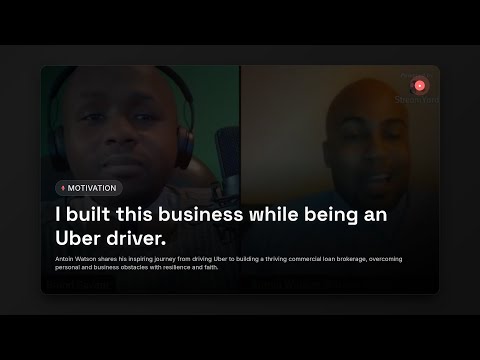
As Antoine Watson put it about building Watson Worldwide Capital while driving Uber at 3 a.m.: "My overnight success took 15 years."
How I Built a Successful Business While Driving Uber – Antoin Watson’s Inspiring Journey
Hustle Zone | Go Live and Prosper
On this episode of Go Live and Prosper, host Ryan Perez sat down with Antoine Watson, founder of Watson Worldwide Capital, a full-service commercial construction loan brokerage firm. Watson’s company connects commercial real estate and construction companies with financing outside the traditional banking system — private lenders, private equity, and venture capital — for projects that typically range from around $10 million up to $800 million. His specific niche, he explained, is financing ground-level commercial construction, and a typical client engagement takes about three months from start to funding, during which Watson says part of his job is simply keeping clients motivated and connected every few days so they don’t lose faith in a process that takes time.
But the loan brokerage business is only the current chapter of a much longer story. Watson told Perez that nothing in his life was ever planned — his journey, in his words, has been one of perseverance and beating the odds. It started in childhood, when he was diagnosed with a learning disability. He described it as a constant fight: concepts that other kids picked up in one try might take him five or six repetitions, and even then his confidence lagged. The school placed him in resource classes with shrunken assignments, which he says helped, but the experience left him private and isolated, unsure how to build friendships while other students speculated about why he was pulled out of class.
The turning point, he said, was discovering basketball in the fourth grade. The game gave him confidence and relationships he hadn’t had before, and it eventually took him overseas to play in Korea and Germany in the early 2000s. He stayed with basketball until about age 20, when the passion faded and he found himself, for the first time in his life, genuinely stuck — everything about his identity up to that point had been built around the sport. He drifted through community college without finishing a degree, until a mentor suggested he try sales. That led to roughly a decade in inside sales, where Watson said he realized he was making cold calls to build wealth for other business owners and started asking himself what he could build for himself instead.
What followed, by his own account, was roughly eight failed businesses — including a basketball training company he ran for three years without ever having his own facility, using an outdoor court with only a roof over it. He described his eventual success as an “overnight success” that actually took fifteen years of trials, self-doubt, and reflection. The current business, Watson Worldwide Capital, was built quite literally while he was driving for Uber: waking at 3 a.m., driving until 9 or 10 a.m., then heading to an office to make cold calls and teach himself the alternative-financing industry. Two earlier attempts to build the company with friends and former college contacts fell apart, he said, because of mismatched work ethic and goals. It was only on the third attempt — after joining a broker training program he found lacking in real mentorship or integrity, and teaching himself much of the industry through research online — that the business finally took hold.
There were lean stretches along the way. Watson recalled a year and a half of continuing to drive Uber at 3 a.m. while living on roughly $1,200 a month and peanut butter and jelly sandwiches. He credited his fiancée, whom he met about a year before the business found its footing, with encouraging him not to give up during a period when he was ready to close the business down, and with contributing to the company’s graphics and messaging as it grew. Today, Watson said, the firm is working on projects in Puerto Rico, the Virgin Islands, and Colombia, including financing needs as large as $150 million — deals he attributes to a specific, detailed prayer about the kind of work he wanted to do.
Asked what he’d tell his younger self, Watson said he’d tell him not to believe the school system’s assessment that he was below average and destined to fail. Toward the end of the conversation, Perez — who shared that he also has dyslexia — noted the parallel between the two of them, framing Watson’s story as proof that neither a rough start nor a slow climb determines where someone ends up.
Lessons from this one
A childhood learning disability diagnosis doesn't cap adult capability — it can even become the origin of a founder's resilience.
This matches a well-established empirical finding, not just anecdote: Julie Logan's peer-reviewed study found a markedly higher incidence of dyslexia among entrepreneurs than in the general population (about 35% in her US entrepreneur sample vs. roughly 5-10% population base rates), and traced this to compensatory coping skills — delegation, verbal communication, problem-solving workarounds — that dyslexic entrepreneurs built in response to academic struggle, which then became business assets. This closely parallels Watson's account of needing repetition to learn and converting that early struggle into founder persistence.
A flexible, low-commitment income source can be a more effective bridge into entrepreneurship than a stable but rigid job.
The closest rigorous evidence here is the 'hybrid entrepreneurship' literature rather than gig-economy research specifically: using eight years of matched Swedish employer-employee data, Folta, Delmar & Wennberg found that a large share of entrepreneurs start by running a venture alongside continued paid work (a 'hybrid' phase) rather than quitting a job outright, and that this staged, income-preserving path behaves differently from — and is often more viable than — a straight leap into full self-employment. It supports the general mechanism (flexible/partial income cushions the founding period) though it isn't about gig-platform hours specifically. Worth flagging as a complication rather than confirmation: a separate Management Science study (Burtch, Carnahan & Greenwood 2018) found that in markets where Uber entered, overall entrepreneurial activity (Kickstarter campaigns, self-employment) went DOWN, not up — driven mainly by fewer marginal/unsuccessful ventures, suggesting gig work can substitute for as often as it bridges to entrepreneurship. Watson's specific case (using driving hours to fund and build a venture that then succeeded) is consistent with the hybrid-entrepreneurship pattern, but the broader research on gig work as a bridge is genuinely mixed.
Early-stage business partnerships tend to fail on mismatched work ethic and goals rather than on a flawed idea.
Noam Wasserman's large-sample research on founding teams (drawn from data on thousands of startups) documents that conflicts among co-founders over commitment level, roles, and differing goals are among the most common and most damaging sources of early-stage startup failure — frequently a bigger threat than the quality of the underlying idea. This directly parallels Watson's account of two failed attempts to launch with partners (a college friend group, then a solo buddy) that dissolved over misaligned work ethic and goals, followed by success once he built alone.
Repeated business failure is often a normal precondition for eventual success, not a signal to quit.
This paper doesn't measure Watson's specific '8 failed businesses over 15 years' narrative, but it is the leading empirical study on whether a founder's track record predicts future outcomes. Using data on serial entrepreneurs and their VC backers, Gompers, Kovner, Lerner & Scharfstein found that prior SUCCESS strongly predicts future success (skill persists), while prior FAILURE does not meaningfully doom a founder's next venture — a previously-failed entrepreneur's odds on their next venture were roughly comparable to a first-time entrepreneur's, not permanently depressed. That is consistent with 'failure isn't a signal to quit,' though the study stops short of showing failure itself confers an advantage — it's more 'failure isn't a life sentence' than 'failure is required.'
A supportive partner during a founder's leanest financial period can be decisive in whether the business survives.
Powell & Eddleston's peer-reviewed study of entrepreneurs found that support and enrichment flowing from family/partner relationships into the business (encouragement, practical backing during hard stretches) is significantly associated with entrepreneurial success, with the size of the effect differing by gender. This substantiates the general mechanism Watson describes — his fiancée's encouragement during a period of near-zero daily earnings, and her talking him out of quitting, as a decisive factor in the business surviving — though the study measures aggregate success outcomes rather than a single 'talked me out of quitting' moment.
Sources
- Julie Logan (2009), "Dyslexic entrepreneurs: the incidence; their coping strategies and their business skills," Dyslexia, 15(4), 328-346, Wiley.
- Timothy B. Folta, Frédéric Delmar & Karl Wennberg (2010), "Hybrid Entrepreneurship," Management Science, 56(2), 253-269.
- Gordon Burtch, Seth Carnahan & Brad N. Greenwood (2018), "Can You Gig It? An Empirical Examination of the Gig Economy and Entrepreneurial Activity," Management Science, 64(12).
- Noam Wasserman (2012), The Founder's Dilemmas: Anticipating and Avoiding the Pitfalls That Can Sink a Startup, Princeton University Press.
- Paul Gompers, Anna Kovner, Josh Lerner & David Scharfstein (2010), "Performance Persistence in Entrepreneurship," Journal of Financial Economics, 96(1), 18-32.
- Gary N. Powell & Kimberly A. Eddleston (2013), "Linking family-to-business enrichment and support to entrepreneurial success: Do female and male entrepreneurs experience different outcomes?" Journal of Business Venturing, 28(2), 261-280.
- Runtime
- 51m
- Show
- HustleZone
- Host
- Ryan Perez
Been through something like this?
HustleZone is conversations with people who built something out of the thing that was supposed to stop them. If that is you, say so.