Leaving a Legacy
Sanda & Luis on Growth, Regret, and Empowering Their Kids
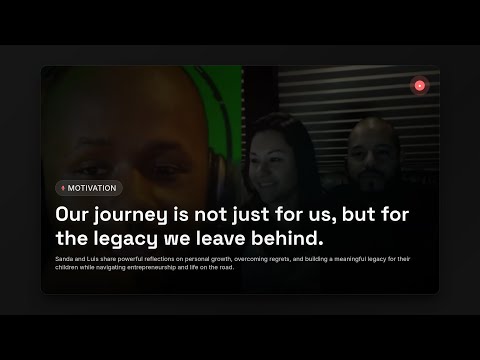
As Sandra put it near the end of the show: "No one has your fingerprints — you are special, don't be a carbon copy."
Leaving a Legacy: Sandra & Luis on Growth, Regret, and Empowering Their Kids
Some episodes of the Hustle Zone move fast. This one didn’t need to. Ryan Perez sat down with Sandra and Luis, the couple behind First Class RV Adventures, for what turned into one of the longest conversations in the show’s year-and-a-half history — and by the time it wrapped, it was clear why. Their story moves from a New York City childhood full of vacations and stability, to a New Jersey apartment fire that erased a two-year-old’s baby pictures, to a domestic violence arrest, a float tank full of overdue forgiveness, and eventually a house on wheels with a two-year-old and a five-year-old in the back seat.
Sandra opens by describing a childhood she calls almost too stable to talk about: two parents together, three or four family vacations a year, and an entrepreneurial streak she says she inherited from her mother’s side of the family rather than her parents directly — she was the kid selling homemade greeting cards at school while her mother wondered where the ideas came from. Luis’s version is close to the opposite. He was two years old when he accidentally started a house fire that destroyed everything his family owned, including his own baby photos. His parents split after his mother was caught cheating, and he grew up bouncing between his father’s relationships, in a home he describes as never quite stable.
The two life stories converge on the theme Ryan keeps circling back to throughout the interview: forgiveness. Luis is candid that he didn’t start forgiving himself, or anyone else, until the year before this recording — a shift he credits to five years of personal development that began after he met Sandra. He describes calling his mother for the first time in his life, and a session in a sensory deprivation float tank where, one by one, he mentally asked forgiveness from everyone he felt he’d wronged. “You have to get your power back,” he says, arguing that people hold onto small resentments with family members they’d drop everything for if that person were on their deathbed.
The couple also doesn’t shy away from the rougher chapters. Luis talks about a relationship before Sandra that ended with a domestic violence arrest — he’d locked his then-partner out of the house, she broke a window, and under the law, someone had to be taken in. He describes sitting in a cell with dozens of other men arrested under similar circumstances and praying for a partner who would “cherish” and “respect” him. Months later, he met Sandra. He’s equally direct about the pull he felt afterward to go back to his ex rather than risk his children growing up in a split household like he did — advice he now passes to other men listening: don’t sacrifice your own happiness trying to force a bad relationship to work for the kids’ sake.
Their business arc gets the same honest treatment. Luis ran a flooring store in downtown Orlando when he and Sandra met, before overhead costs pushed him to close it. Sandra spent years building a network marketing business and working as an esthetician from zero clients, and admits the two argued constantly while she was building it and Luis hadn’t yet done his own personal growth work. The RV decision, they say, wasn’t a long-plotted pivot — it followed a single weekend trip in a relative’s RV, during which Sandra realized she could run her business from the road. They sold nearly everything in seven yard sales and left. The first two months felt easy; then their single income stream collapsed, a scare that pushed them to build toward the seven income streams they say support them now.
Ryan also credits a blunt conversation he had with the couple about “starting from scratch” with their story-branding, which Luis initially resisted before crediting it with helping them lock into their niche — RV travel, adventure, and freedom — rather than trying to be everything at once.
Asked what legacy they want to leave their kids, Luis says he wants them free to choose who they want to be. Sandra’s answer is about self-love: she wants her children to love themselves enough that it naturally overflows onto other people, “because that’s kind of what happened in my case.” It’s a fitting close to an hour that covered fires, jail cells, float tanks, and a family now measuring its backyard in mountains instead of square footage.
Lessons from this one
Reconciling with an estranged parent can mark a real turning point in emotional healing.
Luis says he didn't start forgiving himself or others until the year before the interview, and describes calling his mother for the first time in his life after not speaking to her since he was 18, plus a float-tank session where he mentally asked forgiveness of everyone he felt had wronged him.
Shared understanding of the entrepreneurial mindset reduces friction between partners during lean periods.
Sandra says building her network marketing business caused repeated arguments with Luis before he had done his own personal development work, and both note how rare it is to date someone who truly understands the ups and downs of entrepreneurial life.
Relying on a single income stream leaves entrepreneurs financially exposed during a major life transition.
The couple says their business had only one income source when they sold everything for RV life, and their income 'started crumbling very quick' within the first couple months on the road, prompting them to build toward seven income streams.
Childhood instability can shape what a person recognizes as healthy love and partnership in adulthood.
Luis says he never quite knew what love from a woman felt like until Sandra, having grown up without a stable maternal presence, and he describes almost returning to a volatile ex-partner in part to avoid recreating his own parents' split household for his children.
Narrowing to a clear niche and refining how a story is told can accelerate audience growth more than expanding into more topics.
Luis initially resisted Ryan's advice to 'start from scratch' on their branding, but credits that conversation with helping them lock into their RV travel niche, alongside a produced video collaboration that became one of their most-viewed and most-commented posts.
Sources
- Wade, N. G., Hoyt, W. T., Kidwell, J. E. M., & Worthington, E. L. (2014). Efficacy of psychotherapeutic interventions to promote forgiveness: A meta-analysis. Journal of Consulting and Clinical Psychology, 82(1), 154-170.
- Werbel, J. D., & Danes, S. M. (2010). Work Family Conflict in New Business Ventures: The Moderating Effects of Spousal Commitment to the New Business Venture. Journal of Small Business Management, 48(3), 421-440.
- Coad, A., & Guenther, C. (2013). Diversification patterns and survival as firms mature. Small Business Economics, 41(4), 633-649.
- Hazan, C., & Shaver, P. (1987). Romantic love conceptualized as an attachment process. Journal of Personality and Social Psychology, 52(3), 511-524.
- Olsen, L. E., Samuelsen, B. M., Pappas, I., & Warlop, L. (2022). Broad vs Narrow Brand Positioning: Effects on Competitive Brand Performance. European Journal of Marketing.
- Runtime
- 1h 18m
- Show
- HustleZone
- Host
- Ryan Perez
Been through something like this?
HustleZone is conversations with people who built something out of the thing that was supposed to stop them. If that is you, say so.