Overcoming Adversity & Embracing Authenticity
Jason Daniels' Journey to Success
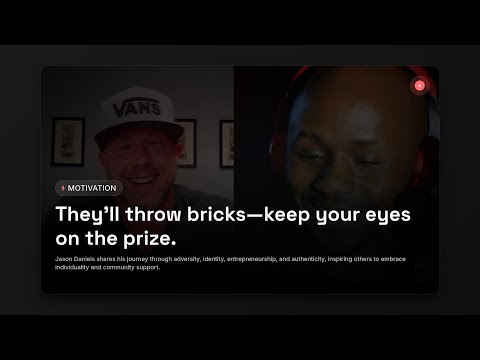
Jason Daniels' advice to his younger self doubles as his whole philosophy: "Don't be scared to be yourself. Walk confidently in exactly who you are and cut your own path."
Overcoming Adversity & Embracing Authenticity: Jason Daniels’ Journey to Success
This episode of Hustle Zone, hosted by Ryan Perez, features Jason Daniels — owner of Titans Electrical, Inc., a motivational speaker, a partner in Home of the Hustle, and known to regulars of the platform simply as “Mister Monday Night.” Perez opens the show the way he opens every episode: by asking his guest for the full story, not the six-years-ago version.
Daniels’ story starts in Memphis, Tennessee, where both of his parents were born, though he didn’t grow up there in a straight line. His father was in the military, and the family moved often — Daniels started school in Germany, then lived out west, including formative years in El Paso, Texas and a stretch in Albuquerque, New Mexico, before his dad retired when Jason was 13 and the family settled back in Memphis for good. He describes starting kindergarten at age four, which left him a junior in high school at fifteen — too young to drive while his sophomore classmates dated and drove themselves to school.
The move back to the Memphis area came with real social cost. Daniels had grown up immersed in a predominantly Hispanic community out west, shaping his taste in music and style, and when he landed first in Southaven, Mississippi and then in a Memphis suburb, he says he simply wasn’t accepted — he didn’t dress the part or sound the part. That rejection, he says, pushed him into a shell. What pulled him back out, starting in his early twenties, was rapping. He pursued a hip-hop career for fifteen years, opening for acts including Digital Underground, Busta Rhymes, Tone Loc, and Outkast, and describes getting to know Tupac Shakur backstage as a formative, humanizing experience beyond the larger-than-life image.
The entrepreneurial turn came later, in his early thirties, while Daniels was married with a young daughter. He’d spent years doing electrical work for other companies and, by his own account, was never happy doing it — not because he was lazy, he says, but because he felt uninspired working to make someone else money while being treated poorly. He tells one specific story: arriving early to a job, unloading a truck of lights inside a church, and getting accused by his boss of showing up late and sneaking in. He walked off that job and never worked for anyone else again. In a twist he shares on the show, he recently had lunch with that same former boss, learning for the first time that the man had been under enormous strain — a lead worker on the crew going through a divorce and drinking on site. “Now that I’m an owner, I feel his pain,” Daniels says.
That experience shaped how he runs Titans Electrical today. He says too many business owners focus only on treating customers well while employees “don’t really matter,” and he set out to build something different — a company where, in his words, “if you’re on my team, I love you like my brother” or sister. He talks about his twelve-year-old daughter, who was set to start working at Titans Electrical two days a week that summer, earning a paycheck and, he hopes, a strong work ethic she can carry into whatever she chooses as an adult.
The conversation also turns candid on tougher subjects. Daniels, who identifies as libertarian, says injustice — especially toward children — is what makes him truly angry, referencing a violent incident that had recently played out on Facebook Live in Memphis. Asked about policing and the Black Lives Matter movement, he draws on his own experience as a minority growing up out west and later riding with Black friends in Memphis, describing firsthand differences in how police treated him versus how his Black friends were treated in similar situations. He’s careful to reject blanket statements in either direction, framing it instead as a case-by-case reality.
Lighter moments round out the episode: carrot cake over cheesecake, a soft spot for Ed Sheeran, and reading recommendations that include Grant Cardone’s Sell or Be Sold and Jocko Willink’s Extreme Ownership, a book he says shapes how he takes responsibility for everything that happens under his watch. Asked what he’d tell his younger self, Daniels doesn’t hesitate: “Don’t be scared to be yourself. Walk confidently in exactly who you are and cut your own path.”
The episode closes, as Hustle Zone always does, with Daniels leading the crowd through the show’s signature call-and-response send-off — “Welcome to the Hustle Zone.”
Lessons from this one
Being mistreated as an employee can be the direct spark for starting a business, not just a desire to make more money.
Daniels describes years of feeling disrespected doing electrical work for other companies, walking off a job after a conflict with a boss over a misunderstanding, and deciding afterward to build a company "where you didn't have to be treated like a dog."
Repeated relocation and social rejection during adolescence can push an otherwise outgoing kid into withdrawal, and a creative outlet can be what draws them back out.
Daniels describes moving from a predominantly Hispanic community out west to Memphis-area schools where he says he simply wasn't accepted, which pushed him into a shell; he credits picking up rapping in his early twenties as the thing that brought him back out.
Framing employees as family rather than as labor can be a deliberate point of differentiation for a small trades business.
Daniels says many business owners focus on treating customers well while employees "don't really matter," and describes building Titans Electrical instead around close, familial relationships with the people who work for him.
Gaining a new vantage point — such as becoming a boss yourself — can retroactively change how you understand an old conflict.
Years after being fired, Daniels had lunch with his former boss and learned the man had been dealing with a crew member's divorce and drinking on the job; Daniels says that now, as an owner, he can finally sympathize with that pressure.
Personal, firsthand experience of differential treatment by police can shape someone's views on justice more directly than political labels or media narratives.
Daniels, describing himself as libertarian, recounts being treated differently by police depending on whether he was riding with white or Black friends in Memphis, and uses that lived experience to reject blanket claims about police or any racial group.
Sources
- Tepper, B. J. (2000). Consequences of Abusive Supervision. Academy of Management Journal, 43(2), 178-190.
- Pollock, D. C., & Van Reken, R. E. Third Culture Kids: Growing Up Among Worlds. Nicholas Brealey Publishing.
- Gallup. How to Improve Employee Engagement in the Workplace. Gallup Workplace.
- Galinsky, A. D., & Moskowitz, G. B. (2000). Perspective-Taking: Decreasing Stereotype Expression, Stereotype Accessibility, and In-Group Favoritism. Journal of Personality and Social Psychology, 78(4), 708-724.
- Pierson, E., Simoiu, C., Overgoor, J., Corbett-Davies, S., Jenson, D., Shoemaker, A., Ramachandran, V., Barghouty, P., Phillips, C., Shroff, R., & Goel, S. (2020). A Large-Scale Analysis of Racial Disparities in Police Stops Across the United States. Nature Human Behaviour, 4, 736-745. (Stanford Open Policing Project)
- Runtime
- 35m
- Show
- HustleZone
- Host
- Ryan Perez
Been through something like this?
HustleZone is conversations with people who built something out of the thing that was supposed to stop them. If that is you, say so.