Living Authentically with AuDHD
Art, Humor & Healing as a Neurodivergent Creator
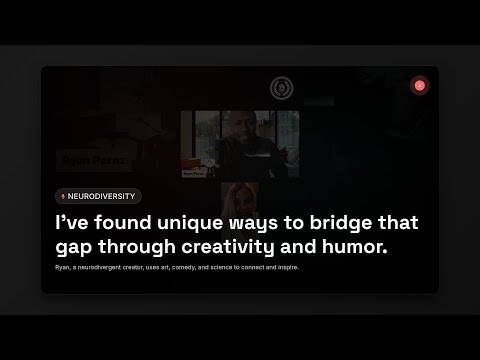
Masking can be a genuine work of art built over a lifetime of studying other people, but that doesn't make it any less exhausting to keep wearing.
Living Authentically with AuDHD: Art, Humor & Healing as a Neurodivergent Creator
What started as a casual “body doubling” livestream — two people getting work done together on camera, chatting in the background — turned into one of the more candid conversations in the Hustle Zone archive. Streaming from Calgary, Alberta, host Ryan sat down (virtually) with Fatima, the woman he’s been dating, for an episode that drifted from productivity check-ins into a wide-ranging, funny, and often raw conversation about being autistic, masking, dating, and simply trying to survive.
Ryan opened by thanking viewers for donations, disclosing that he is currently couch surfing and homeless, and explaining that the stream doubles as a way to get support while he works toward finding stable housing and getting further help with his autism. Fatima, joining from her own business — she’s a portrait photographer for women, specializing in boudoir and glamour work under the name Photos by Fatima — talked about how the two met and how their shared neurotype has shaped the relationship.
Much of the conversation circled around masking: the performed, socially acceptable version of themselves both guests present to the world, versus who they are underneath it. Ryan traced his own on-camera persona back to childhood — hours spent studying talk-show hosts like Oprah, Ricki Lake, Jenny Jones, and Donahue, plus comedians and performers such as Chris Rock, Dave Chappelle, and Michael Jackson — describing the resulting voice and energy as a deliberately crafted “work of art” rather than a lie. But he was equally clear that maintaining it is exhausting: he described unmasking as something that can trigger what he called “skill regression,” pacing, and difficulty functioning for weeks at a time, especially layered on top of the stress of his current housing situation.
Fatima offered a different version of the same tension. She described herself as naturally quiet and monotone, someone who learned to project energy and confidence because her photography business required it — to the point that people who meet her now don’t recognize the quieter version underneath. Both agreed that dropping the mask, even with people who say they accept you as you are, often invites confusion or judgment instead.
The two also talked at length about what it’s like to date within the autistic community versus outside it. They described their communication as “cut and dry” — direct, literal, free of the games and second-guessing they’d experienced in past relationships. Ryan mentioned appreciating that Fatima doesn’t take offense at abrupt goodbyes on the phone, and both talked about hyperfixation, sensory sensitivities, and stimming (Ryan mentioned singing and pacing) as simply part of how they operate together without needing constant explanation.
A recurring theme was the amount of protective effort that goes into navigating relationships and public life as autistic adults. Ryan described doing detailed research on people — checking social media profiles, looking for patterns — before deciding whether to trust them, framing it as a safety mechanism born from being misread and, in his words, having his autism “weaponized” against him in the past. He also talked about deliberately disclosing his diagnosis upfront, both online and to a neighbor in his current living situation, as a way to get ahead of misinterpretation.
The stream wasn’t all heavy. Viewer comments were read live throughout, guests including a longtime friend named Bobby (a nurse who also identifies as autistic, and who Ryan knew from the early live-streaming platform Blab) joined in, and the conversation swung into tangents about a viral Kendrick Lamar track, animal facts, and a new YouTube channel Ryan started called “self diagnosis is valid.” Ryan also noted that the pandemic had, in some ways, been a relief — giving him permission to stop attending in-person meetings and lean fully into a homebound routine that suited him better.
By the end, the conversation returned to something more grounded: Ryan’s acknowledgment that he needs consistent professional support — ideally a therapist who knows his history — and that free or one-off services haven’t been enough. It’s a reminder that underneath the humor and the persona, the episode is ultimately about two people trying to be understood, and trying to build a life where they don’t have to perform to be loved.
Lessons from this one
Masking exacts a hidden cost that can trigger burnout and functional regression once it comes off.
Ryan described unmasking as very draining, mentioning what he called 'skill regression,' pacing, and needing weeks to recover after periods of sustained masking, especially while under housing stress.
Shared neurotype in a relationship can reduce the relational guesswork that causes anxiety in mixed-neurotype pairings.
Both Ryan and Fatima described their communication as direct and 'cut and dry,' appreciating that things like abrupt goodbyes or blunt honesty aren't taken personally between them the way they might be in other relationships.
Extensive pre-vetting of new people can function as a protective strategy for autistic adults who have been misread or taken advantage of.
Ryan described doing detailed background research on people's social media before trusting them, explicitly framing it as protection after having his autism 'weaponized' against him in past relationships and situations.
Proactively disclosing a diagnosis can be used as a deliberate self-advocacy tactic to prevent being misjudged.
Ryan explained that he intentionally states he is autistic early in interactions, whether in his early videos or with a neighbor, specifically so his behavior and tone aren't misinterpreted.
Financial and housing instability compound the psychological burden of navigating a recent autism diagnosis openly.
Ryan discussed being homeless and couch surfing while also waiting months for a clinical assessment, and expressed wanting a consistent therapist who knows his history rather than one-off or free services.
Sources
- Hull, L., Petrides, K.V., Allison, C., Smith, P., Baron-Cohen, S., Lai, M.C., & Mandy, W. (2017). "Putting on My Best Normal": Social Camouflaging in Adults with Autism Spectrum Conditions. Journal of Autism and Developmental Disorders, 47(8), 2519-2534.
- Crompton, C.J., Ropar, D., Evans-Williams, C.V., Flynn, E.G., & Fletcher-Watson, S. (2020). Autistic peer-to-peer information transfer is highly effective. Autism, 24(7), 1704-1712.
- Weiss, J.A., & Fardella, M.A. (2018). Victimization and Perpetration Experiences of Adults With Autism. Frontiers in Psychiatry, 9, 203.
- Romualdez, A.M., Walker, Z., & Remington, A. (2021). Autistic adults' experiences of diagnostic disclosure in the workplace. Autism & Developmental Language Impairments, 6.
- Taylor, F., Ahmed, N., Pemovska, T., Dar, F., Lloyd-Evans, B., & Johnson, S. (2026). Autistic adults' experiences of accessing and receiving mental health care and their priorities for improvements: A qualitative study. PLOS Mental Health, 3(5).
- Churchard, A., Ryder, M., Greenhill, A., & Mandy, W. (2019). The prevalence of autistic traits in a homeless population. Autism, 23(3), 665-676.
- Runtime
- 2h 19m
- Show
- HustleZone
- Host
- Ryan Perez
Been through something like this?
HustleZone is conversations with people who built something out of the thing that was supposed to stop them. If that is you, say so.