Entrepreneur Secrets
Creativity, Resourcefulness & Smart Investments for Success
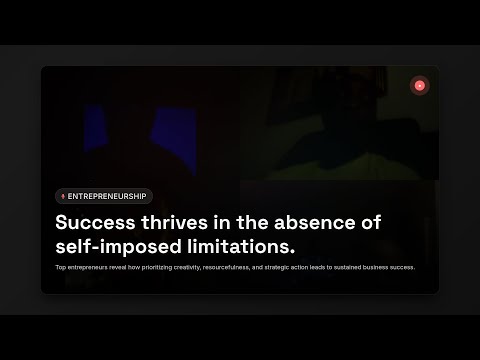
Money is nothing more than the daily byproduct of the work you actually love — chase the work, and eventually the money chases you back.
Money, Gold, and the 1% Mindset: A Late-Night Roundtable on Hustle Zone
Some episodes of the show play like a structured interview. This one plays like eavesdropping on a group chat that got loud. Recorded deep into the night on the live-streaming app Blab — guests kept apologizing for the hour, one joking it was almost 3 a.m. where he sat — the conversation moves from money philosophy to gold and Bitcoin to dyslexia to website pricing, with people dropping in and out as their connections failed and new voices climbing into the open seat.
The opening question sets the tone: is money everything, or isn’t it? Gary, one of the recurring voices on the call, argues that the entrepreneurs who actually make real money rarely lean on capital at all — they lean on resourcefulness, on reading the market around them and being creative enough that they don’t need to spend big to build something profitable. Shane, an insurance and annuities broker who runs his own “1% Show,” takes it further: money, he says, is just the byproduct of what you do every day. Chase it directly and you’ll never feel satisfied; do work you actually love, and the money follows. He circles back to a line he attributes to Zig Ziglar — that people love to say money doesn’t buy happiness, but it sure puts a down payment on it — and to his own rule of thumb: money is a vehicle, and what matters is who you’re driving it to help.
That framing carries into the show’s longest thread: investing in gold and Bitcoin. Corey, who trades gold professionally, and a guest going by Miss Cleo, who works in compliance and investigations for a financial institution and has traded both gold and Bitcoin, spend a long stretch picking apart fractionalized “gold card” products sold through MLM channels — warning that buyers often pay 20 to 30 percent over spot price for gold that’s difficult to verify or resell. Miss Cleo also raises Executive Order 6102, the 1933 rule that let the U.S. government compel citizens to register and surrender gold, as a reason some investors prefer holding it overseas. Her bottom-line advice on investing generally: diversify, never put all your eggs in one basket, and do the research — because when people lose money on an investment, she says, it’s almost always their own fault for missing the warning signs on when to get out.
The Bitcoin side of the conversation gets personal. Miss Cleo describes working for a Bitcoin exchange starting in 2013 that handled roughly $700 million and 300,000 customers in a single year, buying in around $30 and selling near $1,200. The group also recalls the human cost of the crash that followed — people who leveraged their houses when Bitcoin was worth pennies and rode it up before it dropped hard, and, more soberly, the financial institution’s own count of suicides tied to the losses. The lesson repeated more than once: never bet more than you’re willing to lose.
Away from markets, the panel keeps returning to a handful of personal stories. Gary describes a family party where he realized the only relatives anyone gossiped about — a cousin running piercing studios across several cities, another distilling rum, an uncle who sold a water-filtration business to a major buyer — were the “weirdos” who didn’t fit in, and how that reframed his sense of what makes an entrepreneur. Shane tells his own version from the other direction: ten years ago he and his wife were $225,000 in debt, their water and phone got shut off, and he built his business back from there — which is why, he says, he doesn’t think you can be a successful entrepreneur without having once had empty pockets. He also walks through a chess analogy he built himself, casting the pawn, knight, bishop, rook, queen, and king as different relationships people have with time and effort.
Learning differences come up more than once, too. Shane and Ryan both describe growing up with dyslexia and being told they were slow, and both built unconventional systems to compensate — Shane fills chalkboards by hand because that’s how his mind organizes information; Ryan relies on a decades-old text-to-speech tool sped up far beyond normal listening pace, paired with concept maps, to retain what he reads.
The episode closes on Ryan’s own business, Bow Tie Creative, where he explains a tiered, flat-rate website package model built around a short list of design principles — no more than two colors, no more than two fonts, no slideshows that break on mobile — designed to make quality web development a repeatable, transparent commodity rather than a bespoke, invoice-padded service.
Lessons from this one
Resourcefulness and creativity can matter more than capital in building a profitable business.
Gary argues that the most successful entrepreneurs he's studied don't rely on money itself — they rely on being resourceful with what's already around them and creative about exploiting markets without heavy spending.
Diversify and size your risk, because most investment losses come down to avoidable mistakes.
Miss Cleo's core investing advice is to never hold all your eggs in one basket and to thoroughly research before investing, noting that 99% of the time a lost investment comes down to missing the warning signs on when to exit; the group also recalls how over-leveraged Bitcoin bets amplified real financial and personal harm during its 2013-2014 crash.
A learning disability can become a personal operating advantage once someone builds their own system around it.
Ryan describes teaching himself to learn through a fast text-to-speech reader and concept-mapping after struggling to read conventionally, while Shane describes filling giant chalkboards by hand because that's how his dyslexic mind organizes ideas — both frame the workaround, not the deficit, as the real skill.
Financial hardship, not comfort, is often the forge that produces committed entrepreneurs.
Shane recounts being $225,000 in debt with his water and phone shut off before building his insurance business, and says he doesn't think you can be a successful entrepreneur without having had empty pockets at some point.
Simplifying and systemizing a service can make it more trustworthy and scalable than customized, per-client consulting.
Ryan describes reducing web design to a short list of core principles (limited colors and fonts, no slideshows that fail on mobile) and packaging his agency's work into flat-rate tiers so the business isn't dependent on any one person, aiming to make quality websites a commodity rather than a bespoke product.
- Runtime
- 3h 41m
- Show
- HustleZone
- Host
- Ryan Perez
Been through something like this?
HustleZone is conversations with people who built something out of the thing that was supposed to stop them. If that is you, say so.