Real Talk & Raw Laughs: Intimacy, Neurodiversity, and Awkward Moments | Hustle Zone Jam
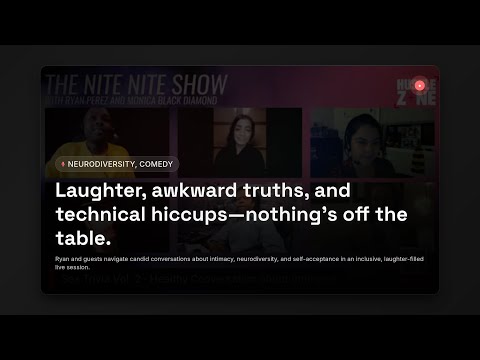
Even on a show built entirely around talking about sex, the most honest moment of the night was Ryan admitting his dyslexia makes it hard to put desire into words on the spot.
Real Talk & Raw Laughs: Intimacy, Neurodiversity, and Awkward Moments
Hustle Zone Jam Session | Sunday Funday
This week’s Hustle Zone TV “Sunday Funday” opened the way it usually does when the topic is sex: late, a little chaotic, and already laughing. Hosts Ryan Perez and Monica Black Diamond admitted on air that they’d lost track of time during their pre-show warm-up, joking that they get together an hour before every stream just to laugh through the night’s questions before they ever go live.
Once the stream steadied — after some early technical hiccups with Facebook audio and sharing links — the panel filled out with regulars Roberta and Sean, and two newer faces: Jasmine, a mindset coach joining her first-ever episode, and William (“Will”), a married guest who brought a very different vantage point to the conversation. Monica opened with a ground rule for the night: no swearing, no weirdness, no long speeches, and respect for the space, since it was billed as a healthy, safe place to talk about something people don’t usually say out loud.
The questions moved fast and got personal quickly. “What’s your favorite way to be seduced?” sent Jasmine — visibly nervous, by her own admission — into an honest answer about slow teasing and being “edged,” while Sean’s answer got explicit enough that Ryan briefly muted the room and joked they’d “gone there” faster than expected. Ryan described himself as a “saposexual,” someone drawn first to intellectual and spiritual connection, and admitted that explaining desire out loud is hard for him — he pointed directly to his dyslexia, saying it sometimes makes his thoughts “get all doubled up” when he’s trying to sound articulate on the spot.
The “would you rather” round covered sex all day versus masturbating all day (several guests leaned toward knowing exactly what works for their own bodies), paying for sex versus being paid, and whether a high body count in a partner is a plus or a red flag — a question that led to a broader discussion about the stigma of assuming more sexual experience means more risk. Roberta pushed back on gendered spending norms in dating, noting she’d spent more on men than they’d spent on her over the past few years of dating.
The most vulnerable stretch of the night came when the panel walked through their first time having sex. Will described his as “neat and weird at the same time,” recalling a friend having sex in the same room, and then, in a sudden shift in tone, mentioned that both his friend and that friend’s partner later died — a detail that landed heavily in an otherwise lighthearted show. One panelist described crying before her first attempt because she didn’t feel ready, and another described a painful, confusing first try where she thought something was physically wrong. Ryan closed the round with his own story: a high school first time at a friend’s house that went sideways when his body didn’t cooperate, followed by a lie about prior experience, tears, and — after getting kicked out — a long walk to the train station alone.
The back half lightened considerably with a rapid-fire “lightning round”: longest car ride ever taken (Will’s answer, thirty-two hours, drew gasps), most-played songs (Ryan named Prince’s “Purple Rain,” saying he’d drifted from being a Michael Jackson fan after watching Leaving Neverland), favorite spot to watch TV, and food dislikes, from peanut allergies to a hard pass on pork.
The episode wrapped with the group previewing the next night’s show, “Manic Monday,” which will run Truth or Dare instead of trivia — with a callback to a previous session where Sean reportedly ran outside singing Michael Jackson and did a dance routine while secretly eating seamoss disguised as a dare. As always, Hustle Zone closed the way it opened: with thanks to the panel, an invitation to join future shows through hustlezone.com, and a reminder that the show is sponsored by Bow Tie Kreative for anyone looking for a shoutout or feature.
Content note: this episode discusses sex, sexuality, and mature themes in an unscripted, adults-only format.
Lessons from this one
Talking openly about intimacy in a group is a vulnerability exercise, not just a comedy bit.
Jasmine, on her first episode, described being "super nervous and sweating" before answering the very first question, even though she said helping people get outside their comfort zone is part of her own coaching work.
Being professionally comfortable with a topic doesn't make personal disclosure about it effortless.
Jasmine is introduced as someone who coaches others on exactly this kind of self-expression, yet she still described sweating and feeling nervous before sharing her own answers on air.
Neurodivergent traits like dyslexia can shape real-time verbal expression of desire, not just reading and writing.
Ryan directly connected his dyslexia to difficulty articulating his feelings on the show, saying his thoughts get "all doubled up" when he tries to explain something like seduction in the moment.
Awkward, upsetting, or physically confusing first sexual experiences are common, not evidence something is wrong with a person.
Panelists described first-time experiences ranging from crying because they felt unready, to a painful and confusing first attempt, to Ryan's own account of his body not cooperating and lying about prior experience out of embarrassment.
Assumptions linking a partner's sexual history to health or trustworthiness function as a social stigma rather than a fact.
During the high-body-count discussion, one panelist explicitly named the assumption that more sexual partners means more disease risk as a stigma people need to get over, while others said a partner's number never factored into their own attraction.
Sources
- Aron, A., Melinat, E., Aron, E. N., Vallone, R. D., & Bator, R. J. (1997). The Experimental Generation of Interpersonal Closeness: A Procedure and Some Preliminary Findings. Personality and Social Psychology Bulletin, 23(4), 363-377.
- Clance, P. R., & Imes, S. A. (1978). The Imposter Phenomenon in High Achieving Women: Dynamics and Therapeutic Intervention. Psychotherapy: Theory, Research & Practice, 15(3), 241-247.
- Faust, M., & Sharfstein-Friedman, S. (2003). Naming Difficulties in Adolescents with Dyslexia: Application of the Tip-of-the-Tongue Paradigm. Brain and Cognition, 53(2), 211-217.
- Higgins, J. A., Trussell, J., Moore, N. B., & Davidson, J. K. (2010). Virginity Lost, Satisfaction Gained? Physiological and Psychological Sexual Satisfaction at Heterosexual Debut. Journal of Sex Research, 47(4), 384-394.
- Crawford, M., & Popp, D. (2003). Sexual Double Standards: A Review and Methodological Critique of Two Decades of Research. Journal of Sex Research, 40(1), 13-26.
- Runtime
- 1h 46m
- Show
- Hustle Zone Jam Session
- Host
- Ryan Perez
Been through something like this?
Hustle Zone Jam Session is conversations with people who built something out of the thing that was supposed to stop them. If that is you, say so.