Resilience Rules
Brandon Adams’ Entrepreneurial Journey & Crowdfunding Secrets
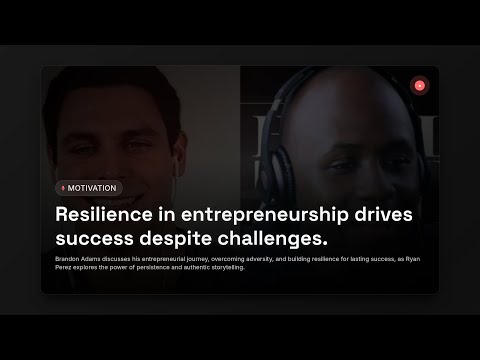
There's no such thing as overnight success - as Brandon Adams put it, every overnight success is years in the making that nobody was around to see.
Resilience Rules: Brandon Adams’ Entrepreneurial Journey & Crowdfunding Secrets
Ryan Perez opened this episode of Hustle Zone a little later than planned - technical hiccups, he admitted, plus a CPU-hungry background he’d just stripped out of his setup - but he made clear the delay was worth it. His guest was Brandon Adams, a fellow millennial entrepreneur Ryan described as someone who has his stuff together, and the two dug into a story that started with ice and ended up in crowdfunding rooms with Shark Tank’s Kevin Harrington and Napoleon Hill’s estate.
Adams’ roots are literal: his father started an Arctic Glacier ice distributorship in 1986, three years before Brandon was born, and Brandon grew up working the business, learning, as he put it, the ins and outs, from customers who didn’t pay to trucks that broke down. He eventually bought a percentage of the company and, two years later, acquired it outright from his dad.
The real turn came from a simple problem: delivering ice on a hot day and wanting a faster way to keep a drink cold and flavored. That idea became the Arctic Stick, and Adams poured three and a half years and about $100,000 into developing it, money earned selling real estate on weekends, selling ice, and working for the company that supplied his product. He calls that $100,000 an education, not a loss, because it’s where he learned marketing, commercials, and how to be on camera.
When Arctic Stick needed a final round of funding, Adams ran a Kickstarter campaign. He’d seen a viral potato salad campaign raise $50,000 and figured he could do something similar. Instead, over 33 days, he raised $26,000, solid, he said, but not huge, and walked away realizing he didn’t know anything about crowdfunding. So he set out to become an expert: interviewing successful campaigners like Chris Hawker (whose cooler campaign raised $13.2 million), studying what separated winning campaigns from failed ones on Kickstarter, starting his own podcast (Live to Grind), and writing a book, Keys to the Crowd: Unlocking the Power of Crowdfunding, in 2015.
That year he also bootstrapped hard, driving an F-150 across the country promoting local campaigns, once completing a ten-day loop from Des Moines to California and back for under a thousand dollars by sleeping in his truck rather than paying for hotels, and funneling the savings into Facebook ads. The payoff came through a podcast interview with John Lee Dumas of Entrepreneur on Fire, which turned into a book-launch crowdfunding campaign for The Freedom Journal that raised half a million dollars in a month; Adams says it became the fifth-largest crowdfunding campaign in history for a book. From there came campaigns with Kevin Harrington (original Shark Tank shark) and a Think and Grow Rich legacy project, plus a campaign that Adams says raised $365,000. Last year, he says, his crowdfunding work brought in $1.5 million for clients and a stake in three companies.
Adams laid out the framework he built from that experience, which he calls FUND: Forethought (45 to 60 days of prep before launch), Utilize a marketing plan (ads, podcasts, PR, JV partnerships, email), Narrative (a story told through video and copy), and Deliver value (an offer people actually want, since backers are pre-ordering, not donating).
The conversation’s rawest moment came when Ryan pushed past the highlight reel. Adams described 2014: he’d left his corporate job, lined up roughly $750,000 in investment for a new product development company, signed a lease, and convinced his girlfriend to quit her job to join him, then the funding fell through at the last minute. He was left with a lease, no money, and a partner who’d walked away from her career for him. He gave himself a week to be angry, then pivoted back to what he knew: relaunching Arctic Stick through crowdfunding while doing modeling gigs and commercials to cover rent.
That setback, he says, taught him that success isn’t overnight, it’s built in the unseen grind beforehand. He credits Think and Grow Rich and its portraits of Henry Ford, Andrew Carnegie, and Thomas Edison for shaping his belief that persistence, not talent alone, separates people who make it from those who quit when things get hard.
A quick lightning round closed things out: milkshakes and cookie dough ice cream for dessert, Black Mirror (a recommendation he got from Kickstarter’s Perry Chang) and Limitless for viewing, know-it-alls as his biggest pet peeve, and Foo Fighters over Nirvana. Asked what he’d tell his younger self, Adams didn’t hesitate: build an audience sooner, and start creating consistent content, video, podcast, blog, whatever the medium, years earlier than he did.
Ryan closed out the episode by inviting Adams back, floating him as a possible contributor to the Hustle Zone magazine launching September 1st, and thanking him for a conversation heavier on hard facts than most.
Lessons from this one
A costly product failure can be the most valuable education an entrepreneur ever pays for.
Peer-reviewed entrepreneurship research backs the general mechanism (not the specific dollar figures or Arctic Stick outcome, which are Adams' own account). Jason Cope's interpretative phenomenological study of entrepreneurs who experienced business failure found that failure triggers a distinct, often deep form of 'higher-level learning' — about oneself, one's business, networks, and how to manage relationships and future ventures — that founders reported as more transformative than learning gained during success. This matches Adams' claim that the money-losing Arctic Stick period taught him marketing, video, and crowdfunding skills he later monetized.
Crowdfunding success follows a repeatable framework rather than luck.
Ethan Mollick's foundational empirical study analyzed over 48,500 Kickstarter projects (roughly $237M raised) and found that outcomes are not random: personal network size, project quality/preparation signals (e.g., video presence, updates), and geography systematically predict whether a campaign succeeds or fails, and funding trajectories follow identifiable patterns. This supports the idea that studying past campaigns to extract a repeatable method (Adams' 'FUND' approach) is a reasonable, evidence-consistent strategy, though the specific FUND framework itself is Adams' own proprietary model, not something the study tested directly.
What looks like an overnight breakout is usually the payoff of a long, invisible grind.
Angela Duckworth and colleagues' widely cited research defined 'grit' as perseverance and sustained passion toward long-term goals despite setbacks and plateaus, and found it predicts achievement across domains (including entrepreneurial-adjacent high-attrition contexts like West Point cadets and National Spelling Bee finalists) better than talent alone. This supports the general pattern Adams describes — a year of grinding before a visible breakout — though the study does not address his specific circumstances (sleeping in a truck, the Freedom Journal campaign).
Giving away consistent, free value builds the trust that later converts into paying customers.
No controlled study found on content marketing or free-value strategies converting into paid course sales specifically. The closest verifiable research grounding is the psychological reciprocity principle: Goldstein, Griskevicius, and Cialdini's field experiments found that providing an unsolicited benefit increases a recipient's willingness to cooperate or reciprocate later, even when the benefit and the eventual ask are unrelated. This offers a plausible psychological mechanism behind 'people buy from people' after receiving free value, but it does not test online content marketing, course launches, or the Michael Devin example directly, so it should be read as supporting context rather than a direct evidence base for the specific claim.
A collapsed deal doesn't have to end a business - pivoting back to fundamentals can save it.
Dean Shepherd's influential theoretical and empirical work on entrepreneurial 'grief recovery' proposes that founders who experience a major venture-threatening loss go through a grief-like process, and that consciously working through that loss (rather than avoiding it) restores the capacity to re-engage with the business and act on new opportunities faster. This maps onto Adams' account of taking a week to process the collapsed $750,000 deal before relaunching his existing Arctic Stick campaign, though the study is about the psychological recovery process generally rather than this specific incident.
Sources
- Cope, J. (2011). Entrepreneurial learning from failure: An interpretative phenomenological analysis. Journal of Business Venturing, 26(6), 604-623.
- Mollick, E. (2014). The Dynamics of Crowdfunding: An Exploratory Study. Journal of Business Venturing, 29(1), 1-16.
- Duckworth, A. L., Peterson, C., Matthews, M. D., & Kelly, D. R. (2007). Grit: Perseverance and Passion for Long-Term Goals. Journal of Personality and Social Psychology, 92(6), 1087-1101.
- Goldstein, N. J., Griskevicius, V., & Cialdini, R. B. (2011). Reciprocity by Proxy: A Novel Influence Strategy for Stimulating Cooperation. Administrative Science Quarterly, 56(3), 441-473.
- Shepherd, D. A. (2003). Learning from Business Failure: Propositions of Grief Recovery for the Self-Employed. Academy of Management Review, 28(2), 318-328.
- Runtime
- 49m
- Show
- HustleZone
- Host
- Ryan Perez
Been through something like this?
HustleZone is conversations with people who built something out of the thing that was supposed to stop them. If that is you, say so.