Overcoming Lyme Disease
Jared Dylan's Inspiring Story of Music, Healing & Resilience
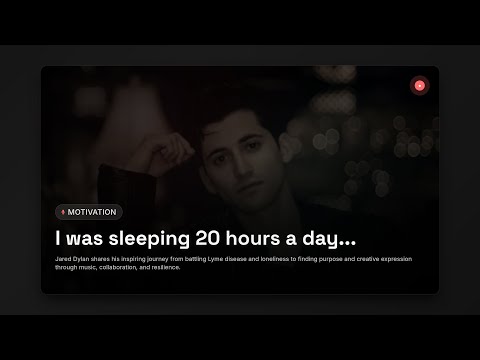
Jared Dylan on isolation in the creative life: "We're all alone, which means we're all alone together."
Overcoming Lyme Disease: Jared Dylan’s Inspiring Story of Music, Healing & Resilience
Hustle Zone Exclusiva
On this episode of Hustle Zone Exclusiva, hosts Ryan Perez and co-host Monica welcomed singer-songwriter Jared Dylan for a conversation that moved between origin story, songwriting craft, industry hard truths, and a live acoustic performance — all introduced, fittingly, under the show’s “story behind the glory” banner.
From a Hospital Bed to a Microphone
Jared’s path into music didn’t start with a childhood dream of the stage. He told Ryan and Monica that he started singing at 15 — and before that, there was “no clue” it was even something he could do. The turning point was a diagnosis of Lyme disease in high school, at a time when he was running varsity track and playing sports. The illness left him sleeping roughly 20 hours a day, he said, while remaining fully present mentally — a frustrating combination. Laying in bed with a guitar he’d had for years, he began “pounding out” his first songs. He calls music his silver lining from that period, and it carried him on to the University of Miami, where he studied music.
Interestingly, music wasn’t his only path being considered. Jared had also taken drafting and architectural design classes in high school and had looked at the University of Miami’s architecture school before deciding — to his parents’ disappointment, as he put it — to pursue music instead. He also recalled that his father used to tell him to stop singing, only to become his biggest supporter once Jared started taking it seriously, including helping arrange a single professional singing lesson before Jared’s first-ever band audition.
Silver Linings and “We Can’t”
Asked why his songs so often land on a silver lining even in sad material, Jared explained that he doesn’t want to be the angry or upset person he sometimes feels like being — the music is how he pushes through instead. He described his songwriting as always rooted in real experience, usually written weeks or months after an event so he can process it first. The exception was “We Can’t,” which he said came out almost in real time: written the day after a difficult, unresolved encounter with a long-distance girlfriend during a trip to Los Angeles, down to a bridge line inspired by ignoring one of her calls mid-session.
He also shared a story about opening for Andy Grammer at the Jersey Shore and again in Rhode Island, where he met a fan after a show who, he learned a week later, had not made it home that night — and whose mother reached out to thank him for the joy he’d brought her. It’s the kind of moment, he said, that reminds him why he makes music at all.
Business Lessons, Independent Artist Myths, and a Pandemic Pivot
When the conversation turned to advice for artists coming up in the industry, Jared pushed back on what he called a “massive misconception” about independence — that going independent means not answering to anyone, when in reality it demands enormous time, money, and energy just to retain ownership of your work. His core advice: you can’t do it alone, be valuable rather than chase money, and — his biggest point — never compromise your voice.
On the pandemic’s impact, Jared said a month of booked Miami gigs was wiped out, cutting into his live-performance income. In response, he launched a freelance graphic design and animation venture, Broken Planet Media, building brand kits and ad creative for other artists and entrepreneurs. He also described crowdsourcing a music video for his song “I Really Want It” from fans across the globe during lockdown, built from clips of people holding up signs about what they wanted once stay-at-home orders lifted — edited and animated entirely by Jared himself in about a week and a half.
A Live Performance and a Parting Thought
Jared closed the interview by picking up a guitar and performing one of the first songs he ever wrote, about — naturally — silver linings. Reflecting on isolation in the industry, he offered a line that stuck with the hosts: that everyone is alone in their own experience, which in a sense means everyone is alone together — and that more understanding is what the world needs.
The episode wrapped with the show’s usual lightning round, covering everything from favorite cities to whether vegans can eat animal crackers, before signing off with Hustle Zone’s signature call and response.
Lessons from this one
A health crisis can become the unexpected origin of a creative calling.
Jared Dylan said he had no inclination to sing before being diagnosed with Lyme disease at 15; sleeping roughly 20 hours a day but mentally present the whole time, he began writing his first songs from bed with a guitar he'd had for years, calling music the silver lining of his illness. This maps onto the peer-reviewed construct of 'posttraumatic growth' in positive psychology, where a subset of people report increased creative output and creative identity specifically following illness or adversity, not despite it.
Artistic authenticity and financial compromise are often framed as a direct trade-off.
Jared said his biggest piece of advice was to never compromise your voice, describing times he let music sound different than he wanted because he was told it was how to become successful, and suggesting that widespread dissatisfaction among successful artists may stem from exactly that compromise. This lines up with the largest empirical study to date of musicians' mental health and career pressure, which found that ambition, commercial pressure, and loss of creative control are strongly linked to anxiety and depression among working musicians, including ones who have achieved conventional success.
Going independent as an artist is widely misunderstood as freedom from obligation, when it actually demands more resources, not fewer.
Jared called it a massive misconception that independent artists don't answer to anybody, stressing the time, money, and energy required just to maintain ownership of one's work, and framed the independent-versus-label choice as a matter of what an artist is actually trying to achieve. Research on the shift toward digitally driven independent music production similarly documents that going independent trades a label's infrastructure for a heavier personal burden of entrepreneurial labor, capital, and self-management, rather than eliminating obligations.
Specific, lived personal experiences can produce songs that feel universally relatable to listeners.
Jared described writing 'We Can't' as a literal, near real-time recount of a specific breakup trip to Los Angeles, yet said he deliberately writes lyrics that capture emotion in a way that leaves room for any listener to apply their own experience to it. A genuine, targeted search (including checks against Crossref and Semantic Scholar for research on specificity versus universality in autobiographical songwriting and listener identification) did not surface a peer-reviewed study examining this specific songwriting mechanism. No controlled study found for this specific claim — reflects the guest's own lived craft experience and songwriting philosophy, presented as such rather than as research-backed fact.
No controlled study found for this specific claim — reflects the guest's own lived craft experience, presented as such rather than as research-backed fact.
Creative professionals facing a collapse in one income stream can pivot to adjacent skills to stay afloat.
Jared explained that COVID-19 wiped out a month of booked Miami performances, a major source of his income, prompting him to launch a freelance graphic design and animation business, Broken Planet Media, building brand kits and ad creative for other entrepreneurs. This matches academic research documenting how COVID-19 exposed the pre-existing precarity of creative and cultural workers and forced many into rapid adaptation of their income sources and work activities; the study documents the disruption and forced adaptability broadly rather than this specific design-pivot case.
Sources
- Forgeard, M. J. C. (2013). "Perceiving Benefits After Adversity: The Relationship Between Self-Reported Posttraumatic Growth and Creativity." Psychology of Aesthetics, Creativity, and the Arts, 7(3), 245-264.
- Gross, S. A., & Musgrave, G. (2020). Can Music Make You Sick? Measuring the Price of Musical Ambition. University of Westminster Press.
- Hracs, B. J. (2012). "A Creative Industry in Transition: The Rise of Digitally Driven Independent Music Production." Growth and Change, 43(3), 421-446.
- Comunian, R., & England, L. (2020). "Creative and cultural work without filters: Covid-19 and exposed precarity in the creative economy." Cultural Trends, 29(2), 112-128.
- Runtime
- 1h 22m
- Show
- HustleZone
- Host
- Ryan Perez
Been through something like this?
HustleZone is conversations with people who built something out of the thing that was supposed to stop them. If that is you, say so.