How RV Living After Loss Transformed My Life – Freedom, Healing & New Beginnings
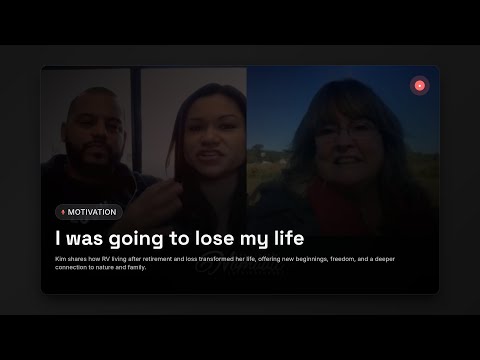
After watching her own mother wait until retirement to travel and die before she got the chance, Kim Ingram decided real freedom meant not waiting for "someday" — so she sold her house, rented it out for income, and moved into an RV instead.
How RV Living After Loss Transformed Kim Ingram’s Life
A year ago, Kim Ingram was a dental assistant of more than 30 years, working out of a three-bedroom, two-bath home. Today she lives on ten acres in Live Oak, North Florida, in an RV, with her two dogs, running a full-time photography business and dreaming about a Volkswagen camper van. On this episode of First Class RV Adventures, hosted by Sandra and Louis, Kim walked through how she got from one life to the other — and why she doesn’t plan on going back.
The turning point wasn’t one single thing, Kim explained, but several forces arriving at once. A hip replacement in February forced her to retire from dental assisting. And underneath that was something heavier: a year and a half before this conversation, her daughter — an RN, 32 years old, mother of three — died tragically. Kim doesn’t dwell on the details on air, but she’s direct about the effect it had on her. Her ex-son-in-law had once joked that she could probably live a year off whatever she made selling everything in her house. After her daughter’s death, that offhand comment stopped sounding like a joke and started sounding like a plan. “Life is too short,” she said — and she began giving things away.
She calls the process “freeing,” and it clearly still moves her to talk about it. Sandra, one of the hosts, said just hearing Kim describe it gave her goosebumps — the realization of how much weight all that stuff had actually been putting on her.
Kim also traces the decision back further, to her own mother, who died of cancer at 62 after spending years waiting until retirement to finally travel. That moment, back in 2001, stuck with Kim as proof that “someday” doesn’t always come. It’s part of why she now describes herself as freer than her brother, even though he lives in a large lakefront home near Orlando and she lives in a camper. He works hard to afford that house, she said, recalling a visit where he admitted he couldn’t stop to enjoy a beautiful sunrise because he had to go to work. Kim sees her own life — birds, a slower pace, sitting by the river — as the thing people actually work their whole lives to eventually get.
The RV setup itself is practical as much as philosophical. Kim’s camper sits on her ten-acre property, and she also owns land on the Swanee River, where the water rises and falls too much to safely build a permanent structure. Renting out her original house, starting in June, now covers her mortgage and expenses — residual income that funds the RV lifestyle rather than a windfall from selling it all off. Her photography, meanwhile, has gone from a side passion to her main pursuit, including small photo travel tour workshops she’s building out, capped intentionally at four or five people so she can actually teach while she travels.
Not everything has been smooth. Kim described a recent roof leak near her AC unit during heavy rain, serious enough that she needed a five-gallon bucket in the middle of the floor. She’s hooked into a septic system since she’s stationary, and during a recent cold snap into the 20s, she ran water all night to keep pipes from freezing. She was also candid about a towing mishap: her RV had to be pulled by friends because her Jeep Grand Cherokee wasn’t capable of hauling it — a mistake she chalks up to inexperience with a rig that size, despite years of towing horse trailers and boats. Her advice for anyone considering the same move: know exactly what your vehicle can handle before you buy.
Looking ahead, Kim wants to eventually trade her current rig for something smaller — a VW-style camper van, both for gas mileage and easier parking, inspired partly by another RV family’s stories about struggling to fit big rigs into tight state park spots.
Asked how she wants to be remembered, Kim didn’t hesitate: she wants to inspire people, especially through her photography, and she wants her grandkids to say “Grammy did this and Grammy did that” — carrying on the same spirit of adventure and self-sufficiency she once taught their mother.
Kim can be found at KimIngramPhotography.com, on Facebook as Kim Ingram, and at phototraveltourworkshops.com, where she’s planning a series of local 2018 trips.
Lessons from this one
Grief and loss can become a direct catalyst for radical life redesign rather than something people simply 'move past.'
Kim's daughter died tragically at 32, and in the aftermath an offhand comment from her ex-son-in-law about selling everything in her house became the practical seed for downsizing into an RV; Kim ties the decision explicitly to the realization that 'life is too short.'
Watching a loved one defer their dreams until retirement can be a powerful trigger for choosing to act now instead of later.
Kim describes her mother dying of cancer at 62 after 'waiting till she retired so she could travel,' calling it a pivotal moment in 2001 that shaped her own resolve to live in the present rather than postpone.
Fung HH, Chu ST, Jiang D, Chen AX, Ng CC (2020). 'Contrasting the Effects of Mortality Salience and Future Time Limitation on Goal Prioritization in Older and Younger Adults.' The Journals of Gerontology: Series B, 75(10): 2112–2121. Note: the study found future-time-limitation and death-reflection primes (not mortality salience alone) shifted older adults' goal priorities toward emotionally meaningful pursuits — a closely related but not identical finding to Kim's specific narrative of a parent deferring travel until retirement.
Deliberately downsizing possessions can produce real, felt psychological relief, not just a smaller footprint.
Kim describes giving away her belongings as 'so freeing,' and both she and host Sandra emphasize the emotional weight of stuff people don't realize they're carrying until they let it go.
Saxbe DE, Repetti R (2010). 'No Place Like Home: Home Tours Correlate With Daily Patterns of Mood and Cortisol.' Personality and Social Psychology Bulletin, 36(1): 71–81. Found that people who described their homes as cluttered/incomplete showed flatter diurnal cortisol slopes (a marker linked to worse health outcomes) and rising depressed mood across the day, versus those describing restorative homes — evidence connecting a cluttered environment to measurable stress, though the study did not test the act of decluttering itself.
Alternative lifestyles are often funded by restructuring existing assets rather than by earning more or living purely on savings.
Kim didn't stop generating income when she moved into the RV — she began renting out her original house, which she says covers her mortgage and expenses as residual income supporting her new lifestyle.
No controlled study found for this specific claim ('house hacking' as a financial-independence strategy is a well-documented personal-finance practice, but a genuine search turned up no peer-reviewed study, government report, or academic source directly evaluating it) — reflects the guest's own lived experience, presented as such rather than as research-backed fact.
An inspiring lifestyle leap still requires unglamorous, practical planning around vehicle capacity, weather, and maintenance.
Kim needed friends to tow her RV because her Jeep Grand Cherokee couldn't pull it, dealt with a roof leak that required a bucket on the floor during heavy rain, and ran water overnight in freezing temperatures to prevent pipes from bursting.
Sources
- K NVSL, Rajkumar E, Gopi A, Hareesh PV, Romate J, Lakshmi R, Abraham J (2024). 'Correlates of post-traumatic growth among persons bereaved from cancer: A systematic review and meta-analysis.' PLOS ONE, 19(3): e0300291.
- Fung HH, Chu ST, Jiang D, Chen AX, Ng CC (2020). 'Contrasting the Effects of Mortality Salience and Future Time Limitation on Goal Prioritization in Older and Younger Adults.' The Journals of Gerontology: Series B, 75(10): 2112–2121.
- Saxbe DE, Repetti R (2010). 'No Place Like Home: Home Tours Correlate With Daily Patterns of Mood and Cortisol.' Personality and Social Psychology Bulletin, 36(1): 71–81.
- RV Safety & Education Foundation (RVSEF) — RV towing, weight-rating, and safety education resources.
- Runtime
- 28m
- Show
- First Class RV Adventures
- Host
- Ryan Perez
Been through something like this?
First Class RV Adventures is conversations with people who built something out of the thing that was supposed to stop them. If that is you, say so.