The Truth About Full-Time RV Living: Freedom, Challenges & Life-Changing Lessons
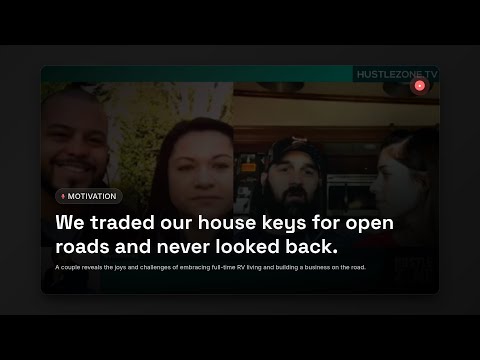
Kelly and Rob's philosophy for full-time RV life is refreshingly simple: keep doing it until it's not fun anymore, and know you can always go back to a house in the suburbs.
The Truth About Full-Time RV Living: Freedom, Challenges & Life-Changing Lessons
First Class RV Adventures — hosted by Sandra and Louis
When Sandra and Louis sat down (virtually, RV-park Wi-Fi permitting) with Kelly and Rob of the Wandering Whims, the couple had just crossed a milestone: one year and ten days on the road, or as they call it, their “Nomiversary.” What followed was a candid conversation about what actually happens when two people trade a house for 400 square feet on wheels — the good, the broken, and the occasional toilet disaster.
From carry-ons to a house full of stuff they didn’t need
Kelly, a former elementary school teacher of eight years, and Rob, a union electrician, didn’t set out to become full-time RVers. The idea was born out of a planned trip to Europe. After researching camper van travel abroad, they instead spent about ten weeks backpacking and living out of Airbnbs and carry-on suitcases. When they returned to their roughly 2,000-square-foot house in Las Vegas, something had shifted. As they put it, they walked in and thought, “why do we have all this stuff?” It didn’t feel like home anymore, and Kelly didn’t want to clean it. They sold the house and bought an RV.
Friends, family, and the “real world” question
Not everyone was on board. Kelly and Rob said most friends and family thought they were crazy, and a year in, some still ask when they’re “going back to the real world.” Kelly’s dad was initially skeptical too — she described his mindset as the classic “work a job for 30 years and then retire” script — but after they visited him for a couple of months, he came around. Kelly and Rob both noted a pattern: people they meet through the RV community simply get it, while people from their old lives take longer, and some, they suspect, are a little jealous they didn’t do it sooner themselves.
Downsizing looked different for each of them
The two approached letting go of possessions in opposite ways. Rob said he threw away anything that was solely his — he doesn’t get attached to things — though he admitted his race car, boat, and 800-square-foot man cave took some real effort to part with; his car still lives in a storage unit they pay for monthly. Kelly went the other direction, keeping a storage unit in Las Vegas that holds years of elementary classroom supplies (expensive and time-consuming to rebuild from scratch) along with her mother’s belongings — her mother passed away two years before they sold the house, and Kelly said she wasn’t emotionally ready to offload everything at once. They haven’t visited that unit in a year and hope to sort through it in the spring. Rob also gave a shoutout to a friend’s startup, Stash, an Airbnb-style alternative to traditional storage units.
The RV that was too big, and the fridge that fell over
Their first rig was a 42-foot fifth wheel, towed by truck for a combined length of around 53 feet — which, they now admit, was too big. They struggled to find parking and make tight turns, and dealt with recurring mechanical issues, including black tank problems and a residential fridge in a slide-out that broke loose while driving, tearing out the surrounding wood. They eventually traded it in — retiring “Old Murphy” — for a Heartland Big Horn fifth wheel they’ve named Bernadette, a change they call a healthy loss.
Living 24/7 in a small space changes how you fight
One of the more honest moments was about relationship communication. Kelly and Rob said that in a house, disagreements could end with someone going upstairs or downstairs. In an RV, there’s nowhere to go — sometimes they’re literally parked in the middle of the woods. They described it as both a blessing and a challenge that forced them to actually work on communication, and said they feel stronger for it now.
Their advice for newcomers
Rob’s tip: don’t buy your first RV too big, and don’t be afraid to buy used — do the research, read blogs, and talk to people who’ve done it. Kelly’s advice centered on community: plug into the RV world early, because the connections that form there — through social media, campground meetups, and total strangers offering a driveway to park in — can replace the sense of neighborhood many people have lost. She also spoke about the harder, identity-level side of the transition — leaving a teaching career she’d wanted since childhood and asking herself, “if I’m not a teacher, then who am I?”
And for anyone wondering about RV toilets: don’t triple up on chemicals. Kelly learned the hard way in Quincy, Washington, that too much can turn toilet paper into a paste that clogs the black tank — solved, eventually, with a drill, a snake, and a lot of patience. Baking soda and vinegar, they said, work just fine.
Kelly and Rob are now launching Wellness on Wheels, a health-coaching brand and YouTube channel with the tagline “Healthy Living For The Modern Nomad,” covering no-gym workouts and holistic nutrition for people living the nomadic lifestyle.
Lessons from this one
Downsizing to a small space is an emotional process, not just a logistical one, and people process attachment differently.
Rob said he threw away everything that was solely his because he doesn't get attached to things, while Kelly kept a storage unit holding her teaching supplies and her late mother's belongings, saying she wasn't emotionally ready to offload it all at once.
Living in a tiny, mobile space with no room to retreat during conflict can force couples to build stronger communication skills.
Kelly and Rob explained that in a house you could walk away from an argument by going upstairs or downstairs, but in the RV there's nowhere to go, which they called both a challenge and something that ultimately strengthened their relationship.
First-time RV buyers commonly overbuy on size, which creates real logistical and mechanical problems down the road.
Their first RV was a 42-foot fifth wheel towing to roughly 53 feet total, which led to parking and maneuvering problems and repeated mechanical failures, prompting Rob's advice to new buyers not to go too big.
Online, interest-based communities can replace the geographic sense of neighborhood that many people have lost in traditional life.
Kelly said she's met more RVers in the last year than neighbors in her whole life, describing strangers who offered driveways, cabins, and help after a single social media post, contrasting it with what she called the transient, disconnected feel of city living.
Leaving a long-held career can trigger an identity crisis independent of the financial or logistical challenges of the transition.
Kelly described wanting to be a teacher since childhood and said that leaving the classroom meant grappling with the question 'if I'm not a teacher, then who am I,' alongside practical concerns about making money on the road.
Sources
- Belk, R. W. (1988). "Possessions and the Extended Self." Journal of Consumer Research, 15(2), 139–168.
- Christensen, A., & Heavey, C. L. (1990). "Gender and Social Structure in the Demand/Withdraw Pattern of Marital Conflict." Journal of Personality and Social Psychology, 59(1), 73–81.
- Sweeney, J. C., Hausknecht, D., & Soutar, G. N. (2000). "Cognitive Dissonance after Purchase: A Multidimensional Scale." Psychology & Marketing, 17(5), 369–385.
- Wellman, B. (2001). "Physical Place and Cyberplace: The Rise of Personalized Networking." International Journal of Urban and Regional Research, 25(2), 227–252.
- Ebaugh, H. R. F. (1988). Becoming an Ex: The Process of Role Exit. University of Chicago Press.
- Runtime
- 29m
- Show
- First Class RV Adventures
- Host
- Ryan Perez
Been through something like this?
First Class RV Adventures is conversations with people who built something out of the thing that was supposed to stop them. If that is you, say so.