Ricardo Mcrae
Balancing Family, Creativity & Entrepreneurship Against All Odds
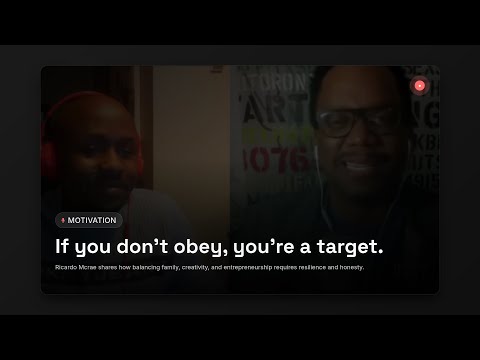
Ricardo McRae's enduring measure of gratitude and resilience, forged from a two-week stretch living on a single shared onion: "If I got more than an onion, I can't be beaten."
Ricardo McRae: Balancing Family, Creativity & Entrepreneurship Against All Odds
There’s a moment early in this episode of Hustle Zone where Ricardo McRae describes coming home from the high of a TEDx stage — his wife nine months pregnant, thousands watching — only to get a call hours later that his ten-year-old nephew had been carried off a football field on a stretcher. “Life happens like that,” he tells host Ryan Perez. That whiplash, between triumph and reality, runs through the whole conversation.
McRae’s story starts in Trinidad and Tobago, where his grandfather and great-grandfather ran a watch and jewelry repair business he was being groomed to inherit before he was sent to Canada for school. The lessons stuck even after the plan changed — he recalls his grandfather explaining that a watch repaired in an hour could still be worth more than one fixed in a week, because “value gets created when you’re good,” not just when you work long hours.
Canada, though, didn’t start easy. At 17, McRae left his father’s house in the middle of a snowstorm with two garbage bags of belongings rather than continue living with what he describes as a strict, sometimes violent household. He was taken in by a family down the street — people he affectionately calls out for saving his life — and finished high school while working, at one point living above a “crackhead,” shopping at Goodwill, and cooking meals in a single pot. He describes a stretch with a friend where the only food in the fridge was one onion, sliced and toasted on a dry skillet and split between them. “If I got more than an onion, I can’t be beaten,” he says — a line that recurs throughout the episode as his personal measure of gratitude.
That hunger, he says, drove him: at 18 he started a painting company that grew to 16 employees within three months, funding his way through university while working what amounted to five jobs at once and riding a bicycle through Canadian winters because he couldn’t afford a car. He later moved into corporate tech sales — including a stint at Worldcom/MCI, where he crossed paths with internet pioneer Vint Cerf — before walking away from a six-figure job in 2000. The catalyst was a close friend, dying of cancer, who told McRae his biggest regret was never finishing a jazz album for his son. McRae quit his job days later to go back to art and web design, eventually blending his corporate and creative sides into branding and marketing work.
He met his wife, Gloria, at a tanning salon in January 2010 while doing design work for the owner. Within a year, she’d left her own job and started a business; they married and built their company, Wedge15, together. McRae credits their partnership’s survival to what he calls radical honesty — debriefing after every client meeting, calling out things like being talked over in real time, and agreeing that the relationship always comes before the business, even when a fight has to be paused mid-meeting with a client.
That commitment to integration extended to parenting. McRae describes losing roughly $40,000 in contracts in the first 30 days after having his son, because he refused to hide the fact that a baby was now part of his work life — bringing him into boardrooms rather than pretending he didn’t exist. One prospective client, he later learned, backed out because “the guy didn’t think you’d be able to manage it.” McRae’s answer was to keep showing up with his son anyway, while acknowledging the real guilt of eventually transitioning him to daycare.
The two also share the story of preparing for and delivering a joint TEDx talk at the University of Waterloo — a rare dual presentation for which they needed special organizer permission — working with a voice and acting coach who had them practice trust exercises (literally balancing sticks between their fingertips with eyes closed) to learn to move together without competing for the spotlight.
Woven through it all are stranger-than-fiction detours: suing a record label as a broke student and winning by out-preparing the opposing lawyers (advice he got, unprompted, from Johnny Cochran at a book signing), and meeting Rosa Parks through the same case. McRae credits years of therapy and personal development work for helping him process a difficult upbringing without letting it define him.
By the end of the conversation, McRae’s focus has shifted outward — not to his own comfort, but to what he can set up for his son and, eventually, grandchildren. Asked what he’d wish for with a single magic wand, he doesn’t hesitate: “abundant resilience and confidence for my son.”
Lessons from this one
Radical, agreed-upon honesty is what lets a couple survive running a business together.
Ricardo says he and Gloria agreed from their first date to be completely honest with each other, debrief after every client meeting with 'how was that for you,' and always resolve personal conflict before returning to business — putting the relationship ahead of the business at all times.
Refusing to hide family life from work can cost real money, but integration over concealment paid off long-term.
Ricardo states they lost about $40,000 in contracts in the first 30 days after having their son because a client assumed he 'wouldn't be able to manage' the business with a baby around, yet he kept bringing his son into boardrooms rather than hide him.
Severe scarcity in youth can be reframed into a lasting resilience and gratitude framework rather than a wound.
Ricardo describes living on a single shared onion for two weeks as a student and still uses the line 'if I got more than an onion, I can't be beaten' as his personal barometer for gratitude and toughness today.
Over-preparation, not raw talent, is what produces calm performance in high-stakes moments.
Ricardo recounts self-preparing an entire lawsuit against a record label as a broke student after Johnny Cochran told him to 'out-prepare the competition,' and separately describes months of TEDx rehearsal with a voice coach that left him and his wife calm on stage despite forgetting rehearsed lines.
Comparative gratitude — measuring your situation against those with far less — can function as a practical coping tool during hardship.
Ricardo tells young entrepreneurs to stop looking only at their own circumstances and instead consider that living in North America already puts them ahead of most of the world, using this comparison to reframe discomfort as solvable rather than a real 'problem.'
Sources
- Fitzgerald, M.A. & Muske, G. (2002). "Copreneurs: An Exploration and Comparison to Other Family Businesses." Family Business Review, 15(1).
- Ashforth, B.E., Kreiner, G.E., & Fugate, M. (2000). "All in a Day's Work: Boundaries and Micro Role Transitions." Academy of Management Review, 25(3), 472-491.
- Rudman, L.A. & Mescher, K. (2013). "Penalizing Men Who Request a Family Leave: Is Flexibility Stigma a Femininity Stigma?" Journal of Social Issues, 69(2), 322-340.
- Tedeschi, R.G. & Calhoun, L.G. (1996). "The Posttraumatic Growth Inventory: Measuring the Positive Legacy of Trauma." Journal of Traumatic Stress, 9(3), 455-471.
- Ericsson, K.A., Krampe, R.T., & Tesch-Römer, C. (1993). "The Role of Deliberate Practice in the Acquisition of Expert Performance." Psychological Review, 100(3), 363-406.
- Wills, T.A. (1981). "Downward Comparison Principles in Social Psychology." Psychological Bulletin, 90(2), 245-271.
- Runtime
- 1h 45m
- Show
- HustleZone
- Host
- Ryan Perez
Been through something like this?
HustleZone is conversations with people who built something out of the thing that was supposed to stop them. If that is you, say so.