
Unlock True Success
How Servant Leadership Transforms Teams & Lives
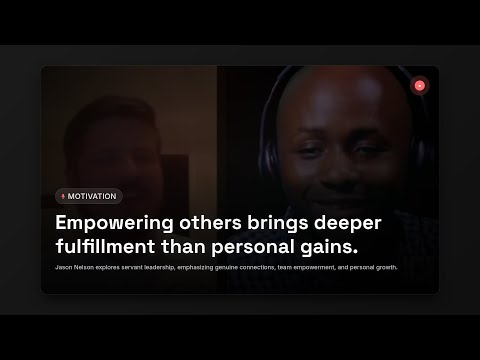
"I always think of myself as serving anyone... rather than me thinking that I'm in charge" — Joshua Nelson's entire leadership philosophy in one line: you lead by serving, not commanding.
Unlock True Success: How Servant Leadership Transforms Teams & Lives
There’s a moment early in this episode of The Hustle Zone where host Ryan Perez admits he almost didn’t know what to expect from his guest. He’d booked Dr. Joshua Nelson — founder of the leadership and coaching company WellFed LLC — off a cold outreach message, hadn’t had time to prep, and spent the day trying to guess what “WellFed” even meant. By the end of the hour, it’s clear the confusion was worth it: Nelson delivers one of the more grounded, lived-in conversations about leadership the show has hosted.
Nelson’s path to leadership wasn’t a straight line. Born in Newport Richey, Florida, he split his childhood between Florida and Arkansas after his parents divorced. By his own account, he wasn’t a serious student — he estimates he graduated high school with something close to a 0.6 GPA and drifted for about a year before enlisting in the Marine Corps on an open contract, which meant the Corps picked his job for him. He became a data network technician and information systems chief, training at Parris Island and Twentynine Palms and serving most of his four years at Camp Lejeune. He left the Marines when his wife was eight months into their second pregnancy, took a 13-month stint at the TV ratings company Nielsen, then moved into the local school system — working his way up the ranks while going back to school for a bachelor’s in business administration, a master’s in management and leadership, and eventually a doctorate in business administration with an emphasis in technology.
The real turning point, he says, came about a year and a half to two years before this taping, when he read Michael Hyatt’s book Living Forward — which opens, notably, by having the reader write their own eulogy. That exercise pushed Nelson to notice that his fulfillment wasn’t really coming from the technology work itself, but from developing and empowering other people. Nine months before this episode aired, that realization became WellFed: a company offering one-on-one coaching, team-building sessions for groups of twenty or fewer, and motivational speaking, all built around helping people reach their own definition of success rather than a one-size-fits-all model.
Pressed on what makes a good leader, Nelson doesn’t hedge: he believes there’s only one real leadership style — servant leadership — even if there are many management techniques (authoritative, diplomatic, persuasive) layered on top of it. “Rather than me thinking that I’m in charge… I look at it in the opposite direction, whereas I’m serving them,” he tells Perez. He traces the instinct back further than his Marine Corps years or his degrees — to a playground moment around age five or six, when being bossy with his friends got him abandoned mid-game. That was his first lesson in the difference between leading and dictating.
Perez walks Nelson through a hypothetical: manage an unfamiliar 30-person team for a single day. Nelson’s answer is structured — start by asking the team what’s working and what isn’t, spend the morning cutting tasks nobody can justify, check in over a group lunch, and close with an after-action debrief that hands ownership back to the team rather than taking credit for the day’s results. On handling employees who aren’t highly skilled, his rule is simple: whatever you’d do for one employee, do for all — because neglect breeds disengagement faster than low skill does. And on people who genuinely aren’t a fit, he argues real service sometimes means an honest conversation, not propping them up out of attachment.
The conversation also covers the collision between entrepreneurship and family life. Nelson, who has five children (three biological, two his girlfriend Ashley’s), talks candidly about a computer repair business he ran in his early twenties that grew fast enough to conflict with his full-time job and schooling — and how he ultimately chose stability over the business. He’s blunt that constant hustle isn’t sustainable, comparing overwork to lifting weights: muscles need to tear and then rest to get stronger, and pushing past personal capacity without recovery just leads to burnout.
Lighter moments round out the hour — dirt pie as a favorite dessert, The Walking Dead over Game of Thrones, Michael Jackson over Prince — before Nelson answers a viewer question from Anthony Davis about sincerity, landing on a Gandhi line: be the change you want to see in the world. He closes by plugging WellFed’s Tap the Well Leadership Conference, held both in person and via livestream, and invites listeners to connect at iamwellfed.com.
Lessons from this one
Real leadership is an act of service, not authority.
Confirmed via Crossref that a real peer-reviewed meta-analysis exists testing servant leadership's incremental validity for follower/employee outcomes above other leadership styles. The paper compares servant, ethical, and authentic leadership against transformational leadership using accumulated follower-outcome data (including performance-related criteria), lending empirical backing to the idea that a service-oriented leadership style is a distinct, measurable driver of follower outcomes rather than just a philosophy.
Ignoring low-performing employees disengages them faster than their lack of skill would.
Gallup's own workplace research page (fetched and confirmed live) reports that managers account for roughly 70% of the variance in team-level engagement, and that engaged vs. disengaged work units differ by large margins in turnover, absenteeism, and profitability. This directly supports the mechanism in Nelson's golden rule: manager attention (or its absence) -- not raw skill level -- is the dominant lever on whether an employee stays engaged. It is a general engagement finding rather than a study isolating 'low performers' specifically, so it contextualizes rather than proves the exact claim.
Sustained high performance requires built-in recovery, not constant grinding.
Confirmed via Crossref that Sonnentag and Fritz's peer-reviewed instrument paper (and its follow-on validation literature) established the core recovery-experience constructs -- psychological detachment, relaxation, mastery, and control -- as the mechanism by which people replenish resources depleted by work stress and avoid burnout. This is the foundational empirical basis behind the 'recovery is required, not optional' claim; the original study was conducted on general working populations rather than entrepreneurs specifically, so it contextualizes the broader burnout-recovery principle Nelson applies to high performers.
Sometimes the most respectful thing a leader can do is help someone leave a role that isn't right for them.
Confirmed via Crossref that this is a real, widely-cited meta-analysis in Personnel Psychology synthesizing decades of research on how well a person's fit with their job, organization, group, and supervisor predicts satisfaction, commitment, and turnover-related outcomes. It supports the underlying premise that poor person-job fit carries real costs for the individual (not just the organization), making the case that moving someone toward better fit -- including out of a role -- can be a genuine benefit to them rather than a loss.
Leadership instincts can be traced back to small, formative childhood moments.
No controlled study was found that specifically validates the claim that a single early childhood incident (like being avoided by playmates after being bossy) causally shapes adult leadership style. There is real, peer-reviewed developmental psychology research on how young children establish social dominance and status hierarchies through peer interaction as early as preschool age, which is the closest genuine scientific territory to Nelson's anecdote -- but it studies group dominance dynamics broadly, not the specific autobiographical mechanism (a memorable social rejection teaching the difference between dictating and leading) that Nelson describes. That specific causal narrative reflects the guest's own lived experience and self-interpretation, presented as such rather than as an established research finding.
Sources
- Hoch, J. E., Bommer, W. H., Dulebohn, J. H., & Wu, D. (2018). 'Do Ethical, Authentic, and Servant Leadership Explain Variance Above and Beyond Transformational Leadership? A Meta-Analysis.' Journal of Management, 44(2), 501-529.
- Gallup, Inc. 'The Benefits of Employee Engagement' (Gallup Workplace research article).
- Sonnentag, S., & Fritz, C. (2007). 'The Recovery Experience Questionnaire: Development and Validation of a Measure for Assessing Recuperation and Unwinding from Work.' Journal of Occupational Health Psychology, 12(3), 204-221.
- Kristof-Brown, A. L., Zimmerman, R. D., & Johnson, E. C. (2005). 'Consequences of Individuals' Fit at Work: A Meta-Analysis of Person-Job, Person-Organization, Person-Group, and Person-Supervisor Fit.' Personnel Psychology, 58(2), 281-342.
- Strayer, F. F., & Strayer, J. (1976). 'An Ethological Analysis of Social Agonism and Dominance Relations among Preschool Children.' Child Development, 47(4), 980-989.
- Runtime
- 1h 02m
- Show
- HustleZone
- Host
- Ryan Perez
Been through something like this?
HustleZone is conversations with people who built something out of the thing that was supposed to stop them. If that is you, say so.