Unfiltered Girl Talk: Relationship Dilemmas, Mental Health & Real-Life Truths Revealed
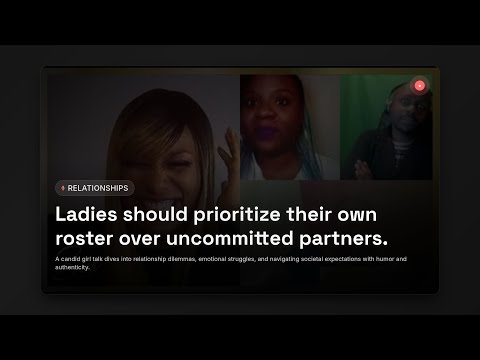
Stop dropping your roster for peasants who only want the perks of being with you, without actually being with you.
Unfiltered Girl Talk: Relationship Dilemmas, Mental Health & Real-Life Truths Revealed
Episode nine of Peasant Sex and Relationships brought host Twila together with two guests — L’Oreal, joining from the US, and a second guest she welcomed alongside her — for what she promised upfront would be “uncensored, real, raw, real time” girl talk. True to form, the hour moved from bedroom mishaps to public scandal without ever losing its edge or its sense of humor.
The “What Would Twila Do” segment
A recurring bit on the show, “What Would Twila Do,” lets listeners submit real scenarios for the host and her guests to weigh in on. This episode opened with a question about intensity in bed that’s “not good for your mental health” — prompting a running joke about needing someone’s anatomy “registered as a deadly weapon.” From there the conversation slid into the side-chick topic (which Twila flagged as its own future episode, tentatively titled “Stigmatized”), with one guest joking about “borrowing” someone else’s partner: if you’re going to do it, at least make it worth your while.
Oral sex, double standards, and cultural stigma
The most extended discussion of the night centered on oral sex as a potential deal-breaker. The guests discussed how, within West Indian and Caribbean communities — and the Jamaican community specifically, they noted — there’s a well-known double standard around men performing oral sex on their partners, with plenty of men publicly denying it while privately doing it anyway. One guest shared a personal story from around age fifteen or sixteen, lying to friends about experience to avoid embarrassment at a dance, and nearly getting exposed for it. The larger point, made repeatedly: “if you’re not giving, do not expect to receive.”
Bad performance, “second chances,” and the roster
The conversation turned frank about what to do when a sexual encounter isn’t working — one guest described a personal rule that if something isn’t good, she’ll simply get up and leave, arguing that not holding partners accountable just perpetuates a cycle of bad performance going unchecked. Both guests joked about wanting a partner’s “resume” and “references” before getting involved, while acknowledging nerves can throw someone off their game and might be worth one chance to redeem.
From there, the group tackled situationships directly — men who want “all the perks of being with you without being with you.” Twila’s advice: become deliberately unavailable, stop dropping your “roster” for men who aren’t ready to commit, and remember that the power in the situation belongs to the woman who knows her worth. That thread tied into a broader conversation about staying connected to self-worth and “divinity,” and the importance of writing down not just what you want in a partner, but what you’re not willing to tolerate.
A listener question about partners who only reach out when they want sex sparked one of the sharpest lines of the night, quoting a friend named Carla: “she ain’t your Thursday [booty call] chick.” The guests agreed that reciprocity has to run both ways, and that “no” doesn’t require an explanation — it’s a complete sentence.
The Derek Jackson conversation
Twila closed the episode by addressing a controversy that had been circulating on social media involving a relationship-advice content creator the group referred to as Derek Jackson (at another point in the conversation named Derek Braxton), who had reportedly been accused of cheating on his wife over an extended period despite building a following by counseling women on relationships. None of the three claimed deep familiarity with his content, but all found the apparent contradiction hard to reconcile — as Twila put it, you can’t build a platform criticizing cheaters while allegedly doing the same thing yourself. The group also pointed out that in situations like this, the woman involved tends to face far harsher public judgment than the man does, and that no one on the call felt qualified to say what should happen next in someone else’s marriage — only that it’s unfortunate when private struggles play out in public.
Guest info
L’Oreal can be found on Instagram and Facebook, and pointed listeners toward her business, Intuitive Biz Solutions, a systems, operations, and executive recruiting agency she’s building. The second guest also shared her Instagram handle before the group signed off, thanking viewers for watching, commenting, and sharing.
Lessons from this one
Reciprocity in physical intimacy is treated as a baseline expectation, not a bonus.
The guests repeatedly returned to the line "if you're not giving, do not expect to receive," framing oral sex specifically as something that has to go both ways in a relationship, not something one partner is entitled to without offering it themselves.
Ambiguous 'situationships' persist because one partner is allowed to enjoy commitment-level benefits without committing.
Twila described men who get "the perks of being with you without being with you" and advised making yourself deliberately unavailable to shift the dynamic, arguing the ambiguity only survives as long as it's tolerated.
Naming explicit deal-breakers in advance prevents settling later.
The group discussed how people often list what they want in a partner but rarely write down what they're not willing to tolerate, arguing that without clear deal-breakers people default to "settling, compromising, tolerating."
Audiences hold relationship-advice influencers to a credibility standard, and a private life that contradicts the public message damages trust.
The hosts reacted to a content creator who built a following advising women on relationships while allegedly being unfaithful to his own wife, calling the apparent contradiction the core problem rather than the infidelity alone.
Public scandals involving infidelity tend to expose women to harsher judgment than the men involved.
One guest noted that in situations like the one discussed, the woman involved "is going to be critiqued and judged much more harshly than the trash dude," a point the host agreed with.
Sources
- Frederick, D. A., St. John, H. K., Garcia, J. R., & Lloyd, E. A. (2018). Differences in Orgasm Frequency Among Gay, Lesbian, Bisexual, and Heterosexual Men and Women in a U.S. National Sample. Archives of Sexual Behavior, 47(1), 273-288.
- Knobloch, L. K., & Solomon, D. H. (1999). Measuring the Sources and Content of Relational Uncertainty. Communication Studies, 50(4), 261-278.
- Jonason, P. K., Garcia, J. R., Webster, G. D., Li, N. P., & Fisher, H. E. (2015). Relationship Dealbreakers: Traits People Avoid in Potential Mates. Personality and Social Psychology Bulletin, 41(12), 1697-1711.
- Djafarova, E., & Rushworth, C. (2017). Exploring the Credibility of Online Celebrities' Instagram Profiles in Influencing the Purchase Decisions of Young Female Users. Computers in Human Behavior, 68, 1-7.
- Crawford, M., & Popp, D. (2003). Sexual Double Standards: A Review and Methodological Critique of Two Decades of Research. Journal of Sex Research, 40(1), 13-26.
- Runtime
- 1h 05m
- Show
- Peasant Sex and Relationships
- Host
- Ryan Perez
Been through something like this?
Peasant Sex and Relationships is conversations with people who built something out of the thing that was supposed to stop them. If that is you, say so.