
Mastering Social Dynamics as an Introvert: Real Strategies & Honest Stories
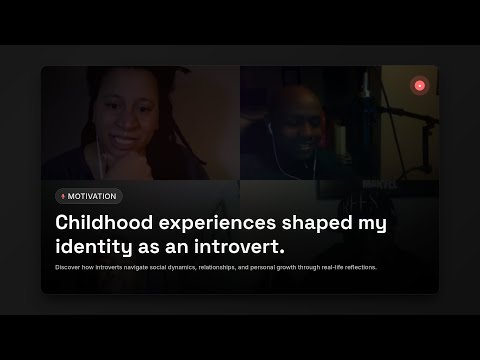
An introvert isn't someone who's shy or afraid of a crowd — it's about what happens after you're around people: whether you come out recharged, or wrung out.
Mastering Social Dynamics as an Introvert: Real Strategies & Honest Stories
For one hour on a live Blab broadcast, host Ryan Perez gathered a small circle of self-identified introverts and ambiverts — Hillman, Maya (who goes by Literary Roadhouse), Jordan, and Erin, with commenters like Dom Kannan and FD Christopher weighing in from the chat — to do something introverts rarely get invited to do: talk, at length, about themselves, in front of an audience.
The conversation opened with Ryan describing advice he gives his own daughters about starting a new job: don’t say anything the first week. Watch. Figure out who’s safe to talk to and who isn’t. That instinct — survey the land before engaging — became the episode’s throughline. Ryan offered a theory that reframed the whole group’s childhoods: introverts, he said, aren’t people who belong to one clique. They’re the ones who move between several — the athletes, the nerds, the punks — without ever fully signing on to any one of them, sitting at the overlap where all those circles meet. Hillman, a guest, said the observation “blew his mind” and connected it instantly to his own life; he described being good at nearly everything as a kid — art, athletics, whatever he tried — yet never landing on the one thing he actually wanted, pulled in too many directions to commit to a single identity.
Each guest’s origin story carried real weight. Maya recalled being teased as a child for keeping bees as pets and realizing, from how classmates reacted, that she was “different.” Ryan described growing up in the middle of a custody battle explicitly framed around race, and not meeting his biological father until 2015, after finding divorce papers as a teenager and later learning his extended family carried the same introverted, intellectually intense traits he’d been ashamed of as a kid. Jordan, who described herself as an ambivert somewhere on the spectrum depending on the day, remembered feeling extroverted growing up — dancing on stage, raising her hand in class — until she noticed she left crowded rooms and open-plan offices completely drained, even when nothing physically demanding had happened.
That distinction became the episode’s clearest definition of the term: an introvert, the group agreed, isn’t someone afraid of a camera or a crowd. It’s about what happens afterward — whether being around people recharges you or empties you out. Several guests described concrete recharge rituals: Jordan’s two-and-a-half-hour morning practice, Ryan sitting alone on his stairs or in his parked car after work, Erin’s need for quiet the moment she gets home. One guest went further, describing feeling other people’s emotional and physical energy so acutely in crowded spaces — once leaving a bar mid-date because she “couldn’t stop feeling everybody” — that she needed to physically remove herself to cope.
The discussion moved into dating, where guests described a recurring pattern: getting bored quickly in relationships, cycling between being completely closed off and completely open, and struggling to be believed when they stated plainly what they needed. Maya said she is “so plainly spoken” that partners, used to guessing, often doubt her directness. Both she and Hillman touched on something darker — an ability, once a relationship soured, to read a partner’s weak point and dismantle them verbally, sometimes without fully realizing the damage until much later.
Small talk drew groans across the group. Hillman described extending unwanted conversations so long, while looking for a graceful exit, that he’d end up looking like the one who wouldn’t stop talking. Maya said her small talk has a habit of sliding into deep, uncomfortable territory within minutes.
Parenting rounded out the conversation. Ryan admitted to timing school pickups to avoid other parents; Maya described avoiding school events “like the plague” and dropping her kids off blocks away. Erin offered a practical tip for mixed households: schedule deliberate one-on-one alone time so an extroverted child doesn’t read a parent’s need for quiet as rejection.
Ryan closed with what he called his tagline for the series: some people are built to do the talking, and some are built to do the thinking.
Lessons from this one
Introversion is defined by energy recovery afterward, not by shyness or fear of attention.
Guests repeatedly stressed that some of them are comfortable on stage, on YouTube, or in front of a microphone — the real marker is whether being around people afterward leaves them recharged or exhausted, as one guest put it directly.
People who never settled into one clique growing up may have been functioning as connectors between separate social groups.
Ryan described introverts as sitting at the overlap of several circles (athletes, nerds, punks) rather than belonging fully to one, and guests like Hillman and Maya described similar patterns of moving between disparate groups without full membership in any.
Deliberate solitude rituals function as necessary recovery, not avoidance.
Guests described specific recharge practices — a two-and-a-half-hour morning routine, sitting alone on stairs or in a parked car after work, needing quiet immediately upon returning home — framing alone time as functional maintenance rather than antisocial behavior.
Introverted parents risk their extroverted children reading normal need for alone time as personal rejection unless that need is explained and scheduled around.
One guest advised setting aside dedicated one-on-one time so an extroverted child understands a parent's post-work need for quiet isn't rejection, while another described needing to get her introverted son alone, without siblings present, before he would open up about his feelings.
People who navigate social life by closely reading others tend to have especially low tolerance for passive-aggressive communication, since it defeats their main way of establishing trust.
Ryan said he distrusts passive-aggressive people specifically because he can't read them, while another guest described consciously using passive-aggressive code-switching as a survival tactic in mixed-race or male-dominated spaces.
Sources
- Eysenck, H.J. (1967). The Biological Basis of Personality. Springfield, IL: Charles C. Thomas.
- Burt, Ronald S. (1995). Structural Holes: The Social Structure of Competition. Cambridge, MA: Harvard University Press.
- Burt, R. (2004). "Structural Holes and Good Ideas." American Journal of Sociology, 110(2), 349-399.
- Kaplan, Rachel & Kaplan, Stephen (1989). The Experience of Nature: A Psychological Perspective. Cambridge University Press.
- Ulrich, R.S. et al. (1991). "Stress Recovery During Exposure to Natural and Urban Environments." Journal of Environmental Psychology, 11(3), 201-230.
- Thomas, A., Chess, S., & Birch, H.G. (1968). Temperament and Behavior Disorders in Children. New York: New York University Press.
- McCluney, C.L., Robotham, K., Lee, S., Smith, R., & Durkee, M. (2019). "The Costs of Codeswitching." Harvard Business Review, November 15, 2019.
- Runtime
- 1h 54m
- Show
- Peasant Sex and Relationships
- Host
- Ryan Perez
Been through something like this?
Peasant Sex and Relationships is conversations with people who built something out of the thing that was supposed to stop them. If that is you, say so.