
Unlock the Secrets of Entrepreneurial Success
Spend Smarter, Build Deeper Happiness
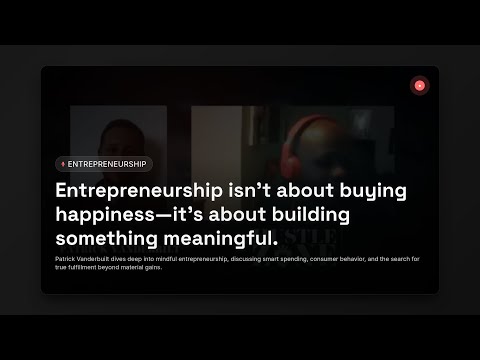
If your focus stays outward — on the next purchase instead of something deeper — internal happiness will always lag behind, because the jolt from buying something fades the moment you get used to having it.
Inside the Entrepreneur’s Mind: What Black Friday Reveals About How You Spend, Save, and Define Success
This episode of Hustle Zone kicks off a recurring segment host Ryan Perez calls “Inside the Entrepreneur’s Mind,” where the plan is to take things happening in the culture and dig into how entrepreneurs actually process them. For this first installment, Perez brings back a returning guest — Patrick Vanderbilt, whom he introduces as a martial artist, artist, photographer, and developer of his own method of psychology who has mentored and advised celebrities.
The conversation opens with a jarring visual: Perez plays a 2016 clip of shoppers scrambling and fighting during Black Friday, seemingly over nothing more than toilet paper. Vanderbilt jokes he’d “elbow someone” for the right paper towel brand, but the laugh quickly gives way to the real question driving the episode — what actually creates that kind of mass hysteria over a perceived deal?
From there, the two dig into consumerism itself. Vanderbilt argues there’s nothing inherently wrong with the freedom to buy whatever you want — that freedom of choice is, in his words, the “pinnacle” of living in a free society. The problem, he says, is the narrative underneath it: that buying things equals being happier, that a bigger house or car will make people like you more. Perez, drawing on his own experience as a marketer, admits marketers are “partially guilty” of building that story — giving people not just a reason to want something, but a manufactured “reason to believe” it will change their life.
Vanderbilt’s core distinction is that any happiness bought this way is temporary. Real fulfillment, he argues, comes from a deeper “why” — something bigger than the next purchase. He contrasts entrepreneurs grinding through pain with no larger purpose against those anchored to real meaning, invoking Steve Jobs as an example of someone who sacrificed enormously, and sharing his own reason for becoming an entrepreneur: wanting to be present for every part of his son’s life.
The episode gets tactical when the conversation turns to cash flow. Perez uses a concrete example — a mid-range flat-screen TV, roughly $1,500 — to illustrate the entrepreneurial mindset shift: that same money could instead fund a Facebook ad campaign to grow a business. He points out that many people who became wealthy didn’t buy the Lamborghini early on; they reinvested that capital into assistants, salespeople, or advertising, letting it multiply instead of depreciate. Vanderbilt builds on this with a nod to Warren Buffett and Benjamin Graham’s The Intelligent Investor — investing in what you understand rather than gambling or speculating, and not reacting emotionally to what everyone else is doing with the market.
A recurring theme is intellectual humility. Vanderbilt repeatedly comes back to the idea that “what you know right now is only a very, very minute small tiny fraction of what there is to know,” urging listeners to dig past the first page of Google results or a Wikipedia summary and follow the trail into deeper, external sources. He frames this searching mindset — planning as a form of learning — as one of the real advantages entrepreneurs have over people on autopilot.
The two also touch on spirituality and the Law of Attraction, with Vanderbilt saying plainly he isn’t a believer — he finds the concept misleading and worries that focusing on material gratification pulls people away from good decision-making. That leads into one of the episode’s most direct moments: Vanderbilt’s point that if your focus stays outward — on what you can acquire or have others do for you — internal happiness will always lag behind, because the jolt from a new purchase fades once you get used to having it.
Perez closes the episode by connecting it back to budgeting, describing a budget not as something “set in stone” but as a guide that helps people make better decisions and understand what’s actually available to them. Both hosts end with a shared challenge to listeners: pay attention to how something like Black Friday actually makes you feel emotionally before you buy — and, more broadly, imagine reaching the end of your life and asking what would have made it feel worth living.
It’s a reflective, slower-paced episode by the show’s own admission — Perez notes they “changed the tone” for this one — trading the usual hustle-and-grind energy for a conversation about the psychology sitting underneath every purchase decision.
Lessons from this one
Reinvesting early business income back into growth tends to outperform spending it on lifestyle purchases.
Perez's TV-vs-Facebook-ad-spend contrast reflects a documented pattern in small-business research: resource-constrained founders commonly practice 'financial bootstrapping' — plowing available cash back into staff, marketing, and operations rather than personal consumption. Winborg & Landström's study of small-business managers catalogs these reinvestment/resource-acquisition behaviors as a defining feature of how small firms fund growth without external financing. Honest caveat: this literature documents the reinvestment behavior pattern itself, not a controlled experiment proving reinvestment dollar-for-dollar 'outperforms' lifestyle spending — that specific comparative claim is Perez's own generalization from experience rather than a tested causal finding.
A budget works best as a flexible decision-making guide rather than a rigid, fixed rule.
This aligns with Richard Thaler's foundational work on 'mental accounting,' which shows people treat money via psychological reference categories and heuristics rather than as strictly fungible against fixed rules — budgets function as guides/frames of reference for decisions, and rigid category enforcement often gets overridden by real-world choices. This directly supports describing a budget as flexible guidance rather than something 'set in stone.'
Purchases deliver only a temporary happiness boost, while chasing external things undermines longer-term well-being.
This is the classic 'hedonic treadmill' finding: Brickman, Coates & Janoff-Bulman's landmark study found lottery winners were not significantly happier than non-winners on follow-up, showing how people adapt back toward a baseline happiness level after a positive event or acquisition. This directly supports Vanderbilt's claim that a purchase's 'jolt' fades because 'we get used to stuff.'
A deeper personal 'why' changes entrepreneurship from painful grinding into purposeful, sustainable work.
Applying self-determination theory's core needs (autonomy, competence, relatedness) to founders, Shir, Nikolaev & Wincent found entrepreneurs' well-being is driven substantially by satisfaction of these psychological needs — i.e., by pursuing meaningful, self-directed work — rather than by external outcomes like income alone. This contextualizes Vanderbilt's claim that a deeper personal 'why' (vs. chasing superficial goals) sustains entrepreneurs through hardship.
Treating current knowledge as incomplete and actively digging past surface-level sources is framed as a real entrepreneurial edge.
Haynie, Shepherd, Mosakowski & Earley's 'situated metacognitive model of the entrepreneurial mindset' proposes that entrepreneurs who actively monitor and revise their own thinking — treating current knowledge as provisional and actively seeking additional/disconfirming information — are better at recognizing opportunities that others miss. This supports framing intellectual humility plus deeper information-seeking as a genuine cognitive advantage, though the study does not specifically measure Wikipedia-vs-deep-source search behavior as described in the episode.
Sources
- Winborg, J., & Landström, H. (2001). Financial bootstrapping in small businesses: Examining small business managers' resource acquisition behaviors. Journal of Business Venturing, 16(3), 235–254.
- Thaler, R. H. (1999). Mental accounting matters. Journal of Behavioral Decision Making, 12(3), 183–206.
- Brickman, P., Coates, D., & Janoff-Bulman, R. (1978). Lottery winners and accident victims: Is happiness relative? Journal of Personality and Social Psychology, 36(8), 917–927.
- Shir, N., Nikolaev, B. N., & Wincent, J. (2019). Entrepreneurship and well-being: The role of psychological autonomy, competence, and relatedness. Journal of Business Venturing, 34(5), 105875.
- Haynie, J. M., Shepherd, D., Mosakowski, E., & Earley, P. C. (2010). A situated metacognitive model of the entrepreneurial mindset. Journal of Business Venturing, 25(2), 217–229.
- Runtime
- 32m
- Show
- HustleZone
- Host
- Ryan Perez
Been through something like this?
HustleZone is conversations with people who built something out of the thing that was supposed to stop them. If that is you, say so.