
Show Up for Success
Andy Audate’s Secrets to Entrepreneurial Growth & Motivation
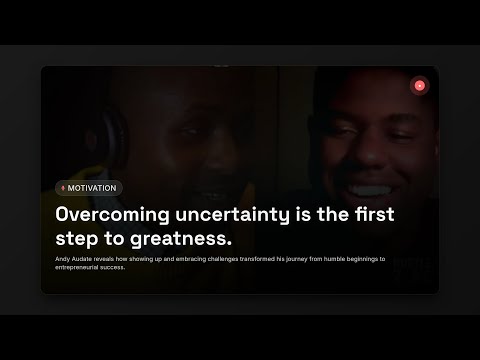
As Andy Audate put it about the moment he met Les Brown in person: "There's opportunity in the show up."
Show Up for Success: Andy Audate’s Secrets to Entrepreneurial Growth & Motivation
Ryan Perez opened this episode of Hustle Zone the way he always does — asking his guest for the whole story, not the highlight reel. His guest this time was Andy Audate, a 22-year-old author and motivational speaker who, as Perez pointed out, had already crossed paths with Les Brown, one of the speakers Perez himself grew up listening to on downloaded MP3s as a teenager. Audate joined from a hotel in New York, in the middle of relaunching his book, No More Average, which he describes as being about “overcoming that average life and experiencing life as the real you.”
Audate’s story starts in Boston, where he was born on December 31st while his mother, Gina, was in labor on the way to the hospital. The family later moved to Rhode Island, and by age 11 Audate was already restless about money — he told his mom he was tired of not having what his friends had and started knocking on doors to shovel snow for $10 a job, then running lemonade stands and yard sales in the summer. By 16 he’d saved enough to buy a $500 car before he even had his license.
The real turning point came at 19. A coworker at a Metro PCS store told him, “Andy, I believe in you, I think you should quit and open up your own cell phone store.” Audate took the leap, starting not with a storefront but a cart in the mall, stocked with nine phones under $100 apiece — inexpensive, prepaid devices aimed at customers who couldn’t afford flagship models. He explained how he built up the roughly $7,000 in startup capital: by hiding a savings account away from the banking app he checked constantly, so money he never saw was money he never spent. Within a year of hustling — reinvesting profit straight back into inventory and eventually earning net-30 credit terms from a supplier — he’d grown to four locations and 14 employees, a company he named Progression Wireless.
Audate also walked through the sales techniques he learned along the way, including a “whisper technique” taught by a manager, and his own addition to it: physically holding onto a customer’s phone so they’d stick around long enough to hear his pitch. He credited a mentor, James Jackson, a Black entrepreneur in his neighborhood he specifically looked up to as a teenager, for showing him the back-office realities of running a business — payroll, hiring, firing, expansion — long before he ran his own store.
The conversation’s most vulnerable moment came when Audate described a financial crash after an unusually strong month. He’d been spending freely — travel, rental cars, a trip to Vegas — when an employee, a single mother, told him she needed to be paid to feed her daughter and buy diapers. Audate described selling phones on Craigslist just to cover payroll, then sitting alone in his office at 11 p.m., lying on the bathroom floor, and crying. He said he then sat in his car and prayed, asking God to “take my life to a whole another level.” Driving home, he heard the song “Seven Years” by Lucas Graham, whose lyrics tracing a life from childhood to old age hit him hard enough that he decided, the next day, to leave Rhode Island for Los Angeles with his best friend Patrick.
That move led to a job in copier sales, which Audate said taught him persistence and “top of mind awareness” — showing up again and again until a prospect finally listened. He used the same approach, he said, to build a relationship with Grant Cardone, and to get himself in front of Les Brown: he flew to the Les Brown Institute’s office in Florida in person, even though the courses were fully available online, because — as he put it — “there’s opportunity in the show up.” Les Brown happened to visit that same office the same day.
The episode closed the way Hustle Zone episodes do, with a lightning round covering everything from favorite holidays (Christmas, six days before his birthday) to cheesecake over pie, before Perez led the traditional call-and-response send-off and pointed listeners to Audate’s book, No More Average, and his own ventures at Bow Tie Creative and the Hustle Zone documentary project.
Lessons from this one
Hiding savings from daily view can build capital without relying on willpower.
Audate explained that he stashed part of each paycheck into a savings account that was deliberately far from his main bank account and hidden from the banking app he checked regularly, so he saved unconsciously — that method is how he accumulated the roughly $7,000 that funded his first cell phone cart.
Proximity to a visible, relatable role model can raise what a young person believes is possible for themselves.
Audate described looking up to James Jackson, a Black entrepreneur in his area, specifically because he could relate to him, and separately recounted a pizza shop owner who showed his son stacks of cash to raise the boy's sense of normal, which Audate credited with the son later becoming a millionaire.
A strong financial peak in a young business can hide a spending problem until a crisis forces a reckoning.
Audate described hitting his best month ever financially and then overspending on travel, rented cars, and a Vegas trip, followed by a valley so severe that an employee's plea to be paid so she could feed her daughter pushed him to sell phones on Craigslist just to make payroll.
No controlled study found for this specific claim — reflects the guest's own lived experience, presented as such rather than as research-backed fact.
Showing up in person can create opportunities that remote or online access alone does not.
Audate said 'there's opportunity in the show up' when describing why he flew to Florida to visit the Les Brown Institute in person even though its courses were fully available online — the trip put him in the office on the exact day Les Brown himself happened to visit.
Repeated, persistent contact converts more relationships and sales than a single attempt.
Audate said his copier sales job taught him persistence and 'top of mind awareness' — returning to a prospect's office again and again until they agreed to hear an offer — and said he used that same repeated-contact strategy to build a relationship with Grant Cardone.
Sources
- Thaler, R. H., & Benartzi, S. (2004). "Save More Tomorrow™: Using Behavioral Economics to Increase Employee Saving." Journal of Political Economy, 112(S1), S164–S187.
- O'Brien, L. T. (2017). "Improving Girls' Sense of Fit in Science: Increasing the Impact of Role Models." Social Psychological and Personality Science.
- Granovetter, M. S. (1973). "The Strength of Weak Ties." American Journal of Sociology, 78(6), 1360–1380.
- Zajonc, R. B. (1968). "Attitudinal Effects of Mere Exposure." Journal of Personality and Social Psychology (Monograph Supplement), 9(2, Pt. 2), 1–27.
- Runtime
- 1h 11m
- Show
- HustleZone
- Host
- Ryan Perez
Been through something like this?
HustleZone is conversations with people who built something out of the thing that was supposed to stop them. If that is you, say so.