Unlock Your Full Potential
Motivation & Success Lessons from Tim of Daily Dose
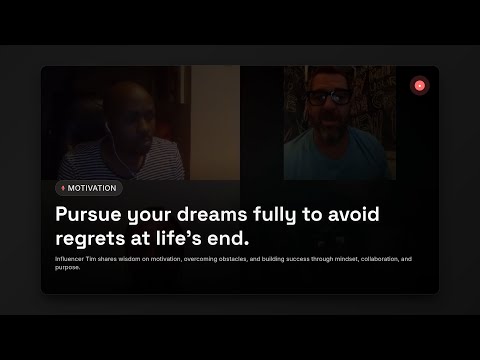
As Shane puts it on the "1% Jam": consistency is the smallest gate, but there aren't many people who can do anything for more than 30 days straight.
The 1% Jam: What Happens When Tim from Daily Dose Doesn’t Show Up
Every live show has a plan, and every live show eventually abandons it. This episode of the “1% Jam” — the after-hours livestream session built around Shane’s nightly “1% Show” — opens with a bit of anticipation: the host mentions he’d invited Tim from Daily Dose, a guest he describes as a former healthcare-facilities builder turned social media influencer who’d recently been spotted at one of Tai Lopez’s parties. “I was hoping he was going to get on tonight,” the host says. Tim never does make it into the room. What unfolds instead is something the regulars seem used to — a loose, hours-long hangout on the live-streaming app Blab, where the conversation drifts from hard-won business philosophy to, eventually, grocery runs and family recipes, with a rotating cast dropping in and out.
The night’s real anchor is Shane, who runs the “1% Show” every night at 11pm and hosts this jam session afterward. He opens by processing something that happened earlier: he’d wandered into another Blab room and, by his own account, got booted while trying to hear out people who were “expressing some aggravation” toward him. Rather than dwell on it, he leans on advice from a mentor: “if you’re not where you’re celebrated and you’re where you’re tolerated, then you need to go where you’re celebrated.” From there the group settles into its actual theme for the night — the difference between chasing money and chasing purpose.
Shane is blunt about his own story: failed three grades, pulled out in seventh grade, called “slow” his whole life. His turnaround, he says, came from daily habits — exercise, cutting out negative people, and a hard-won self-love he describes as being “unfuckable” with other people’s opinions. He tells trolls they get 24 hours to “come correct” before he blocks them, and he’s equally clear that this isn’t about being combative: “we’re about being better, not bitter… not about getting even, but getting in the add.”
That philosophy extends into a running debate about money versus purpose. Shane argues the “1% doesn’t work for money — they work for passion, they have a purpose,” and insists a real “why” has to describe what you’re doing for other people, not for yourself. He backs it up with the story of boxer Buster Douglas, the only man to knock down Mike Tyson in his prime, crediting Douglas’s comeback to a promise made to his mother days before she died. Ryan, one of the regulars, matches Shane’s energy with his own metaphor — comparing himself to a jackhammer that “bounces around” before eventually breaking through to the goal.
The group also gets into a genuine disagreement about how to build something. One guest, a marketing consultant who’d left a corporate job with a real budget to strike out on her own, describes being handed a shoestring marketing budget at one point in her career — “a nickel and 98 cents,” as she put it — and having to get creative because there was no other option. She and another participant, a software consultant who name-checks management theorist Peter Drucker, go back and forth on collaboration: is it always better to bring in more people, or does a solo focus actually get more done? Ross, pushing back on the idea that teamwork is automatically superior, is adamant that he needs to trust someone completely before delegating to them, and that being handed a group he didn’t choose feels like being set up to carry someone else’s failure. Others in the room, including a car salesman from Michigan working his way up in dealership sales, weigh in with their own versions of “know your why” and the value of cutting negative people out of your circle entirely.
Books come up more than once — Daymond John’s The Power of Broke, a well-thumbed classic by David J. Schwartz that one guest credits with turning her from “a follower” into someone who runs her own show, and The Alchemist, recommended as a coming-of-age read for a teenager about to start her first job.
By the second hour, the conversation loosens further, moving into terrain that has little to do with hustle culture at all — cooking traditions, ethnic markets, and birth plans, courtesy of a guest based in Columbus, Ohio who’s building a beauty and skincare business sourced from West Africa. It’s a reminder of what these late-night Blab sessions actually were: less a produced show than a standing invitation to keep talking until somebody has to go to bed. Tim from Daily Dose may have missed this one, but the room clearly didn’t need him to fill the two hours.
Lessons from this one
Consistency, not intensity, is what actually compounds success.
Shane says he hasn't missed his 11pm '1% Show' broadcast since January and calls consistency 'the smallest gate,' noting that few people can sustain any habit for more than 30 days.
A 'why' rooted in other people sustains motivation further than one rooted in money.
Shane repeatedly argues the '1%' work for passion and purpose rather than money, insisting a real why 'has to describe people,' and cites Buster Douglas's comeback against Mike Tyson — driven by a promise to his dying mother — as proof of what a bigger why can overcome.
Admired solo successes are rarely actually solo.
Ryan and Shane point out that Steve Jobs didn't build his company alone but surrounded himself with capable people starting in a garage, using it to argue you 'can't go any higher' working entirely by yourself.
Tight constraints can force more creative, effective work than a generous budget does.
One guest describes going from an 'excellent budget' at a corporate marketing job to a self-funded venture with a budget of 'a nickel and 98 cents,' saying the scarcity forced her to get creative and that ultimately 'the key was me' rather than any budget or collateral.
Trusting someone enough to delegate matters more than simply adding more people to a project.
Ross explains he has no problem delegating but has to fully trust someone first, and resists being placed into a group he didn't choose because he doesn't want to carry the weight of someone else's dropped ball.
Sources
- Lally, P., van Jaarsveld, C.H.M., Potts, H.W.W., & Wardle, J. (2010). "How are habits formed: Modelling habit formation in the real world." European Journal of Social Psychology, 40(6), 998-1009.
- Ryan, R.M. & Deci, E.L. (2000). "Self-Determination Theory and the Facilitation of Intrinsic Motivation, Social Development, and Well-Being." American Psychologist, 55(1), 68-78.
- Montuori, A. & Purser, R.E. (1995). "Deconstructing the Lone Genius Myth: Toward a Contextual View of Creativity." Journal of Humanistic Psychology, 35(3), 69-112.
- Acar, O.A., Tarakci, M., & van Knippenberg, D. (2019). "Creativity and Innovation Under Constraints: A Cross-Disciplinary Integrative Review." Journal of Management, 45(1), 96-121.
- de Jong, B.A., Dirks, K.T., & Gillespie, N. (2016). "Trust and Team Performance: A Meta-Analysis of Main Effects, Moderators, and Covariates." Journal of Applied Psychology, 101(8), 1134-1150.
- Runtime
- 4h 28m
- Show
- HustleZone
- Host
- Ryan Perez
Been through something like this?
HustleZone is conversations with people who built something out of the thing that was supposed to stop them. If that is you, say so.