Neurodivergent Entrepreneur
Turning Autism, ADHD & Identity Into Creative Success
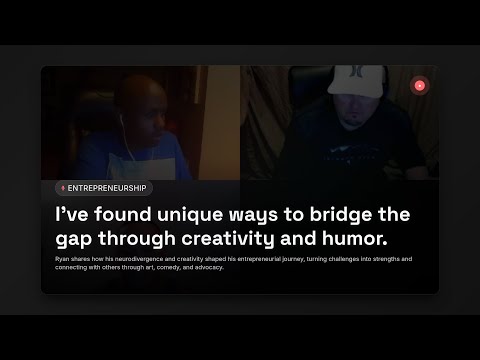
Ryan Perez put it simply: what actually motivates him isn't money or material things — it's being told he can't do something.
Neurodivergent Entrepreneur: Turning Autism, ADHD & Identity Into Creative Success
Hustle Zone / 1% Jam Session
Some nights on the 1% Jam Session start rough — tonight’s did. Host Ryan Perez spent the first several minutes wrangling technical hiccups, a co-host running late, and a guest who couldn’t get connected, before finally getting the show live from “the man cave” in West Palm Beach. Shane the Train, one of the show’s regular hosts, was out sick and missing the episode, so Keenan White — owner of a credit card processing company and a 1% Jam Session regular — stepped in to help carry the night alongside Ryan.
Once the technical dust settled, the conversation turned, as it usually does on this show, toward origin stories — the messy, unglamorous backstory behind the polished entrepreneur people see today.
Tim’s story: the family business and the price of loyalty
The evening’s featured guest was Tim (“figgity”), who runs figgity marketing, a trailer business, and Lucid Capital Group out of Southern California. Tim traced his family’s business lineage back through his grandfather’s furniture stores in Nevada, through his father’s used-car lot (opened in 1981) and eventual pivot into trailers, up to the day Tim bought the business from his father about thirteen years ago.
The harder part of the story was personal. Tim described his father as “a raging alcoholic” who was already drinking by early morning, and described repeated conflict between them — arguments, walkouts, threats to quit. What kept him from actually leaving, he said, wasn’t the business itself but his mother: he didn’t want her to lose the house her own father had built, the home the family had moved back into after an earlier setback. “It’s not money that drives us,” Tim said of entrepreneurs generally. “It’s family. It’s pain.”
Tim also talked about what the work cost him growing up — weekends and after-school hours spent washing and detailing cars and trailers while friends went to the beach or to parties. At 29, he said, he still hadn’t been to Disney World, despite living in Florida.
Ryan’s story: dyslexia, dropping out, and building without a blueprint
Ryan Perez, the show’s host and founder of Bow Tie Creative — which runs a program donating free websites to entrepreneurs with disabilities — shared pieces of his own path. He described being dyslexic, being labeled “slow,” and being bullied in school, then coming home to more difficulty rather than relief. He said he left high school without graduating, and that no one formally taught him the skills he now runs a business on: marketing, video editing, graphic design, copywriting, or music production. He also mentioned stuttering as a kid, and said a mentor who was a musician pushed him to get on stage until he learned to work through it, using what the mentor called “three Ps and three Rs” — practice, practice, practice; repetition, repetition, repetition.
What strikes people who assume Ryan is naturally extroverted, he said, is that he actually considers himself an introvert — someone who does most of his work online rather than in person — and that platforms like this one are part of what built his public confidence over time.
Keenan added his own chapter to the night’s theme of sacrifice: despite having a college degree and a background playing football, he described a stretch of homelessness — sleeping and showering at the beach for roughly three months — before building the business he now runs, about seven years in.
The through-line: pain as fuel, not just wound
What tied the stories together wasn’t a tidy lesson so much as a repeated instinct: each guest described difficulty — an alcoholic parent, homelessness, a learning disability, being told “you can’t” — not as something to hide, but as the actual source of their drive. Ryan put it plainly: what motivates him isn’t money or material things, but being told he can’t do something. Tim echoed a version of the same idea about his father: “without that negativity, I wouldn’t have that positivity.”
The episode closed with the show’s recurring reminders — that the 1% Jam Session distinguishes “small business owners” from “entrepreneurs” by whether they give back to their community, that spamming the group isn’t welcome, and that guests are encouraged to share their own stories rather than pitch. Keenan pointed people to his social channels; Tim pointed listeners to figgitymarketing.com; Ryan closed out reminding viewers about Bow Tie Creative’s website-donation program for entrepreneurs with disabilities.
Lessons from this one
Early struggles like a learning disability, bullying, or being told 'you can't' can be reframed as the actual engine of entrepreneurial drive rather than something to hide.
Ryan Perez described being dyslexic, labeled 'slow,' and bullied in school, and said directly that no amount of money motivates him the way being told he can't do something does.
Self-directed, informal learning can substitute for formal credentials in building a working creative or marketing business.
Ryan said he left high school without graduating and that no one formally taught him marketing, video editing, graphic design, copywriting, or music production — he taught himself.
Family obligation, more than profit, can be the real reason someone stays in a difficult family business.
Tim described enduring years of conflict with his alcoholic father specifically to protect his mother from losing the family home, saying explicitly that family and pain, not money, drive entrepreneurs.
Deliberate, repeated practice can help someone move past childhood stuttering or performance anxiety into public confidence.
Ryan credited a mentor's formula of 'three Ps and three Rs' — practice practice practice, repetition repetition repetition — for helping him get past a childhood stutter and stage fear to eventually perform and host publicly. Note: no study evaluates this specific mnemonic/formula; the closest real research is on structured exposure-based practice for social anxiety in people who stutter, which supports the general mechanism (repeated, graded exposure reduces stutter-related social fear) without validating the guest's exact framing.
Sources
- Wang, L., & Huang, J. (2022). Mediating Role of Entrepreneurial Self-Efficacy and Prosocial Tendency in the Relation Between College Students' Post-traumatic Growth and Entrepreneurial Intention in the Post-COVID-19 Era. Frontiers in Psychology, 13:861484.
- Tseng, C.-C. (2013). Connecting self-directed learning with entrepreneurial learning to entrepreneurial performance. International Journal of Entrepreneurial Behavior & Research, 19(4), 425-446.
- Gómez-Mejía, L. R., Haynes, K. T., Núñez-Nickel, M., Jacobson, K. J. L., & Moyano-Fuentes, J. (2007). Socioemotional Wealth and Business Risks in Family-Controlled Firms: Evidence from Spanish Olive Oil Mills. Administrative Science Quarterly, 52(1), 106-137.
- Scheurich, J. A., Beidel, D. C., & Vanryckeghem, M. (2019). Exposure therapy for social anxiety disorder in people who stutter: An exploratory multiple baseline design. Journal of Fluency Disorders, 59, 21-32.
- Runtime
- 1h 05m
- Show
- HustleZone
- Host
- Ryan Perez
Been through something like this?
HustleZone is conversations with people who built something out of the thing that was supposed to stop them. If that is you, say so.