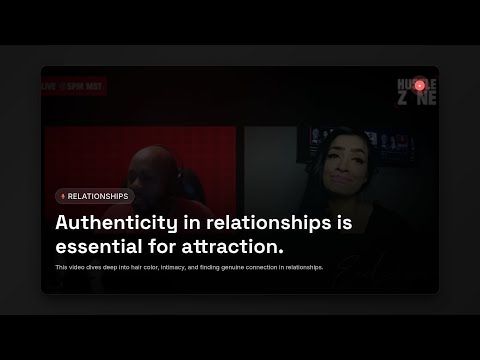
Unlocking Connection: How Authenticity & Communication Transform Relationships
Across every age bracket she interviewed — down to an 87-year-old still happily married — Kaa found the same three ingredients kept coming up as the key to a relationship lasting: communication, sexuality, and finances.
Unlocking Connection: How Authenticity & Communication Transform Relationships
Ryan Perez and Monica opened this Hustle Zone Jam Session with some real-life news before the cameras even settled: Ryan is in a new relationship, and by his own account, happier than he’s been in a long time. He described reconnecting with a woman he first met ten years ago on Plenty of Fish (POF) — they’d lost touch, followed each other’s lives through Facebook as fellow single parents, and finally went on a first date this year after Monica and their friend Anna pushed him to actually show up. He called the moment he knew — a look across the room on their second date — an almost out-of-body experience, one he described as feeling like being shown his soulmate. It’s a fitting warm-up for an episode that spent the rest of its runtime picking apart what makes connection actually work.
The panel — Ryan, Monica, and returning and first-time guests Anna, Kaa, and Robert, with a quick cameo from Javier — worked through a running list of viewer-submitted questions about dating and relationships, and the answers landed less on romance-novel stuff and more on practical behavior. Who pays on a first date? The consensus was that gendered rules are outdated and it should simply be discussed beforehand — though several panelists admitted they just like paying, full stop. First-date no-nos came fast: staring at your phone the entire time, talking only about your kids instead of each other, and being rude to waitstaff, which multiple guests flagged as a real character tell.
Turn-offs clustered around a few themes: lack of intelligence, body odor, laziness, and — repeated by more than one guest — a partner who isn’t actually present. Anna and Kaa both described wanting eye contact and real engagement, though Anna noted an exception for a friend whose husband is on the autism spectrum and has difficulty with eye contact, saying the couple has simply built their own way of communicating over years together. Stagnation came up too — several guests said an unwillingness to grow or change is its own kind of turn-off, separate from any specific flaw.
Movies and music turned out to be a recurring tool the panel uses to read a date without asking directly. Guests talked about choosing a first movie based on what it reveals about a partner’s preferences, and Ryan described building a shared Spotify playlist during road-trip dates, using songs a partner sings along to as a way into conversations about memory and meaning. Kaa put it plainly: songs and shared media help you “gauge what they’re going through” before you’ve had the deeper conversation.
The most candid stretch of the episode dealt with sex — what not to say in the moment (the group agreed a name mix-up is the cardinal sin), and how and when to bring up fetishes with a partner. Kaa described being caught off guard early in a relationship when a partner introduced something she hadn’t been consulted about beforehand, and said she now raises fantasies explicitly by the fourth or fifth date rather than leaving anything to guesswork.
That thread led into the episode’s most personal moment. Kaa shared that she was molested at 12, and that it took until her first separation at 23 to begin learning what healthy sexual boundaries and communication actually looked like. In 2017, still working on herself, she turned dating into a research project — deliberately interviewing twenty men across different age brackets, including one 87-year-old still in his marriage, about what made relationships last. The answer she kept hearing, regardless of age, was three things: communication, sexuality, and finances. She went on to go on more than a hundred coffee dates in a single month as part of that project, which eventually led to a relationship.
The episode closed, as the show’s jam sessions do, with a lightning round — Michael Jackson vs. Prince, alternative rock vs. heavy metal, favorite Disney movies, and a surprisingly divisive debate about cranberries — before the group thanked its guests and pointed viewers toward Hustle Zone’s ongoing fundraiser for its documentary project.
Lessons from this one
Discuss desires and boundaries before intimacy escalates, not after the fact.
Kaa described being blindsided when a partner introduced something sexual she hadn't agreed to beforehand, and said she now deliberately raises fantasies and fetishes with a partner by the fourth or fifth date rather than leaving it unspoken.
The fundamentals of a lasting relationship stay consistent across age brackets.
Kaa's own research project interviewing twenty men of different ages, including an 87-year-old still married, kept surfacing the same three themes: communication, sexuality, and finances.
Being fully present, not distracted by a phone or elsewhere mentally, is treated as a baseline signal of real interest.
Several panelists named phone use and a partner being mentally 'on another planet' as instant turn-offs, while also noting exceptions for partners who communicate differently, such as a spouse on the autism spectrum.
Shared media like music and movies function as a low-stakes way to learn about a partner early on.
Guests described picking first-date movies based on what they reveal about a partner's preferences, and building road-trip playlists together as a way to surface memories and gauge what a partner is going through emotionally.
Unresolved childhood trauma can delay a person's ability to set healthy sexual and relational boundaries until they actively work through it.
Kaa shared that she was molested at 12 and didn't begin learning what healthy boundaries and communication looked like until years later, after her first marriage ended at 23.
Sources
- Montesi, J. L., Fauber, R. L., Gordon, E. A., & Heimberg, R. G. (2011). The specific importance of communicating about sex to couples' sexual and overall relationship satisfaction. Journal of Social and Personal Relationships, 28(5), 591-609.
- Gottman, J. M., & Levenson, R. W. (2000). The timing of divorce: Predicting when a couple will divorce over a 14-year period. Journal of Marriage and Family, 62(3), 737-745.
- Roberts, J. A., & David, M. E. (2016). My life has become a major distraction from my cell phone: Partner phubbing and relationship satisfaction among romantic partners. Computers in Human Behavior, 54, 134-141.
- Boer, D., Fischer, R., Strack, M., Bond, M. H., Lo, E., & Lam, J. (2011). How shared preferences in music create bonds between people: Values as the missing link. Personality and Social Psychology Bulletin, 37(9), 1159-1171.
- DiLillo, D. (2001). Interpersonal functioning among women reporting a history of childhood sexual abuse: Empirical findings and methodological issues. Clinical Psychology Review, 21(4), 553-576.
- Runtime
- 1h 54m
- Show
- Peasant Sex and Relationships
- Host
- Ryan Perez
Been through something like this?
Peasant Sex and Relationships is conversations with people who built something out of the thing that was supposed to stop them. If that is you, say so.