Adrian Truth’s Musical Journey
From Church Choir to Industry Innovator | Exclusive Interview
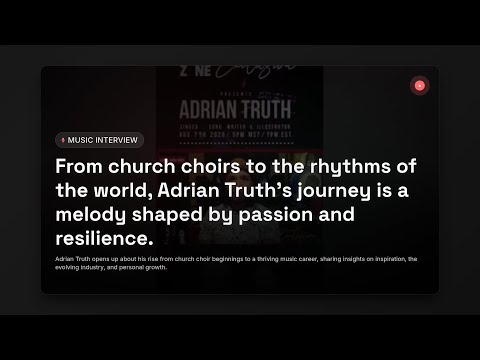
"You can be talented, and if you ain't got the bag, then you're gonna be kind of like trying to win a lottery" — talent alone doesn't build a music career, Adrian Truth says; talent plus capital does.
Adrian Truth’s Musical Journey: From Church Choir to Industry Innovator
Some artists can point to the exact moment music found them. For singer, painter, and graphic designer Adrian Truth, it started in his grandfather’s church — and it wasn’t optional.
Sitting down with hosts Ryan and Monica for an episode of Hustle Zone TV’s exclusive interview series, Adrian Truth traced his story back to being around ten years old, sitting in the choir his grandfather, the church’s pastor, ran. As Adrian put it, in that house “you couldn’t just sit back and just praise God” — every kid had to be a Usher or do something. He was thrown into the choir. He describes himself at that age as quiet, someone who “didn’t really talk a lot,” and singing in front of the congregation is what gave him his voice. By high school he’d formed a group, people responded well to his vocals, and he started taking music seriously, putting out content and linking up with other artists around his city.
Asked whether he believed he was destined for this path, Adrian said he was “for sure created to entertain” and to put positive energy into the world — and that inspiration doesn’t have to travel in a straight line. A conversation with a stranger might spark someone else’s painting or song, he said, just as movies or other artists spark his own ideas.
His creative process, he explained, is concept-first. He gave the example of drawing a flower — rather than rendering it simply, he’d rather make it look like it’s melting or wilting into something else entirely, maybe a phoenix. He carries that same instinct into his music, aiming for lyrics that work on more than one level, the way he says Prince used a car as a stand-in for a woman in “Little Red Corvette.”
One of the biggest validations of his path, Adrian said, came from Tech N9ne — a “hometown hero” from his own city and, in Adrian’s words, “the number one independent rap artist in the world,” owner of the label Strange Music. Getting on a song together, and hearing directly that his voice was one of the reasons he was brought on, was a serious confidence boost.
On surviving the music business itself, Adrian didn’t claim to have it figured out. “I’m actually just a student,” he said — watching what works and doesn’t for artists who are already signed, and adjusting his own approach accordingly. His career, he said, is built on relationships, humility, and hunger, and he’s treating it as “a marathon,” not a sprint. His advice to younger artists coming up: be a good human being, build long-lasting relationships, assemble a solid team — and have real capital behind the talent, because talent alone without money behind it is “like trying to win a lottery.”
Family came up too. Adrian described his relatives as fully supportive, letting him “do me” because they trust he won’t do anything negative — and he mentioned that his mom went back and graduated college just two years ago, proof, in his view, that it’s never too late to chase something. He’s also a father now, to a son close to eight months old, and said he’d tell his son to never settle, never compromise his goals and dreams, and to be authentic — “there’s only one you.”
The conversation also turned serious when the hosts asked about COVID-19 and the protests around police violence and Black Lives Matter. Adrian said racism has affected him “tremendously,” and long before the pandemic — he described COVID as almost a “blessing in disguise” because it stripped away the usual distractions of daily life and forced people to actually see what Black communities had been saying all along. He said he isn’t out protesting or part of any riots, but does use his platform subtly — an Instagram story, or a hat reading “1619” for those who catch the reference.
The episode closed with a rapid-fire lightning round (Prince over Michael Jackson, a love of both beanies and baseball caps, Aaliyah as his first celebrity crush, and “be an asset, not a liability” as his favorite quote) before Adrian shared what’s next: an unannounced album due out in the fall, called The Art Project, featuring eleven tracks each paired with its own original painting — buy the print, and the song comes with it.
He’s on social media everywhere as Adrian Truth, posting daily.
Lessons from this one
Talent alone won't carry an artist's career — capital behind it matters just as much.
Adrian Truth said plainly that being talented without money behind you is 'like trying to win a lottery,' and that talent plus capital is what actually lets an artist advance.
Treating yourself as a perpetual student of the industry, rather than assuming you already know the path, is a viable strategy for unsigned artists.
Adrian described himself as 'actually just a student,' watching what works and doesn't for artists who are signed and adjusting his own approach, building his career on relationships, humility, and persistence.
Mandatory early creative participation can build confidence and voice in a naturally quiet child.
Adrian said he was quiet and didn't talk much before being placed in his grandfather's church choir at around age ten; that experience, not a personal choice, is what gave him his voice and eventually his confidence to pursue music seriously.
A shared crisis event can force wider recognition of harms that an affected community had already been describing for years.
Adrian described COVID-19 as almost 'a blessing in disguise' because it removed everyday distractions and let people finally see the police violence and racism Black communities had been naming all along, likening prior dismissal to the 'boy who cried wolf.'
Layering ambiguous or symbolic meaning into creative work, rather than being literal, can make it resonate more deeply.
Adrian described a concept-first artistic process — turning a drawn flower into something melting or becoming a phoenix — and said he applies the same layered-meaning approach to his music, pointing to Prince's 'Little Red Corvette' as a model of writing about one thing while meaning another.
Sources
- Loman, B., Loots, E., & Dalla Chiesa, C. (2026). "From peers to fans: How crowdfunding reconfigures capital mobilization and conversion for DIY musicians." SAGE Journals.
- Bandura, A. (1977). "Self-efficacy: Toward a unifying theory of behavioral change." Psychological Review, 84(2), 191-215.
- Jiang, J. (2024). "Impact of music learning on students' psychological development with mediating role of self-efficacy and self-esteem." PLOS ONE, 19(9): e0309601.
- Merritt, D. (2021). "George Floyd's death and COVID-19: inflection points in the Anthropocene Era?" Journal of Analytical Psychology, 66(3), 750-762.
- Hayn-Leichsenring, G. U. (2017). "The Ambiguity of Artworks – A Guideline for Empirical Aesthetics Research with Artworks as Stimuli." Frontiers in Psychology, 8:1857.
- Runtime
- 45m
- Show
- HustleZone
- Host
- Ryan Perez
Been through something like this?
HustleZone is conversations with people who built something out of the thing that was supposed to stop them. If that is you, say so.