
Embrace Discomfort
Stacy E Cross on Hustle, Failure, and Entrepreneurial Growth
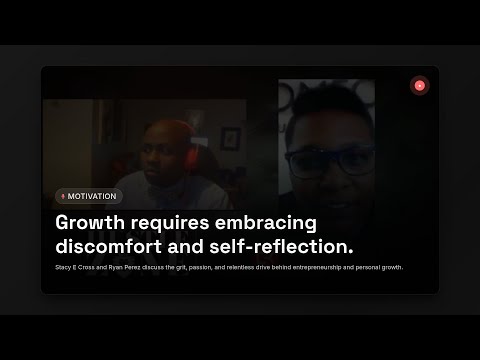
"I paid with energy because I didn't have the money" — Stacy E Cross built Comfort Killers on effort and discipline before she ever had capital.
Embrace Discomfort: Stacy E Cross on Hustle, Failure, and Entrepreneurial Growth
There was a moment early in this episode of Hustle Zone where host Ryan Perez admitted he’d been fan-boying over his guest before she even logged on — he’d watched her appear on Grant Cardone’s show and couldn’t quite believe she was now sitting across from him on his own Facebook Live stream. That energy set the tone for the whole conversation with Stacy E Cross, founder of the personal-development brand Comfort Killers, who joined Perez to tell — in her words — “the story on how these entrepreneurs get here.”
And it is, by her own account, a story that runs through a lot of failure before it gets anywhere near success.
Cross traces her hustle back to childhood: selling pens and pencils for nickels in middle school, using other kids’ toys at a garage sale, knocking on doors to shovel snow. Her family had come to America from Jamaica in the 1980s chasing what she called “the American dream,” and she describes struggling through school — bad grades in high school, bad grades in college — despite knowing she was intelligent. She left school without a diploma, and she spoke openly about having dyslexia, saying it never stopped her because “wanting to prove those people wrong was my motivation.”
Before Comfort Killers, there was rap. Cross said she used to write and perform under the name Strizzy 88, and even delivered a quick freestyle live on the show at Perez’s request. But she eventually walked away from music because, as she put it, she “wasn’t living on purpose.” The turning point came at a free seminar — she recalled looking around the room and asking herself what she was doing there if no one, including herself, could provide the motivation she needed. She walked out determined to build a company within nine months. That promise to herself became Comfort Killers, a brand built around helping people “get uncomfortable to think better, act better, and live better.” She even explained the name’s logic: “comfort” and “killers” are both negative words, but “two negatives in this case does equal a positive.”
Cross was candid that the path wasn’t a straight line. She said she started companies after companies from age 19 through her late twenties, failing repeatedly, and she credits every one of those failures with getting her closer to eventual success. Without startup capital, she said she “paid with energy” — leaning on attitude, discipline, and effort instead of money to get the business off the ground, including building the Comfort Killers website herself.
One of the more memorable exchanges touched on competition. Asked whether specific people had once doubted her, Cross said she genuinely couldn’t recall anyone standing in her way — not because no one did, but because she wasn’t paying attention to it. She described being in competition only with herself, using the line, “I’m on the fifth, they’re playing on the third,” to explain how she tunes out rivals and instead studies people doing something well so she can “cop it” and keep elevating.
Perez asked what advice Cross would give her younger self, and she turned the question around — she said she wouldn’t change anything about her past, because she wants her old self to reach the same “aha moment” she did. Her answer: “Keep doing what you’re doing, keep failing, keep growing.”
Cross also mentioned some of what she’s built since that seminar: over a hundred articles written since walking out the door, an ebook and audiobook called The Comfort Killer Handbook that she says she wrote in 24 hours, and a “2017 War Plan” resource on her site. She pointed listeners to comfortkillers.com and her social channels, joking that people shouldn’t “follow” her but “lead” — echoing her brand’s message that momentum comes from within.
As always on Hustle Zone, Perez closed the episode by reminding listeners about Bow Tie Creative’s practice of donating free websites to entrepreneurs with disabilities, inviting anyone who knows someone who could use one to reach out.
For anyone chasing a business idea while doubting their own credentials, Cross’s episode is a reminder that the resume isn’t the requirement — the repetition is.
Lessons from this one
Entrepreneurial instincts often show up long before any formal business training.
Cross traces her hustle back to selling pens and pencils for nickels in middle school, running garage sales with other kids' toys, and shoveling snow door to door — well before she built Comfort Killers as an adult.
Repeated business failure can be reframed as the actual mechanism of eventual success rather than a detour from it.
Cross said she started and failed at multiple companies from age 19 to her late twenties, and credited each failure with bringing her closer to success rather than setting her back.
Ignoring competitors in favor of self-competition can sharpen focus and execution.
Asked about people who doubted her, Cross said she couldn't recall specific detractors because she stays focused only on competing with herself, summarizing it as 'I'm on the fifth, they're playing on the third.'
Lack of formal education or a learning difference does not have to be a ceiling on entrepreneurial achievement.
Cross said she left school without a high school diploma and has dyslexia, but became self-taught through reading, experience, and what she called the 'school of hard knocks,' driven partly by wanting to prove doubters wrong.
When startup capital is unavailable, sustained effort and discipline can function as a substitute currency in the early stages of a business.
Cross described building her own website and launching Comfort Killers with no significant money, saying she 'paid with energy' through attitude, discipline, and effort instead.
Sources
- Wismans, A., Jansen, P., Thurik, R., Prinzie, P., & Franken, I. (2024). "Seeking the roots of entrepreneurship: Childhood and adolescence extraversion predict entrepreneurial intention in adults." Applied Psychology, 73(4), 2021-2046.
- Cope, J. (2011). "Entrepreneurial learning from failure: An interpretative phenomenological analysis." Journal of Business Venturing, 26(6), 604-623.
- Ames, C. (1992). "Classrooms: Goals, structures, and student motivation." Journal of Educational Psychology, 84(3), 261-271.
- Logan, J. (2009). "Dyslexic entrepreneurs: the incidence; their coping strategies and their business skills." Dyslexia, 15(4), 328-346.
- Winborg, J., & Landström, H. (2001). "Financial bootstrapping in small businesses: Examining small business managers' resource acquisition behaviors." Journal of Business Venturing, 16(3), 235-254.
- Runtime
- 26m
- Show
- HustleZone
- Host
- Ryan Perez
Been through something like this?
HustleZone is conversations with people who built something out of the thing that was supposed to stop them. If that is you, say so.