Prepare for Uncertainty
Master Financial Stability, Resilience & Growth
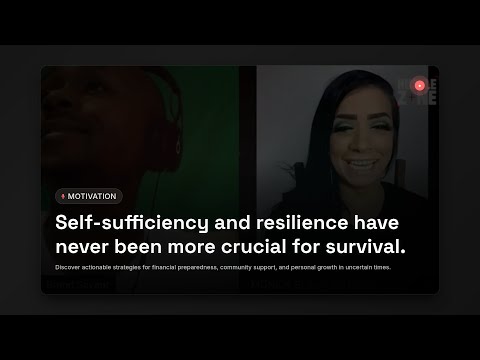
As one panelist put it, bankruptcy and money are illusions — the only thing that really matters is our interconnectedness and our resiliency, the ability to rise above whatever happens.
Prepare for Uncertainty: Master Financial Stability, Resilience & Growth
Hustle Zone TV Jam Session
Recorded in the early, disorienting weeks of the COVID-19 lockdown, this episode of the Hustle Zone TV Jam Session finds hosts Ryan and Monica Black Diamond opening their virtual doors to a rotating panel of small business owners and asking the question everyone was quietly sitting with: what happens to your business, your money, and your family when the ground shifts overnight.
The conversation moves fast and informally — guests dial in and drop off, the stream glitches, the lightning round eventually devolves into muscle cars and salsa dancing — but underneath the banter is a genuinely useful, lived-in conversation about financial preparedness.
Building the buffer before you need it
Life coach Roberta, one of the recurring panelists, lays out a simple philosophy she says has kept her afloat: maintain a gap between what you earn and what you spend, and don’t put too many eggs in one basket. She describes having already built savings before the pandemic hit, which is “kind of why I’m still floating the way that I am” — though she’s candid that a buffer like that “can only last for so long.” She pushes the group toward something more concrete than good intentions: an actual action plan, worked out in advance, for what you’ll do if this happens, and then what you’ll do if that happens — so a crisis doesn’t leave you, in her words, going by the seat of your pants.
Monica adds specific numbers to the philosophy: when money comes in, set aside 10% for a contingency fund, keep good credit by paying bills on time, and put a portion of income toward staples and dry goods rather than spending it all. She references mentors who told her to keep six months of income in reserve for exactly this kind of moment, and extends the logic past money entirely — generators, solar panels, water backup systems, even growing your own food where climate allows.
Diversified income as a survival strategy
Patrick, a Chicago sports broadcaster and voiceover artist, and Nav, who owns a mechanic shop in Calgary, both describe leaning hard on flexibility once the shutdown hit. Nav says his business dropped roughly 60% almost overnight and started offering pickup, drop-off, and mobile service to keep revenue moving. Patrick shifted his energy toward voiceover work to supplement his income, at lower prices, because — as he puts it — “not a lot of people are going to say yeah, I want to spend money right now.” Both men, along with Nav’s later advice, land on the same core idea: never rely on a single stream of income, and keep expanding your skills so you have something to fall back on if one avenue dries up.
Patrick’s story also surfaces a harder truth about relief programs. He explains that as someone on disability who hasn’t filed taxes in years, he doesn’t qualify for the stimulus check at all — a gap he says affects roughly 30 million people in the U.S. in similar situations. It’s a sharp reminder that safety-net programs don’t reach everyone evenly, and that financial planning sometimes has to work around, not just within, the system.
Beyond the balance sheet
The episode keeps circling back to something less quantifiable: community. Monica describes organizing with neighbors in her area to share fruit trees, vegetables, and seeds — treating the moment, only half-jokingly, like “the apocalypse” where the response is mutual aid rather than money. Roberta goes further, arguing that bankruptcy and money are, in a sense, illusions — that the only thing that really matters is human interconnectedness and resiliency, the ability to rise above whatever happens.
The conversation also turns toward mental health and family. Patrick admits he’s been “very, very depressed” over the preceding week and a half despite keeping his work routine intact. Several panelists talk about the strain and, in some cases, the strengthening of relationships under lockdown, and about how to talk to kids about uncertainty without empty reassurance. Sammy, an aspiring youth coach, urges people not to let fear or boredom win — pointing to his own pivot into writing, painting, and short videos as ways to stay creative when the usual outlets close.
By the end, the show settles into its usual lighter rhythm, but the throughline holds: build the buffer, diversify the income, lean on the people around you, and have a plan before you need one.
Lessons from this one
Build your financial buffer before the crisis, not during it.
Roberta explains that maintaining a gap between what she earns and what she spends — savings she'd already built up before the pandemic — is the reason she was still able to stay afloat, while acknowledging a buffer like that can only last so long.
Diversify income streams instead of relying on one business model.
Nav pivoted his mechanic shop to pickup, drop-off, and mobile service after seeing a roughly 60% revenue drop, while Patrick leaned into voiceover work to supplement his broadcasting income — both framing 'don't put all your eggs in one basket' as the core survival principle.
No controlled study found for this specific claim within this session — my web search budget was exhausted and direct attempts to fetch likely candidate sources (Federal Reserve Small Business Credit Survey, SBA Office of Advocacy pandemic resilience reports) returned 404/403 errors rather than confirmable pages. This reflects the guests' own lived experience and business decisions, presented as such rather than as research-backed fact.
Emergency relief programs don't reach everyone equally, so planning has to account for gaps in the safety net.
Patrick describes being ineligible for the U.S. stimulus check because of his disability status and lack of recent tax filings, noting this affects an estimated 30 million people in similar circumstances.
No verifiable source found for the specific '30 million people' figure within this session — my web search budget was exhausted and direct attempts to fetch likely candidate sources (CBPP, National Disability Institute, KFF analyses of CARES Act stimulus payment access for disabled/non-filing populations) returned 404/403 errors. This should be treated as the guest's own recollection/estimate rather than a confirmed research statistic; note that under the actual CARES Act, SSI and SSDI recipients were in fact made eligible for stimulus payments via a non-filer process, so this claim may also reflect a specific edge case rather than a general rule.
A concrete contingency plan beats improvising in the moment.
Roberta and Monica both push for having an actual action plan worked out in advance — what you'll do if X happens, then what you'll do if Y happens — plus tactical steps like setting aside 10% of income and stocking staples, rather than reacting in the moment.
Community mutual aid is a resilience strategy that operates independently of money.
Monica describes organizing with neighbors to share garden produce and seeds, treating the crisis like a moment to figure out how to help each other without money changing hands, echoing Roberta's point that interconnectedness matters more than financial illusions.
Sources
- Board of Governors of the Federal Reserve System, Report on the Economic Well-Being of U.S. Households (SHED), annual survey since 2013
- Paul J.H. Schoemaker (1995), "Scenario Planning: A Tool for Strategic Thinking," MIT Sloan Management Review
- Daniel P. Aldrich (2012), Building Resilience: Social Capital in Post-Disaster Recovery, University of Chicago Press
- Runtime
- 2h 33m
- Show
- HustleZone
- Host
- Ryan Perez
Been through something like this?
HustleZone is conversations with people who built something out of the thing that was supposed to stop them. If that is you, say so.