Breaking Generational Curses
Neurodivergent Journeys, Fatherhood & Creativity | Digital Stem Cell
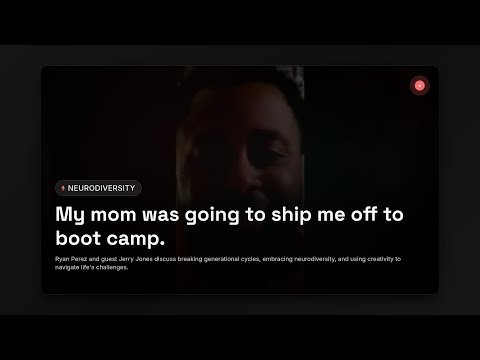
Jerry Jones on choosing fatherhood over his own father's advice: "I'm going to make the decision to be a dad" — insisting on 50/50 custody so his son gets the childhood he didn't.
Breaking Generational Curses: Neurodivergent Journeys, Fatherhood & Creativity
On this episode of Hustle Zone TV — the show Ryan Perez has rebranded around his own identity as “Digital Stem Cell” — the conversation starts with a chance encounter. Perez, who is open about being neurodivergent (he names autism, dyslexia, and ADHD as part of how he sees the world), was out shooting a video when a stranger stopped to film him back. That stranger turned out to be Jerry Jones: a retired U.S. Navy Chief, a content creator, a father, a consultant, and a fashion designer whose Instagram bow-tie game was sharp enough that Perez clocked him on sight.
Jones opens by laying out his Navy career. He didn’t enlist out of patriotism — he needed a paycheck, and his mother had told him that if he wasn’t doing something substantial by 19 she’d send him to boot camp herself. He grew up in Chesapeake, Virginia, in the shadow of Norfolk, home to the largest naval base in the world, though he says he barely noticed the Navy’s presence around him until he came home from boot camp and suddenly saw it everywhere. He started as a Deck Seaman, rose to Boatswain’s Mate second class, then pivoted into Navy human resources as a career counselor once he found the deck work mentally unchallenging. By his own description, he became “the plug” — the guy who could get sailors whatever they needed, a habit he still carries into civilian life. He talks about the difference between “day ones” (blood relatives) and “day twos” — the people you’d go to war and possibly die alongside — as the bond that shaped how he sees loyalty.
That problem-solving instinct became the seed of his brand, Alter Ego Apparel. Jones explains the name isn’t about anything clinical — it’s about the idea that everyone has a version of themselves they switch into for work, for social settings, for command presence. He connects it back to Navy culture too: Chiefs are nicknamed “goats,” and their gathering space is literally called the “goat locker,” which he says lines up with the brand’s message of striving to become the greatest version of yourself.
The most personal stretch of the conversation is about fatherhood. Jones talks about growing up in a single-parent home, with a stepfather he calls dad who wasn’t consistently present, and says plainly that he never wanted to repeat that pattern with his own son, who is 14. He describes insisting on 50/50 custody when his son’s mother moved out, and choosing fatherhood over dating advice his own father gave him at the time. He talks about learning to skateboard with his son in his late 30s, buying him clothes from H&M and the Gap because he couldn’t find stylish options for kids, and posting a photo of his son in lime-green skinny jeans from the girls’ department as the first image on his “Gemini King” Instagram. Both men return to the phrase “generational curses” — the idea that their generation is now reclaiming a childhood some of them didn’t fully get to have, whether that’s through skateboarding, video games, or simply being present in ways their own fathers weren’t. Perez, whose son is 12, shares the same instinct to change that narrative rather than assume it’s inevitable.
The episode closes out with a lightning round (Tacoma, Washington as a favorite city; Wednesdays; a self-rated “Tyrese 10” as a driver) and a run of business plugs. Jones talks about his drop-shipping site, forthcoming cut-and-sew Alter Ego hoodies arriving from Pakistan, and two logo directions — one Prada-inspired, one an “erratic” rockstar style — designed by a Connecticut-based designer he credits by name. He also credits Rod Wave’s “Ghetto Gospel” with getting him through a hard period. Perez, in turn, highlights his own “Made for Dyslexic” shirt line sold through Teespring, where the text is deliberately misspelled — a nod to typoglycemia and to Albert Einstein, whom he cites as dyslexic — and invites Jones back for a future round-table episode of the show.
The episode plays less like an interview and more like two people who recognized something in each other on the street and kept talking — about the Navy, about fatherhood, about building something of your own after the uniform comes off.
Lessons from this one
Breaking a cycle of absent fatherhood often starts with a single deliberate decision, not a gradual change.
Jerry Jones describes insisting on 50/50 custody when his son's mother moved out, and explicitly rejecting his own father's advice to go date instead, saying "I'm going to make the decision to be a dad now." He ties this directly to growing up without a consistently present father himself.
Adults reclaiming childhood experiences they missed (through play, skateboarding, or fashion) can be a form of self-repair, not immaturity.
Jones explains defensively that men his age play video games or learn skateboarding with their kids because they're 'going back to their childhood' to recover joy they were denied as kids forced into adult roles too early.
Neurodivergent traits can function as a professional advantage rather than a limitation when reframed around specific strengths.
Ryan Perez frames his autism, dyslexia, and ADHD as giving him a 'unique perspective' that fuels his multi-hyphenate career as producer, web developer, and consultant under the Digital Stem Cell brand, and separately promotes a 'Made for Dyslexic' shirt line built around typoglycemia and dyslexic reading ability.
Military service can create found-family bonds that carry as much or more weight than biological family ties.
Jones distinguishes 'day ones' (blood relatives) from 'day twos' (the people you served and would risk your life alongside), arguing the latter can hold more value because of shared hardship and mutual protection.
Career reinvention after military retirement is common and often depends on translating service-honed skills (problem-solving, HR, leadership) into new civilian ventures.
Jones moved from deck duty into Navy HR/career counseling because he wasn't mentally challenged, and after retiring built Alter Ego Apparel, a drop-shipping business, and a consulting practice using the same 'problem-fixer' skill set from his 20 years in the Navy.
Sources
- Madden, V., Domoney, J., Aumayer, K., Sethna, V., Iles, J., Hubbard, I., Giannakakis, A., Psychogiou, L., & Ramchandani, P. (2015). Intergenerational transmission of parenting: findings from a UK longitudinal study. European Journal of Public Health, 25(6), 1030-1035.
- Sedikides, C., Wildschut, T., Arndt, J., & Routledge, C. (2008). Nostalgia: Past, present, and future. Current Directions in Psychological Science, 17(5), 304-307.
- Bongiorno, G., Passarelli, M., Ooms, F., & Massaro, S. (2025). The Neuroscience of Neurodiversity in Entrepreneurship, in Neurodiversity in Entrepreneurship (eds. L.D. Marino, A.C. Corbett, D.A. Lerner), Emerald Publishing Limited.
- Medeiros, S.S. The Thin Blue Line: Perspectives From Military Veteran Police Officers on Camaraderie and Cooperation. Journal of Veterans Studies.
- Tihic, M., Pritchard, A., & McKelvie, A. (2026). The emergence and impact of the military veteran entrepreneurship industry. Small Business Economics, 66(2), 737-751 (published online 2025).
- Runtime
- 35m
- Show
- HustleZone
- Host
- Ryan Perez
Been through something like this?
HustleZone is conversations with people who built something out of the thing that was supposed to stop them. If that is you, say so.