From 16 Subscribers to Success
Brenden Kumarasamy’s YouTube Growth Secrets
As Brendan Kumarasamy put it: "The secret to 10,000 followers is 10,000 conversations."
From 16 Subscribers to Success: Brenden Kumarasamy’s YouTube Growth Secrets
On this episode of Hustle Zone TV, host Ryan Perez sat down with Brendan Kumarasamy, founder of the YouTube channel Master Talk, for a wide-ranging conversation about public speaking, building trust with an audience, and turning a basement side project into a coaching business. The two connected through Matchmaker.fm, and Perez opened the interview with the show’s usual first question: what’s your story?
Brendan’s answer started in Montreal, where he grew up needing to learn French for school. Presenting in a language he barely knew left him freezing up in front of his class as a kid — by his own account, he’d get to the front of the room and just go quiet. That changed in university, where he threw himself into business-school case competitions, describing them as “professional sports but for nerds.” Three years and hundreds of presentations later, he’d also coached plenty of classmates on communication. When he moved into the corporate world, he asked himself a simple question — how could he contribute more to society — and landed on Master Talk, filming his first videos in his mother’s basement.
What pushed him to start, he explained, was noticing how much of the public-speaking content already on YouTube didn’t practice what it preached. Coaches would talk about adding energy to a presentation in the flattest possible tone, or explain vocal variety without varying their own voice at all. He also pointed out a business reality: a speech coach only needs ten or fifteen well-paying clients to have a solid business, so most people skilled enough to teach communication well never bother making free content.
Much of the conversation centered on Brendan’s puzzle analogy for structuring a talk — start with the corner pieces (the introduction and the conclusion), because they’re the easiest to anchor a presentation around. His specific advice: practice the intro fifty times, not three or five, and do the same with the conclusion — about an hour each. Only after that framework is solid should a speaker fill in the middle. He also stressed practicing with other people rather than alone, the way you’d tackle a jigsaw puzzle with friends rather than solo.
Perez pushed back a bit, asking whether over-rehearsed material risks sounding “canned” and losing a genuine connection with listeners. Brendan’s response leaned on Tony Robbins, who he noted has run essentially the same seminar for forty years. The idea isn’t canned, he argued — it’s simply been delivered so many times that it comes out polished and authentic. Even though this was his 250th interview and his answers repeat show to show, they land because the idea is new to whoever is hearing it for the first time.
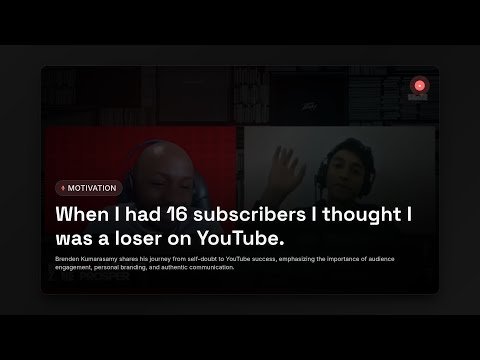
On validating a message, Brendan described a habit he credits with much of his early success: when Master Talk had just seven subscribers, he met every single one of them for a one-on-one, hour-long conversation. The puzzle analogy itself came out of one of those sessions, coaching a client who was struggling to understand how to structure a speech. He recalled feeling like “a loser” making videos in his basement with only sixteen subscribers, until he started asking the people who did watch why they bothered — and their answers shaped what he made next.
Asked how a message goes on to reach a bigger audience, Brendan offered a simple frame: “whenever you see someone successful, never say wow — always ask how.” He pointed to Gary Vaynerchuk taking seventeen minutes to talk to fans one-on-one even with a flight to catch, and argued that growth comes from finding your “smallest viable audience” — a nod to Seth Godin — rather than trying to appeal to everyone at once. For Brendan, that audience was podcast hosts. His summary line: “the secret to 10,000 followers is 10,000 conversations.”
The two also talked about trust, presentation, and personal brand — Brendan’s rule for building credibility is to “show, don’t tell,” letting people judge his ability to speak from watching rather than from his claims about himself. He described his own personal brand as being “a classy man of the people,” and explained why he wears a suit on camera even from what he admitted was, that day, a mattress.
The episode closed with a lightning round covering favorite cities, retirement plans (28, so he can focus on Master Talk), and — Perez’s traditional closer — whether a vegan can eat animal crackers (yes, Brendan says, as long as there’s no dairy in them).
Lessons from this one
Validate a new idea by talking directly to your earliest few listeners, not by guessing what a bigger audience wants.
Brendan says that when Master Talk had only seven subscribers, he met every one of them for a one-hour conversation, and the puzzle analogy that became his signature teaching tool came directly out of a one-on-one coaching session.
Deliberately over-practicing the opening and closing of a talk matters more than rehearsing the whole thing evenly.
Brendan's puzzle framework calls for practicing a presentation's introduction and conclusion fifty times each (about an hour apiece) before worrying about the middle, comparing it to starting a jigsaw puzzle with the corner pieces.
A message delivered many times isn't "canned" -- repetition makes it land better, not worse, for a new listener.
Brendan points to Tony Robbins running the same seminar for forty years and notes that even in his own 250th interview with largely repeated answers, the ideas are still new to whoever is hearing them for the first time.
Growing an audience starts with targeting the smallest viable niche, not trying to reach everyone at once.
Brendan says he grew Master Talk by focusing specifically on podcast hosts rather than a general audience, citing Seth Godin's idea of the "smallest viable audience," and argues both a following and a business are built on superfans.
Credibility is built by demonstrating competence, not by claiming expertise.
Brendan's rule is to "show, don't tell" -- let people watch a sample of your work and judge for themselves -- and he compares unearned authority to trusting health advice from a coach who clearly doesn't practice what they preach.
Sources
- Blank, S. (2005). The Four Steps to the Epiphany: Successful Strategies for Products that Win.
- Ries, E. (2011). The Lean Startup.
- Ericsson, K. A., Krampe, R. T., & Tesch-Romer, C. (1993). 'The Role of Deliberate Practice in the Acquisition of Expert Performance.' Psychological Review, 100(3), 363-406.
- Murdock, B. B. (1962). 'The Serial Position Effect of Free Recall.' Journal of Experimental Psychology, 64(5), 482-488.
- Hasher, L., Goldstein, D., & Toppino, T. (1977). 'Frequency and the Conference of Referential Validity.' Journal of Verbal Learning and Verbal Behavior, 16(1), 107-112.
- Fazio, L. K., et al. (2015). 'Knowledge Does Not Protect Against Illusory Truth.' Journal of Experimental Psychology: General, 144(5), 993-1002.
- Godin, S. (2018). This Is Marketing: You Can't Be Seen Until You Learn to See. Portfolio/Penguin.
- Kelly, K. (2008). '1,000 True Fans.' The Technium.
- Hovland, C. I., & Weiss, W. (1951). 'The Influence of Source Credibility on Communication Effectiveness.' Public Opinion Quarterly, 15(4), 635-650.
- Runtime
- 53m
- Show
- HustleZone
- Host
- Ryan Perez
Been through something like this?
HustleZone is conversations with people who built something out of the thing that was supposed to stop them. If that is you, say so.