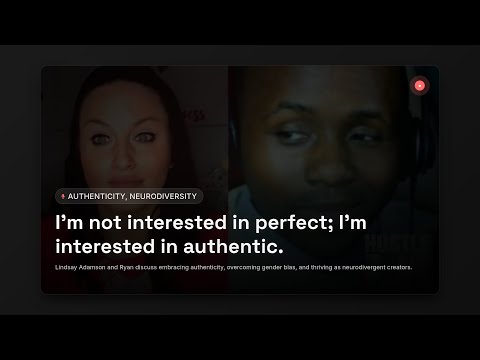
Embracing Authenticity
Neurodivergent Success & Overcoming Perfectionism | Lindsay Adamson & Ryan
"If something or someone is truly important to you, you will always make time for them; if they're not, you will always make excuses."
Embracing Authenticity: Lindsay Adamson on Neurodivergent Success and Overcoming Perfectionism
Some guests come on a live show to promote something. Lindsay Adamson came on Hustle Zone to tell the whole story — the messy parts included. Before the interview even started, host Ryan asked her the question that seems to matter most on this show: why go on camera with no makeup?
Her answer set the tone for the entire conversation. Adamson explained that her first business, The Lifestyle Millionaire, was a brand built for her by a mentor — one she spent eight to ten months constructing and was genuinely proud of, but that eventually left her feeling “imprisoned.” She described the pressure to post perfect pictures, deliver the perfect speech, and sound like “a news reporter” in her early videos. Somewhere in that process, she said, she fell out of alignment with herself and started building things designed to make money rather than things she was passionate about. The breaking point came mid-launch of a course under that old brand, when — sitting at her desk — the idea for a new brand, The Hungry Lioness, simply arrived. She had a logo made within the day and started writing “like a mad woman.” The name, she explained, comes from the fact that lionesses hunt together rather than compete, which is the model of women supporting women she wants her brand to represent.
The long version of her story, which Ryan invited her to tell in full, traced a path from childhood. She started singing at age three, recording herself over cassette tapes with a toy microphone that had an applause button. Her parents supported her without ever placing unrealistic expectations on her — her mother drove her hours round-trip to singing lessons, once a week, for two straight years while she attended boarding school. By sixteen she was performing in nightclubs to crowds of thousands and hearing her songs on the radio; by nineteen, meeting record label producers in LA, she says she got her heart broken by how ruthless the music industry could be.
After university — cheerleading championships, a bartending job — she needed summer income and answered a sign promising $100 to $500 a day. It turned out to be door-to-door lawn aeration sales: a 300-pound machine, twelve-hour shifts alone on assigned streets, any weather. Her first day she made four sales and brought home $34. By the fifth day, something clicked, and she broke a company sales record. She went on to become the company’s national sales director, eventually helping run a program that donated roughly 75,000 toys to children across Canada and driving $1.9 million in sales in a single three-branch stretch — before a pay dispute with her boss pushed her to quit, buy a one-way ticket to Costa Rica, and eventually open her own beachside yoga studio.
Even there, she admitted, depression crept in — despite having more money than ever, she found herself absorbing the “broke mindset” of the community around her. That thread carried into the present day, when audience member Susan Day asked directly whether Adamson gets depressed. She said yes — often tied to feeling she isn’t making progress — and described learning to give herself a few designated days to rest without piling guilt and shame on top of the low feeling itself.
The conversation also touched on relationships and friendship, where Adamson was candid about often feeling lonely as what she calls a “spiritual entrepreneur,” caught between people who are either spiritual or entrepreneurial but rarely both. She described recently meeting eight online friends in person for the first time during a California trip, including hugging her coach after a year of working together only virtually.
During the show’s lightning round, Adamson mentioned in passing that she has dyslexia, describing how letters can jumble as she reads — a detail that sits alongside the achievements she’d just spent an hour recounting. Asked by a viewer how two busy entrepreneurs find time for each other, she offered a line she said isn’t originally hers but has stuck with her for years: if someone is truly important to you, you’ll always make time; if not, you’ll always make excuses.
She closed by launching a 7-day, $47 mini-course, capped at 20 participants, aimed at giving people an accessible entry point after her earlier programs had priced out anyone not ready to spend thousands.
Lessons from this one
Choosing connection over perfection builds a more sustainable brand than chasing a polished image.
Adamson described feeling 'imprisoned' by her original brand's pressure to look and sound perfect, and said she deliberately shows the full spectrum of her life -- messy-bun days and dressed-up days alike -- because 'people don't relate to' someone who only ever appears perfect.
Giving yourself permission to rest without guilt shortens recovery from burnout-driven low periods.
Adamson said she regularly experiences a few days of depression, especially after big trips or launches, and that stacking guilt and shame on top of the low mood used to make it worse; deliberately allowing herself a designated day off, without judgment, let her get back to momentum faster.
Early failure is often just the on-ramp to competence, not a sign someone isn't cut out for the work.
Adamson made only four sales and $34 on her first 12-hour day of door-to-door lawn aeration sales, could barely operate the machine, and considered quitting -- yet by day five she broke a company-wide sales record.
Surrounding environment can shape someone's financial mindset independent of their actual financial reality.
Adamson said that while living in a small Costa Rican town she was, by her own account, better off financially than ever before, but adopted a 'broke mindset' and depression simply from being immersed in a community that treated money as scarce.
A neurodivergent trait like dyslexia can coexist with, rather than block, high-achieving entrepreneurial output.
Adamson mentioned in the lightning round that she has dyslexia and experiences reading as letters jumbling, a detail she raised only briefly and without dwelling on it, in the same conversation where she recounted building multiple businesses and touring as a national sales director.
Sources
- Sodergren, J. (2021). Brand authenticity: 25 years of research. International Journal of Consumer Studies, 45(4), 645-663.
- Schabram, K., & Heng, Y. T. (2022). How Other- and Self-Compassion Reduce Burnout through Resource Replenishment. Academy of Management Journal, 65(2), 453-478.
- Eskreis-Winkler, L., Shulman, E. P., Beal, S. A., & Duckworth, A. L. (2014). The grit effect: predicting retention in the military, the workplace, school and marriage. Frontiers in Psychology, 5, Article 36.
- Luttmer, E. F. P. (2005). Neighbors as Negatives: Relative Earnings and Well-Being. Quarterly Journal of Economics, 120(3), 963-1002.
- Logan, J. (2009). Dyslexic entrepreneurs: the incidence; their coping strategies and their business skills. Dyslexia, 15(4), 328-346.
- Runtime
- 1h 34m
- Show
- HustleZone
- Host
- Ryan Perez
Been through something like this?
HustleZone is conversations with people who built something out of the thing that was supposed to stop them. If that is you, say so.